


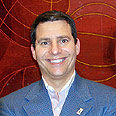
His heart remains in Israel
IDF soldier, kibbutz volunteer, New York businessman, successful author and self-made millionaire, Peter Morgan Kash has done it all
Peter Morgan Kash is a Wall Street entrepreneur, who recently co-founded Two River Group Holdings, LLC, a biotechnology merchant bank focused on creating companies to commercially develop novel technologies to treat unmet medical needs.
Mr. Kash has raised nearly USD 150 million dollars in private equity financing for more than 20 biotechnology companies.
Kash is currently an adjunct professor at the Sy Syms School of Business at Yeshiva University, and he has also taught at the Wharton School of Business, Polytechnic University and was a visiting professor at Nihon University in Japan.
He is the author of the book “Make Your Own Luck: Success Tactics You Won’t Learn in Business School” (Prentice Hall), which has recently been translated into Hebrew, Chinese, Korean, Portuguese and Russian.
1. What is the gist of the “Web of life” concept mentioned in your book?
Basically, the web of life is a form of karma or better yet Taoism, which is the philosophy that both good and bad happen for a reason. I believe there are reasons for these “Web of Life” coincidences and we might not understand them or appreciate them for a week, a month, a year, or until future generations.
Sometimes these coincidences can be for good and bad. But, the bad can be for good purposes. Remember that a negative multiplied by a negative can be a positive. With all the chaos in the universe there is still a definitive sense of order.
2. Do you believe it applies to the Israeli business world as well?
Yes, perhaps more so than any other environment. The Web is a powerful tool if you learn to use it correctly. Let us use myself as a case study; how did a Jew with a lower-middle class economic background come to Israel to live on kibbutz and yet have the opportunity to meet prime ministers like Yitzhak Shamir, Yitzhak Rabin, Shimon Peres, Benjamin Netanyahu, and Ariel Sharon, and then continue to meet world and business leaders throughout the world?
When one considers that there are over 1,500 high tech startups in Israel one has to believe that this tool works very well in Israel. I do believe there is something magical about Israel. Perhaps as the joke goes maybe the connection to God is just a local phone call from Israel.
3. Can people really make their own luck? Isn’t being business savvy more of an innate characteristic?
That is a great question. What is luck in Hebrew? “Mazal.” It is actually not a word, but rather an acronym: the letter mem for “makom” (place), the zayin for “zman” (time), the lamed for “la’asot (to do something). So, success is 99 percent perspiration and 1 percent inspiration, although by utilizing the Web you increase your chances for success.
You never know who you are in an elevator with, or who you are in a revolving door with. Even if you get a negative answer from someone it could lead to a positive outcome.
4. Do you find the Israeli biopharmaceutical industry mature enough to appeal to the U.S. venture capital community and capital markets?
Israeli biotech can be 100 times greater with simple measures. First, there is more money available world wide in biotech companies and for investments at large.
But Israel has to become focused on development, rather than research. Israel has great clinical Goods Manufacturing Practice (GMP) facilities and there is no reason why Israel can’t become hugely successful off of its biotech. I think it can be done in three easy steps. One has to remember that Israel is not the United States; it does not have USD 30 billion in National Institutes of Health funds, and 3,000 universities and colleges. So, it cannot afford to be so independent.
There needs to be better communication between research centers in Israel. Egos need to be buried.
I would adopt the Michael Milken model as he had done with his prostate cancer foundation. That is, government grants from the chief scientist should be increased if competitive scientists from different universities would agree to work together. This would increase the chances of success.
Unfortunately everyone wants to have their own company, but there is only a certain amount of quality management to go around.
5. Is the Israeli government doing enough to boost the local economy?
This is the single most important question. The answer is unequivocally no. In fact, I have failed on numerous occasions to convince Prime Ministers Shamir, Rabin, Peres, Netanyahu, and Sharon because I have not succeeded in convincing them of this model, which even former United Nations Ambassador Gad Yacobi believed would work.
The chief scientist’s budget is about USD 350 million, which should be immediately doubled. Secondly, and most importantly, Israel needs to take 20-25 percent of this budget and start investing outside of Israel.
Before one thinks this is a bad idea, the Economic Development Board (EDB), which is the government investment arm of Singapore, has invested billions outside of Singapore and brings technology back for co-research and co-manufacturing.
Lastly, if Israel invests USD 100 million yearly outside of Israel over the next 20 years there will be 1,000-2,000 companies abroad in the United States, China, Japan, Russia, Singapore, Argentina, Ireland as well as other countries.
These companies and their management teams will in many cases have equity ownership in their Israel subsidiaries, not just in biotech, but also in high-tech, telecommunications, new materials, energy. None of the companies and management will want a war to prevail to hurt their interests.
Imagine if the Israeli government instead of giving more than a billion dollars in tax credits to Intel, that back in 1968 they invested USD 250,000 in Intel or Motorola or Hewlett Packard or Amgen. Where would the Israeli economy be today? What I don’t understand is if Singapore has had such great success with 3.5 million highly educated citizens why Israel doesn’t duplicate it.
6. You’ve served in a combat IDF unit during your military service, and you contribute to several Israeli humanitarian foundations; you are obviously an avid supporter of Israel. Would you and your family ever consider making aliya?
If you ask me if I would ever consider making aliya, I would say that the U.S. is my mother and Israel is my grandmother and for sure in an ultimate situation would eventually have dual residence to complete more work more quickly to come up with cures for cancer and neurological diseases.
When I’m in Israel I feel like a day is like a week. And a week is like a month, so I understand how many of our forefathers perhaps lived hundred of years.
7. Do you ever feel the urge to ditch the frantic corporate world and become a bona fide slacker, complete with daytime television and long afternoon naps?
No, for me slacking is waking up at 6:30 a.m. instead of 6 a.m. It’s doing 200 sit-ups instead of 250 and it’s doing five miles cycling instead of seven miles in 20 minutes or swimming less than a mile a day.
We have all been blessed with an opportunity to live and contribute to society. I figure, I will have over 15 billion years to relax before the next Big Bang and life starts all over.
I still love teaching at Yeshiva University business school. I still study once a week, but I do relax watching my two boys, who have achieved black belt status, compete in karate. In addition, I’m planning on writing a new book about the future of medicine.
In summary, I’m bullish on life. Although, I believe there will be bumps on the road, in the end I believe great peace and prosperity will slowly envelop the world.
