


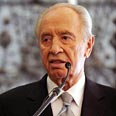
Peres: Peace talks must not be stopped for one moment
President stresses time is running out in negotiations with Palestinians. 'We can’t spend the entire year just talking. We must negotiate, openly and secretly,' he says at Geneva Accord conference
"Both (Prime Minister Ehud) Olmert and (Palestinian President Mahmoud) Abbas want peace," the president added.
Although the discussion on the core issues between Israel and the Palestinians are scheduled to be launched on Monday, Peres tried not to sound too enthused.
"No one will deal with the key issues at the beginning of the negotiations. On most issues there is an agreement, but writing the document is extremely difficult. I am not surprised that the Palestinians insist on their demands. So do we.
"We have a year, and that's very little time. We cannot spend this year talking. We have to negotiate, both openly and secretly, and we must not stop for one moment. I believe that moving from the opening positions to the interim positions will take a long time, several months.
"US President Bush was here and said, 'I am your best friend. I'll do whatever you tell me, but I am here to tell you that there is not much time. Just talking will yield nothing. If you think it's time to move forward, then it's time to move forward. Time is the most crucial thing.'"
Addressing the political arena, the president said, "There is no room for ideological arguments, from the moment the right-wing also wants two states. The question is why we can't reach peace.
"The difference between business negotiations and political negotiations is that business negotiations you hold with the other side, while political negotiations you hold with yourself. It's difficult, because the support at home is capricious."
Foreign Minister Tzipi Livni, head of the Israeli negotiations team, and former Palestinian Prime Minister Ahmed Qureia, head of the Palestinian negotiation team, will meet Monday for a first discussion on the core issues, which include Jerusalem, the settlements, the Palestinian refugees, the borders, security and the water resources.
In another diplomatic remark recently, Peres praised the United State's intervention: "It's different from Oslo, when America was not present. Today no one is twisting Israel's arm or doubting its desire for peace." Before the Annapolis peace conference, Peres said that Israel and Syria were holding secret talks.
