


MK Barakeh. 'Charges will be refuted'
צילום: חגי אהרון
MK Barakeh in court: I am reason Mazuz won't be judge
Hadash chairman, charged with assaulting officers during protests, is certain he will be found innocent and promises to continue protesting. Barakeh's supporters demonstrate outside courthouse
Knesset Member Mohammad Barakeh, charged with assaulting police officers on duty, arrived in court Wednesday for the first hearing in his case at Tel Aviv Magistrates' Court. While speaking with his supporters who demonstrated outside the courthouse, former President Moshe Katsav, being tried behind closed doors on rape charges, showed up.
Katsav stopped next to Barakeh, heartily shook his hand, asked how he was doing, and continued on his way.
"There are two trials, but there is no connection between them," the Hadash chairman reminded.
Barakeh is being charged with insulting a public servant, assaulting and disturbing an officer on duty in four different incidents during demonstrations in which he took part. In one of them, he allegedly choked a prison services officer. Barakeh claimed that the charges against him are part of a "persecution campaign in order to quash freedom of expression."
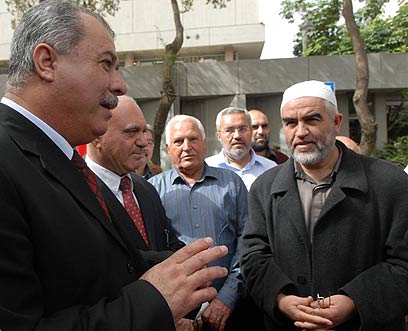
Barakeh (L) and Sheikh Raed Salah outside the courthouse Wednesday (Photo: Yaron Brener)
In a conversation with Ynet, MK Barakeh reiterated his claims that the allegations against him are baseless and will be refuted one by one in court.
He also criticized former Attorney General Menachem Mazuz for deciding to try him in court. "The indictment against me shows how low Menachem Mazuz can stoop. When the charges are refuted, Mazuz's chances of being part of the Supreme Court will be minute."
Some 30 supporters demonstrated outside the courthouse in support of Barakeh, including Knesset members from his faction Dov Khenin, Afou Agbaria, and Hanna Swaid. Members of the Arab Higher Monitoring Committee and left-wing activists also showed up. Leader of the northern branch of the Islamic Movement, Sheikh Raed Salah, also attended.
"The one who is guilty all along of using violence against protestors is the police, the very ones who are supposed to defend the right to political protest. If the Supreme Court needs to get involved in order to allow protests in Sheikh Jarrah, this is telling of the police conduct in the demographic sphere," said Barakeh.
"If anyone thinks that I will be deterred in response to the indictment, I say that the first thing I did immediately after it was issued was to go and protest against the fence in Bilin. I am proud of being in the field. I do not represent elitist politics, but am among the people and will continue to be so," added Barakeh, who did not ask for parliamentary immunity like MK Said Naffaa did. Barakeh said he declined to issue such a request "because I know the truth."
During the demonstration outside the courthouse, activists shouted, "Jews and Arabs behave like enemies."
A confrontation broke out between the protesters and an elderly handicapped man at the courthouse. The man shouted at them, "Shame on you for being here today. We are Holocaust survivors. We built this country. You have no right to speak. We built this country on our backs." One of the left-wing activists responded by telling him: "Go to hell."
Barakeh is being represented by Attorneys Orna Cohen and Hassan Jabareen from the Adalah Legal Center for Arab Minority Rights in Israel. Jabareen does not deny that there was "friction" between Barakeh and the police during the demonstrations. However, he claims that they are of the sort "that happen at every protest." According to him, a Supreme Court ruling stipulates that once activities at a rally are defined as political, no indictment is issued.
"There was no Jewish Knesset member indicted for his behavior at rallies he participated in against the disengagement. Behind this indictment are external considerations and an eager finger on the trigger," explained Jabareen.
Barakeh's lawyers recently turned to the EU and the Inter-Parliamentary Union (IPU) in his name. The EU elected to send representatives to monitor from up close the court proceedings. The IPU asked Knesset Speaker Reuven Rivlin for clarifications on the legal process. The court case against Barakeh will be raised for discussion at the IPU's next convention that will be held at the end of the month in Bangkok.
Vered Luvitch and Sharon Roffe-Ofir contributed to this report
