



My mother’s death
Op-ed: Journalist recounts his mother's release from nursing home 'prison' and her final days, surrounded by loved ones
Sixteen years of my mother’s life were spent at a home for the elderly. The number of a girl’s years from birth to blossoming. Sweet 16. Bitter 96. An innocent woman serving a brutal sentence from the age of 80 till nearly 100. So it was from the day she took my already slightly disoriented father, Izio Sarna, and a few belongings in a handbag, left behind everything she owned and went of her own free will and firm decision to a retirement home that suited the modest income of a housewife and a retired schoolteacher.
Not a backward glance. “I went so that someone would finally take care of me,” she later said, my naïve mother who had dreamt of being pampered after all her years of taking care of others. She who had worked for 70 years, starting at the age of six on her father’s poor farm near Warsaw, Poland, and continuing throughout her life in Israel. Only years later, at the nursing home, did she admit that she had made a mistake; that instead of the Ritz she had visualized, she found herself in the realm of Hades: Her very words. It was there she realized that natural death was dead, replaced by diapered, hellish eternal life.
Nursing homes, particularly homes for residents of modest means, are waiting-rooms for death, reeking of mashed potatoes and urine. “Hiding places we’ve invented so we could put our elderly out of sight,” as the district doctor said to me, “when what most old people want is to die in their beds, with us at their side.” And so I drove my parents to the home of eternally extended life, to a realm of groans and the scuffing of tennis balls on the feet of walking frames. My father died the first year, of boredom, heartbreak, and a host of terminal diseases that had descended on the small, sentimental, perceptive man. Mother, left on her own, said to me again and again: Bring me poison.
She came from a hard-working, ultra-orthodox Jewish home, where you ate only if you nursed at the breast or helped with the housework. Milking, herding, boiling bones to make glue. At the end of her years of toil in this world – bearing and rearing children, working as a clerk and running a household – she longed to die and join her multitude of relatives who had perished in the Holocaust. But she continued to live, at that house of gruel and adult diapers, almost until the end of her life.
So many years, beginning with a physically healthy widowhood of independent walking, of helping the staff and attending lectures in which she was a single alert listener amongst a groggy audience, and continuing with a slow loss of skills, a fall and a chair, diapers, the loss of any remaining vestiges of dignity, desecration of the living body, deafness and creeping blindness, harsh morning baths at the hands of minimally-paid staff, lolling uselessly in a chair and staring into space, lowing and feeding, a thick layer of paste smeared on her loins. A disgraceful infanthood, an endless wait for death: “I just hope it won’t hurt”.
During the final months her swallowing muscles gradually ceased to function and we were summoned to the office of the director, a tall doctor with rich geriatric experience. We were presented with the option of feeding-tubes and all those other torment-extending mechanisms that have become the pride of merciless medicine. Plumbing that keeps rasping mummified bodies alive, trapped in a tangle of tubes, their mouths open as if in a final scream.
My sister wept, and I made it clear that we would not agree to any invasive interventional procedure. For too many years we had watched Mom crawling towards the end of that dark tunnel, only to find the door welded shut. By this time she looked wizened as a mummy, yet the human spark pulsed within her until the end.
New emotional hurdle
In one swift move I extracted her from the nursing home. I signed an indemnity, a waiver of responsibility, an assumption of liability, and took her to my apartment. Two days earlier, while I was driving to see her, a decision that had been ripening for years suddenly hatched fully-fledged: to sit a reverse “Shiva” with her. Not a post-death Shiva with forgotten, talkative neighbors and relatives, but one that would take place beside her living self, with all those who would come to touch, talk and say goodbye. In my home.My long-debated decision to be beside my mother’s deathbed would not have been made if it were not preceded for me by five happy years with a loving partner. Paradoxically, love is an excellent preparation for goodbye. It fills the quarries of the heart. You cannot take leave properly, even of your mother, if you are full of anger or bitterness. The parting from my beloved, which came before the parting from my mother, served both to right what had gone wrong and to prepare me for what came next.
In my mind I carried a bitter lesson – the painful memory of not taking leave of my father. Ill and demented, Dad had quickly deteriorated at the nursing home and on most nights would have to be taken urgently to the hospital. There he lay, ripping the tubes from his body, bleeding. Sometimes bound, always gazing in terror at my face as though pleading with his first-born son: Help me. The night he died I had been told he was in hospital again, but I did not hurry. I was firmly rooted in my own life, in bringing up my children, and perhaps I was also apprehensive of what I might see. He died alone; his eyes still fixed open in terror even as he was buried.
The moment I conceived the plan to release my mother from her prison, I also overcame that relatively new emotional hurdle we have invented – the artificial division between life and death: The concealment of death and the dying behind the high walls of nursing homes; hired caregivers; rituals of cleansing and of burial. From the moment that the vision of her homecoming solidified into a plan, everything began to move as smoothly as though the universe was complying with my tiny wish: The home released her immediately, it took no longer than a day to find a wonderful caregiver through Facebook, a friend repaid an old debt that would cover a few days’ nursing costs. A therapist came and told me how she took her own dying mother home. A room became available.
Our caregiver, Marius, an enormous, gentle man, carried my mother in his arms to the bed I had prepared. In the quiet, simple room we had equipped for her, 12 days of farewell began. I had not been so close to Mom since I was drafted as an 18-year-old boy, 43 years before. At the cliff’s edge of her life, extinguished and shrunken, Mom was teaching us the important lesson of saying goodbye. Unconscious, she became my teacher of dying, a barely breathing spiritual guide, so resolute that we all stood in awe before her.
'Leave me here'
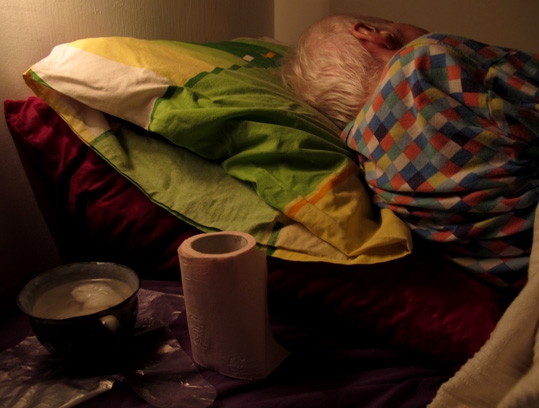
In the room next to mine, in my two-roomed apartment, Mom lay on her side, with a cup of cold water and some cotton wool beside her - her only sustenance. From that moment we continually fed her mineral water, on which she suckled like a baby. Only once did she speak: “It’s very hard.” Then she drew a rasping breath and fell silent. People came to her bedside: My friends, my sister, my beloved. My children. Their mother. My nephew. A kind neighbor. At her bedside I learnt who were those who preferred to shrink away and who were those who would come to visit; those full of emotion and those tight of buttock; those open to love and those full of fear. There were the ones who accepted and the ones who tut-tutted: Get a doctor. Give her a feeding tube. Take her from here to there. Have a normal Shiva. There were those who caressed and those who would not cross our threshold.
A writer friend laid hands on my mother’s chest and sang to her, and her muscles relaxed before my eyes. "You are free, Yola," said the woman, trying to grant her the flying and freedom license denied her all those years at the nursing home. For 16 years Mom had obeyed. She had swallowed thousands of pills that she did not want and was on time for every meal. She was a diligent student of dying, always with an anxious regard for authority.
By some alchemical process the pain was transformed into heartrending beauty. A photographer friend came from time to time to make a photographic record. A girl artist sketched my mother’s face. At night, when we were alone, I would put on music: Ave Maria, Polish children’s songs, songs in Yiddish. Mom seemed to be attending closely, listening to the melody emerging from her childhood, from that Jewish home going up in flames. During the day her caregiver Marius sat by her side, watering and stroking, and at night I would rise from my bed and tiptoe to hers as I used to tiptoe to my children’s cradles. I would stand there and watch: Were they breathing? Her chest rose and fell lightly.
By day we sat at her side and talked to her, about her, or about everyday things. Life moved around her. Flowers and the fragrance of eucalyptus countering the smell of death. Joy and love and an insignificant quarrel, a caress and an embrace. Sometimes she would open two blind eyes as though listening to a distant, familiar voice or looking up at a light coming through a high window. As these days of water went by, she sank deeper into her sleep. On Saturdays we were left alone and I would change her diapers. Changing one’s mother’s diaper is a completely different matter from changing one’s children’s.
On the 12th day of my mother’s life in my home I transferred her to my room. She had become very weak, and Marius said to her, “Yolachka,” as he called her, always explaining what he was about to do, “Yolachka, we’re moving into your son’s room.” He picked her up and carried her, a sturdy, generous man holding in his arms, as in a reverse pieta, an old little girl, dark with sunspots, as though she had dried up in the light of the country to which she had come on the ship Carnaro 80 years before.
My little room became very crowded, and the sound of her slight breath wafted in its space. Towards one o’clock on Friday night I gave her some water and fell asleep next to her dying, as one who falls asleep near a cobra in a dark hut and wakes released from his fears.
At half past two in the morning I woke, and her breathing was very shallow. I read a little of Julian Barnes’ Nothing To Be Frightened Of and logged into Facebook. I corresponded with a friend who wrote that she was also on “breathing duty” at her father’s side. At 4:20 am, as an early-rising bird began to sing upon the ficus tree in the yard, I offered water to my mother’s mouth. Her lips moved and she seemed to stop breathing only for a moment in order to suckle, but her breath never returned. I touched her face and wrist as somewhere her spirit flew out of the window and into the yard. In the bed, the shell of my mother remained. I covered it in a white blanket and went out to the street and drove to the seashore. I was stirred by a longing for the salty, healing water of childhood. Under the waves I felt the rushing power of a stormy sea.
Then errands and formalities. A private ambulance and a doctor who came and confirmed my mother’s death. She was wrapped in her last sheet and carried to the ambulance and to the cold chambers. The next day she would travel in the same way to a non-religious cemetery, beautiful as a wild Eden, on a nearby kibbutz. For hours after her departure I was overwhelmed by a wave of “all our sympathy”s and “be strong”s. Telephone calls and text messages. A wise friend corrected: “Be weak.” Another quoted a wise Ethiopian saying: “May your stomach be big enough for all the sorrow.” Because sorrow, pain, grief and fear are your friends, and it is not strong that you need to be, but open and mindful.
Early on Sunday afternoon we came to the pit excavated in the light-colored earth, next to my father’s grave, where year after year my mother would say, “Leave me here,” and whence year after year she would be taken away again to her institutional bed. This time the ambulance drove to a secluded corner in the graveyard’s foliage and unloaded my mother’s body. I came with Marius, bringing a pink bath sponge and towels so he could wash her, in the absence of the religious Chevra Kadisha undertakers with their barren, sun-scorched cement cemeteries and their ever-creaking hearses.
Even after all my days beside her I was apprehensive of the moment her body would be uncovered. But when the sheet opened I found that this interlude had removed all aversion and fear. We filled a plastic pail with water from a garden hose and Marius began to clean her with fragrant soap. I washed her face and dried the light down of her hair. We dressed her in a blue gown, lifted her and laid her upon a sheet inside the wooden coffin. The driver pulled the top closed. With a small electric screwdriver I shut the lid on my mother, and it was only then that I felt separate from the woman who gave me life one hot summer’s day of 1952.
