


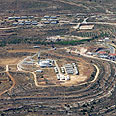
In the footsteps of King Saul
The Binyamin region, where King Saul was born, and which became the first capital of Israel, is a place where you can see the remnants of the Biblical stories. Efrat Natan from the Yad Ben Tzvi Institute goes out to the sites where history is still alive
Nebe Samuel is a quiet site on an ordinary day, but underneath, it is teeming with historical spirits. For example, once a year, on the twenty-eighth of Iyar, the place comes alive.
On this day, which according to tradition is the day Samuel died, a joyous celebration in his memory takes place, with roots stretching back to the Middle Ages, and which rivals the celebrations in Meron.
The place is identified with Mitzpe, the city in the Binyamin portion where Samuel’s dramatic anointing of Saul occurred. It is where Samuel gathered the nation of Israel against the Philistine enemy, and cast the lots, which identified Saul as a man of Binyamin, where he was crowned king of Israel.
In Mitzpe, Gedalya Ben Achikam lived after the Babylonian conquest and the destruction. His fellow Jews who did not accept his reign murdered him. It is also the place where Judah Maccabbee gathered his army during the era of the Second Temple because “Mitzpe is a place of prayer for Israel”.
Another detail that is not widely known about the place is that it was completely destroyed during World War I. The British methodically restored the original building on its ruins, yet the site, which has wall-to-wall history, was only built ninety years ago.
On our way
Nebe Samuel is the starting point of our tour, or to be more exact, the building of the crusader church in Nebe Samuel, which is on the top of a hill at the edge of the Ramot neighborhood on the outskirts of Jerusalem.
Cross the crusader moat, where archaeological finds from the Judean kingdom (8 B.C.E) were discovered, and reach the crusader church, which was converted to a mosque in the Middle Ages, and today houses a synagogue and Yeshiva for Kabbalists.
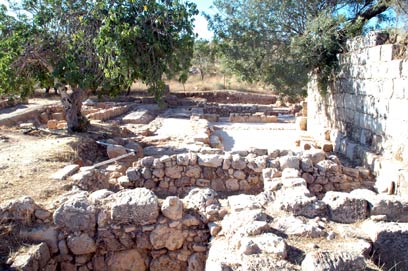
Tel Shilo: A church, a mosque and then a synagogue (Photo: Eliezer Stein)
After you climb to the roof, on steep stairs to the left of the entrance, you will immediately understand why the place was called Mitzpe (lookout): from the south you can see Jerusalem in all its splendor, and in the background, the hills of Hebron; from the west, you can see the plains, and from the east, the Moab Mountains.
From the north, the stage of Bet El is spread before you, it is a flat area populated by Arab and Jewish settlements, almost exactly how it was in earlier periods. This is the land of Binyamin.
Right below us, on a hill in the heart of the valley, is the village of El Jib, where the remnants of the city of Givon were found. You can see how Joshua utilized the blinding sun, which rises in the east to surprise his enemies, and hear him call “Stand still, O sun, at Givon, O moon, in the valley of Ayalon” with the advancement of the pursuit westward.
After a tour of the excavations, we leave Nebe Samuel for Tel Shilo: go back toward Jerusalem, and travel north to the Pisgat Zeev neighborhood. West of the neighborhood, at Tel El Ful stands the skeleton of the palace that Jordan’s King Hussein began building right before the six-day war.
The building was never completed, but 3,000 years before hand on this hill, which was then called Givat Shaul (Saul’s hill) or Givat Bnei Binyamin (the children of Benjamin’s hill), stood the palace of Saul, the first king of the united kingdom.
From Pisgat Zeev, exit to road 60 through the Hizma crossing. You can use the names along the way in order to reenact the biblical events that took place in this area. A-Ram is Ramah, the city and burial place of the prophet Samuel. When you pass Adam-Geva Binyamin, you will see the village of Jeba on the left side, a few kilometers further you will pass a village called Mukhmash, these are Geva and Mikhmas; between them you can see the rocky stream on whose rocks, Yonatan, son of Saul, climbed in order to surprise the Philistine guards. (Samuel I, 13-14)
Remains from 2000 B.C.E.
Near Tel Shilo, which is at the foot of the settlement of Shilo, a number of churches and mosques were built due to the identification of this site throughout all the eras with Shilo, the home of the Tabernacle.
Today a large Byzantine church is being dug around the foot of the barrow, and a sign with the name Shilo on it has been found, which reinforces the ancient identification.
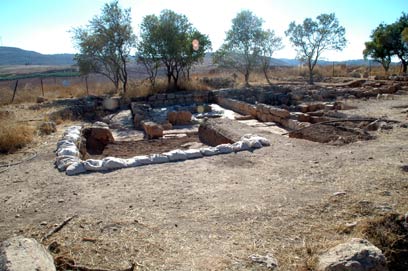
If you're quiet, you might hear the prayer
Look at the mosaic floors and go up the barrow, on which still stands the glorious remains of a wall from the first half of 2000 B.C.E. On these remains rest buildings from the end of 2000 B.C.E., the era of the settlements and Judges.
According to tradition, Joshua gathered the nation in a city that was desolate at the time, and after he sent a delegation to search out the land “to go through the country and write down a description of it” (Joshua 18:4), he divided the portions among the tribes according to lots.
In Shilo the Tabernacle was placed, possibly on the large, flat, leveled area located north of the city. It lies east to west and is 25 meters wide (fifty cubits).
In the prevailing silence you can try to hear the prayers of Hannah who yearned for a son. When the son, Samuel, was born and weaned, he grew up here, at the Tabernacle of Shilo, alongside the elderly Eli. When you stand on the northern surface, and look out at the city over the barrow, remember the end of Shilo: The ark of the Lord was taken from the Tabernacle in order to assist in the battle against the Philistines in Aphek and was taken captive.
Then a “man from Binyamin” left the battlefield towards Shilo in order to report to Eli about the destruction and that “your two sons, Hofni and Pinchas, are dead, and the Ark of God has been captured” (Samuel I, 4:17). When Eli heard the devastating news, he fell and died.
Archaeologists discovered the destruction of Shilo in the twentieth century in the form of burnt rooms and large accumulation vessels containing charred olive pits.
Dancing in the orchards
Shilo has not only known destruction. The Bible speaks of an ancient festival that was celebrated here: “The annual feast of the Lord is now being held at Shilo” (Judges 21:19), the girls would go out to dance in the orchards (try to dance under the ripe grapes…in white clothes). This is the ancient mention of Tu B’Av (the fifteenth of Av), on which the sages remarked “there were no better days for Israel than Tu B’Av and Yom Kippur”.
The festival of wine, which took place during the height of the harvest, and then became a holiday of love, began as a feast for G-d in Shilo. Go out of Shilo into the wine vineyards surrounding it, when you get tired from the dancing you can travel north and turn before the gas station on the dirt road with a sign for “Maayan Hagiborim” (the spring of heroes) which is underneath the settlement of Eli.
There, in the shade of a fig tree, in the place where the water of the spring accumulates into a round pool, you can refresh yourself and finish our tour.
The writer is a coordinator and guide at the Yad Ben Tzvi Institute.
Additional articles in the series “Traveling with the Bible”: King David in the Judean Lowlands, Philistines Upon You, Samson, Here Lives the Jebusi family.
