



Drones to map Europe’s Jewish cemeteries
The European Jewish Cemeteries Initiative plans to survey 1,500 endangered Jewish graveyards in Slovakia, Greece, Moldova, Lithuania and Ukraine, and then enclose and clean them, both to preserve and 'so people know there’s a Jewish cemetery.'
A private organization that wants to preserve thousands of old Jewish cemeteries in Europe is using aerial drones to map burial sites in countries where the Holocaust decimated Jewish populations that existed before World War II.
The European Jewish Cemeteries Initiative said Tuesday that teams of drone operators plan to survey 1,500 endangered Jewish cemeteries in Slovakia, Greece, Moldova, Lithuania and Ukraine this year. Once the boundaries are recorded, the sites will be enclosed and cleaned, the Germany-based organization said.

The European Union is funding the effort with an 800,000-euro grant ($911,100) at a time of rising alarm over anti-Semitic acts in some countries. This month, swastikas were painted on about 80 gravestones at a Jewish cemetery in France, and vandals damaged windows, sinks and a prominent headstone at a Jewish cemetery in northwestern England.
The chief executive of the initiative, Philip Carmel, said walls fitted with locking gates will be erected around the graveyards covered by the EU-funded project both to protect them and to re-establish a physical presence, “so people know there’s a Jewish cemetery.”
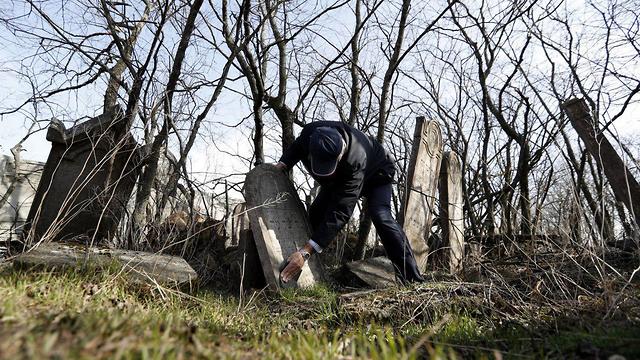
The group also wants to recruit volunteers in the five countries to help maintain and safeguard the cemeteries.
“Fencing doesn’t protect. It’s the people who protect the cemeteries,” Carmel said, noting that a fence didn’t protect a cemetery near the French city of Strasbourg where 37 gravestones and a monument to Holocaust victims were tagged with anti-Semitic graffiti in December.
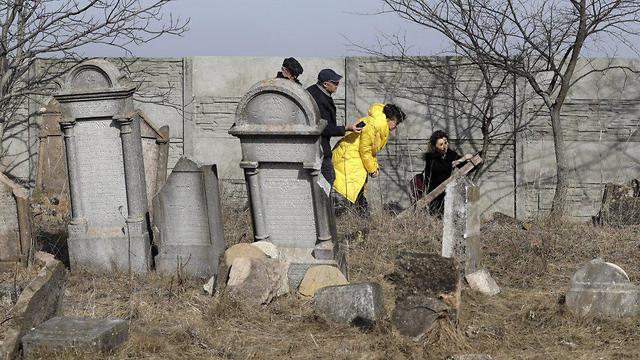
There are about 10,000 known Jewish burial sites in 46 European countries, according to the European Jewish Cemeteries Initiative. About three-quarters are located in central and eastern Europe.
In some parts of the east, the organization is on what Carmel called a last-minute “rescuing mission.” Germany funded the nonprofit group’s previous projects, involving 123 cemeteries in Russia, Belarus, Ukraine, Poland, the Czech Republic and Slovakia.
“It is vital, especially, that the next generation of Europeans learns about Jewish existence to combat rising anti-Semitism and Holocaust denial,” Carmel said. “The cemeteries are so often the last physical proof of centuries of Jewish life in the towns and villages of Europe, which were wiped out in the Shoah. There is no better proof to deny Holocaust denial.”
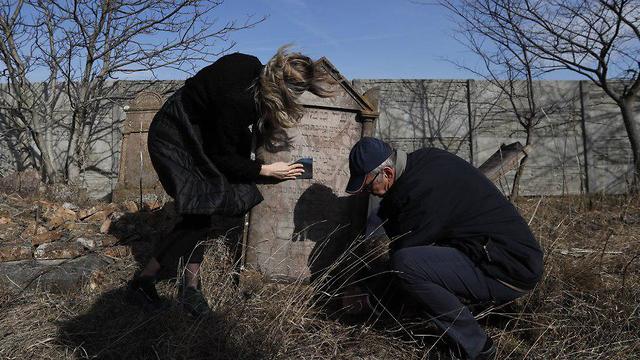
Many of the cemeteries to be surveyed and enclosed this year had to be found before they could be protected. Local residents helped the organization’s researchers find some, abandoned and grown over since World War II. Pre-1918 maps and aerial photos that Germany’s Luftwaffe used to pinpoint targets for aerial bombing missions helped reveal more.
Now, drones are collecting topographic data that experts based in Kiev can use to design plans preservation plans for the sites.
As part of the project, workers erected a fence Tuesday around a neglected Jewish cemetery in Slovakia that dates from the 18th century and sits like an island in the middle of vast farmlands east of the capital, Bratislava.
“Preserving our Jewish history creates a vital link to our past, which in turn makes us more aware of the present and shapes our future,” Rabbi Isaac Schapira, the initiative’s founder, said. “We owe our ancestors this duty and mark of respect by ensuring their final resting places are restored and preserved.”
