


Bahrain: Israel has 'right' to respond to Iran
Arab Gulf country's foreign minister tweets that so long as Iran uses its forces and missiles to try and destabilize the region, 'it is the right of any country in the region, including Israel, to defend itself by destroying sources of danger'; White House says Iran's Revolutionary Guard 'bears full responsibility for the consequences of its reckless actions.'
Foreign Minister Khalid bin Ahmed Al Khalifa wrote on Twitter Thursday that so long as Iran uses its forces and missiles to try and destabilize the region, "it is the right of any country in the region, including Israel to defend itself by destroying sources of danger."
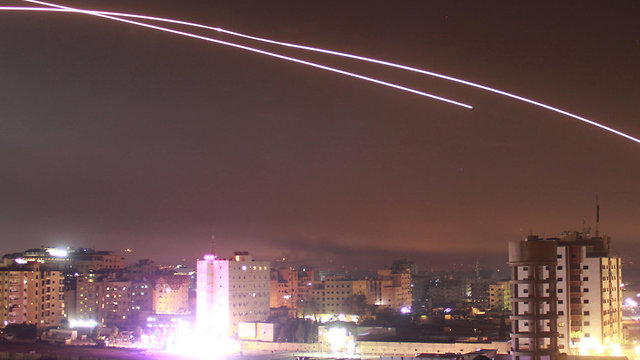
Israel says Iranian rocket attacks on Israeli positions in the Golan Heights prompted the overnight strikes. Iran has not commented on the accusations.
Bahrain, a close US ally, considers Iran a regional threat. The tiny island-nation accuses its Persian Gulf neighbor of arming and training Shiite Bahraini protesters with the aim of destabilizing the Sunni-ruled country. Bahrain has also welcomed President Donald Trump's decision to withdraw from the nuclear accord with Iran.
The United States on Thursday condemned Iran's "provocative rocket attacks" from Syria and supported Israel's right to defend itself.
"The Iranian regime's deployment into Syria of offensive rocket and missile systems aimed at Israel is an unacceptable and highly dangerous development for the entire Middle East," the White House said in a statement.
It said Iran's Islamic Revolutionary Guard Corps "bears full responsibility for the consequences of its reckless actions."
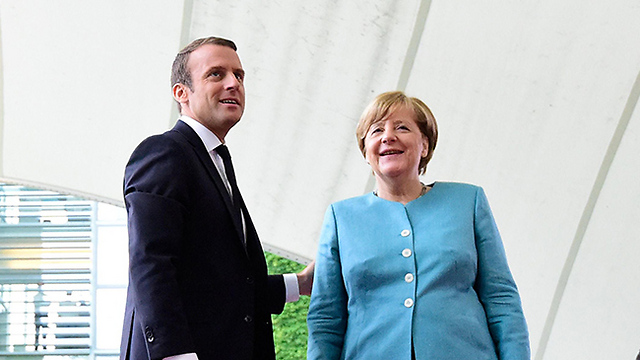
German Chancellor Angela Merkel and French President Emmanuel Macron called for de-escalation in the Middle East.
Merkel and Macron met in Aachen, Germany Thursday on the sidelines of a ceremony where Macron was awarded a prize for contributions to European unity. The German government said they discussed events in the Middle East and called for "level-headedness and de-escalation in the region."
Merkel alluded to the two countries' support for the Iran nuclear deal. She said: "We know that we face an extremely complicated situation here. The escalation of the last few hours shows it is truly a matter of war and peace, and I can only call on all involved to exercise restraint."
Britain condemned the Iranian rocket attack "in the strongest terms."
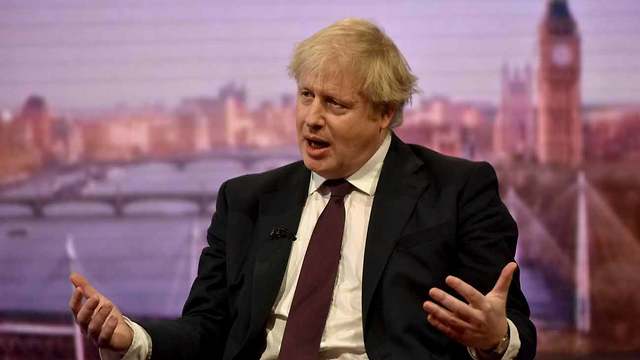
In a statement Thursday, Foreign Secretary Boris Johnson urged Iran to refrain from actions that could destabilize the region. Johnson also called on Russia to press the Syrian government, its ally, to work toward a broader political settlement.
Russia said the Israeli strikes on Iranian facilities in Syria marked a dangerous escalation, urging both Israel and Iran to avoid provoking each other.
Foreign Minister Sergey Lavrov said Moscow saw Thursday's strikes as a "very alarming development."
He noted that in contacts with the leadership of both countries, including a meeting Wednesday between Russian President Vladimir Putin and Prime Minister Benjamin Netanyahu, "we underlined the necessity of avoiding any actions that might be mutually provocative." Netanyahu visited Moscow Wednesday to attend celebrations marking the WWII victory anniversary.
The Associated Press and Reuters contributed to this report.
