

It all started with a sweater. Or more precisely, Microsoft's traditional ugly sweater, which returns every year during the holiday season (Hanukkah and Christmas) and manages to be both ugly and endearing at the same time. This year at least, as someone who saw it up close, it's actually not ugly at all. And when you learn what's behind it, it becomes downright beautiful.
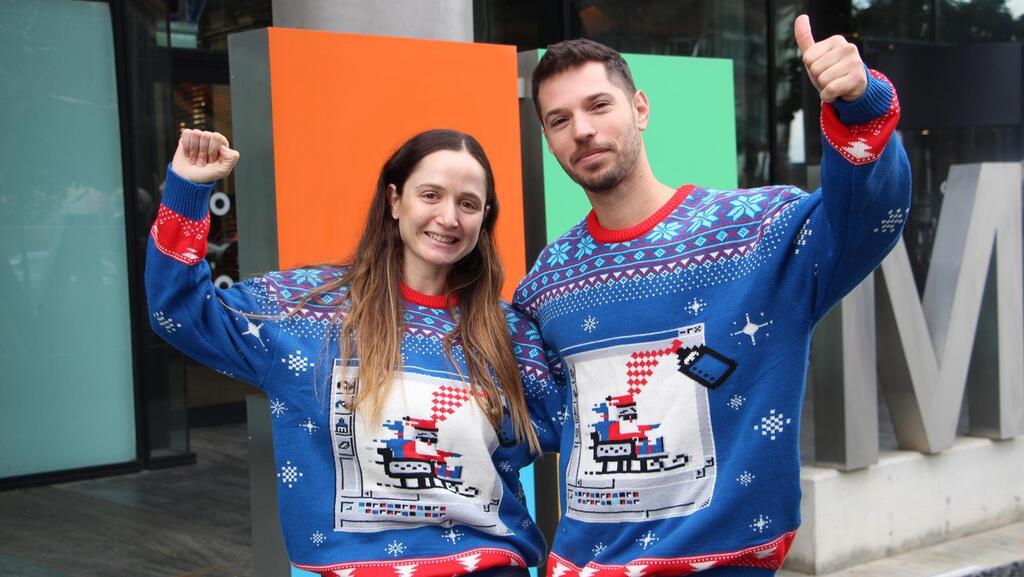
This year, the ugly sweater is a local initiative by Microsoft Israel's development center. It was designed as a tribute to Paint, that iconic drawing program that has accompanied Windows since the mid-1980s, and there's probably not a single person who hasn't used it at some point in their life.
The Invisible People
But beyond the design, this year the sweater is backed by a Microsoft initiative with the Albom Shakuf (Transparent Album) nonprofit, which helps thousands of discharged combat veterans and people with mental injuries from military service begin rehabilitation processes at the push of a button, without bureaucracy and without getting stuck for months in long queues waiting for assistance.
Accordingly, all proceeds from sweater sales were donated to the organization, with Microsoft employees themselves donating thousands of shekels, the company doubled the amount and in total more than 130,000 shekels were transferred for this important cause.
The platform developed by Albom Shakuf aggregates hospitals, nonprofits, government programs and health fund services, and makes all the options accessible in one place. Moreover, every provider appearing on the platform is obligated to respond to the applicant within 72 hours. And this is not a recommendation, but a requirement.
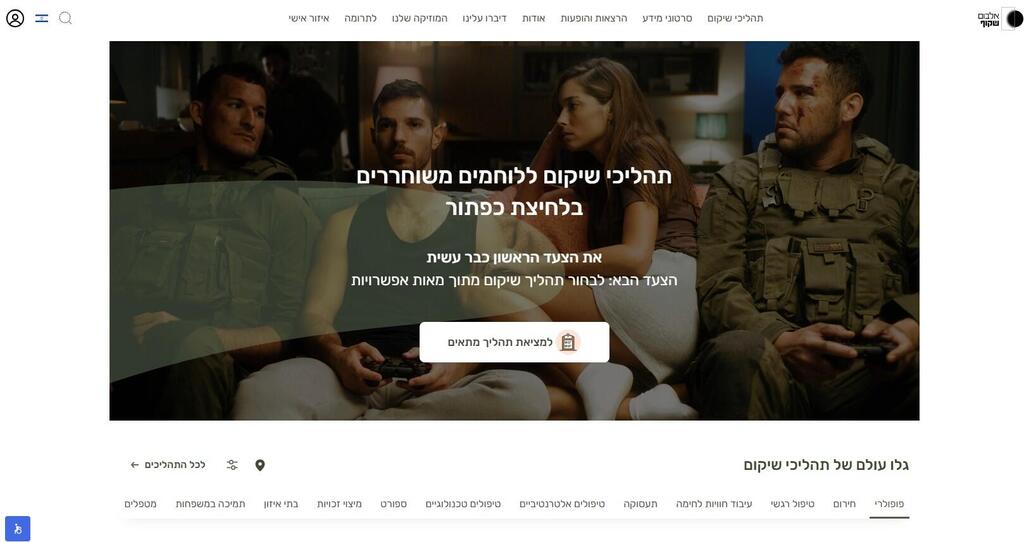
The Albom Shakuf platform
(Screenshot)
"Our goal in the current partnership with Microsoft around the not-so-ugly sweater in my eyes is to bring the nonprofit and its activities to center stage," says Shani Super, the organization's CEO, in a conversation with ynet.
"We aspire that no person falls through the cracks," Super says. "Many times a combat veteran reaches a point where he understands he needs help, reaches out, calls and no one gets back to him for months, or they tell him it's not suitable, or they don't even answer him. And then he falls. We understood that we need to become an entity that centralizes all services, updates daily and ensures a quick response to applicants, because that's what's missing today."
The idea for the platform was born even before COVID, from personal pain. Super and her husband, the organization's co-founder, looked at the state of mental rehabilitation in Israel and saw mainly fragmentation. One nonprofit for yoga, another for emotional therapy, another that organizes trips and mainly a lot of information that passes by word of mouth or in PDF files that become outdated after two days.
"We understood that a single roof is needed," she says, "one that makes all services accessible in a smart way and is suitable for both combat veterans and their family members. Our platform is not only intended for those dealing with it themselves, but also for the circles close to them, who are often required to support the person dealing with it."
"Many times a combat veteran reaches a point where he understands he needs help, reaches out, calls and no one gets back to him for months, or they tell him it's not suitable, or they don't even answer him"
The Connection with Microsoft
Albom Shakuf's connection with Microsoft didn't start this year, and not around the sweater either. About five years ago, the nonprofit produced a large event for Memorial Day for the company. "The events we create combine music with growth from loss and mental coping," Super says. "It creates identification and gives a lot of hope." The event touched the employees and since then a relationship has been formed that has been maintained and deepened.
"What's special about this collaboration," she says, "is that it's not just money. The employees are involved, know what the money is donated for and they participate and share. There's also awareness here. It's not a quiet campaign, but each time a new story. Each time different creative thinking."
And the impact is felt almost immediately. During the campaign, there was a sharp increase in site visits and registrations for rehabilitation processes, sometimes four times the routine. "We measure this very clearly," Super explains.
"Both in the quantity of registrations and in their quality. Feedback, questionnaires, quantitative and verbal measurement. We also know where each applicant came from, whether through Microsoft's campaign or through another marketing tool we operated."

From an Albom Shakuf campaign
(Courtesy of the nonprofit)
But the platform is only part of the story. "We have a system of social workers and volunteers who accompany combat veterans and families personally. Each one comes from a different place, with a different story, different mental state and even different rights they're entitled to by law. So this is not uniform treatment. For each person, a personally tailored rehabilitation program is designed."
In her view, it's precisely the lightness of a campaign like the ugly sweater that is the key. "The truth is it simply normalizes what we call 'invisible injuries,' and it raises awareness without labeling. It's brilliant because it's both marketing of a good product and raising awareness for activity that saves lives."
And the feedback comes from the field as well. "People tell how much it touched them," she says. "As siblings, as spouses, as families of those with PTSD. The feeling is that you're not alone, that there's someone who sees you. And that means there's a place for it and we need to talk about it."
When Super is asked for an example of a success story, she doesn't stop at one. Fathers in their fifties and sixties, young students returning from reserve duty trying to return to life, female combat veterans, ZAKA volunteers, police officers, family members. Once they see on screen coping with trauma, they understand what they're dealing with themselves. "This recognition is part of the rehabilitation," she argues.
"People tell how much it touched them as siblings, as spouses, as families of those with PTSD. The feeling is that you're not alone, that there's someone who sees you"
At the end of the conversation she has one request. Simple. "We're available to anyone who needs help through the platform. Enter the site, distribute it to friends, to reservists, to people you know. Don't be indifferent. It can save lives."
Ido Sheinberg Ziv, Corporate Social Responsibility Manager at Microsoft Israel Research and Development: "We choose each year a nonprofit that will receive all the proceeds from the ugly sweater campaign, according to a burning and relevant social issue for that year. The choice is guided by long-term commitment to social responsibility and a desire to create real and meaningful impact in the community.
"This year we chose the Albom Shakuf nonprofit, which beyond its professional and deep work, engages in activity that restores hope, strengthens people at their most critical points and helps them return to functioning and a meaningful life path.
"We have been accompanying the organization for years, and the proceeds from the campaign will allow expanding its activities. The fact that already at the beginning of the campaign a significant increase in inquiries seeking assistance was recorded, illustrates for us the true value of the initiative - connection between employees and community, between values and action, and creating tangible impact that is felt in the field."