

We’ve tried regulations, but many Israelis ignore them. We’ve tried posting police on street corners to fine people not wearing masks, but many people wear masks improperly or not at all.
We’ve tried sending in police to break up weddings and parties, but all that gets us is riots and clashes.
Gallery

Police forces in Bnei Brak following Haredi riots over coronavirus regulations
(Photo: Tal Shahar)
Now we’ve raised the fines for illegally opening schools, though the school principals say openly they don’t care how high the fines are. So that won’t work, either.
What’s left? Only the most radical solution – mass compliance with the regulations because it’s the right thing to do.
“Oh, sure,” I hear you saying, “as if that will ever happen. This guy clearly hasn’t lived in Israel long enough to know the people and how they behave.”
I think my 49 years here is enough time to get a handle on that. I can also point to a precedent from the distant past.
Used to be that when you took your family out for a nature hike (remember that?), you’d come home with a fistful of wildflowers to liven up your apartment. Not anymore. Israelis learned that picking wildflowers is bad for the environment, bad for the scenery, just plain bad – and they stopped doing it.
It began with a law banning picking wildflowers in 1963, followed by a years-long public relations campaign to educate the people. It worked.

Wildflowers in northern Israel
(Photo: Keren Natanzon Weits)
So behavior can be changed, even in Israel. And if it can be changed for something as trivial as wildflowers, all the more so for a cruel pandemic that globally has killed millions and damaged the health and well-being of hundreds of millions.
Let’s first recognize a central aspect of Israeli mentality. In the “old country” I left in 1972, the default was to obey the laws. There were exceptions, of course – people tried to skimp on their taxes, and if the highway speed limit was too low, they’d exceed it.
An interesting study comparing Indiana and Ohio back then showed that drivers in Ohio, where the speed limit was 55 mph, drove faster than drivers in Indiana, where the speed limit was 65.
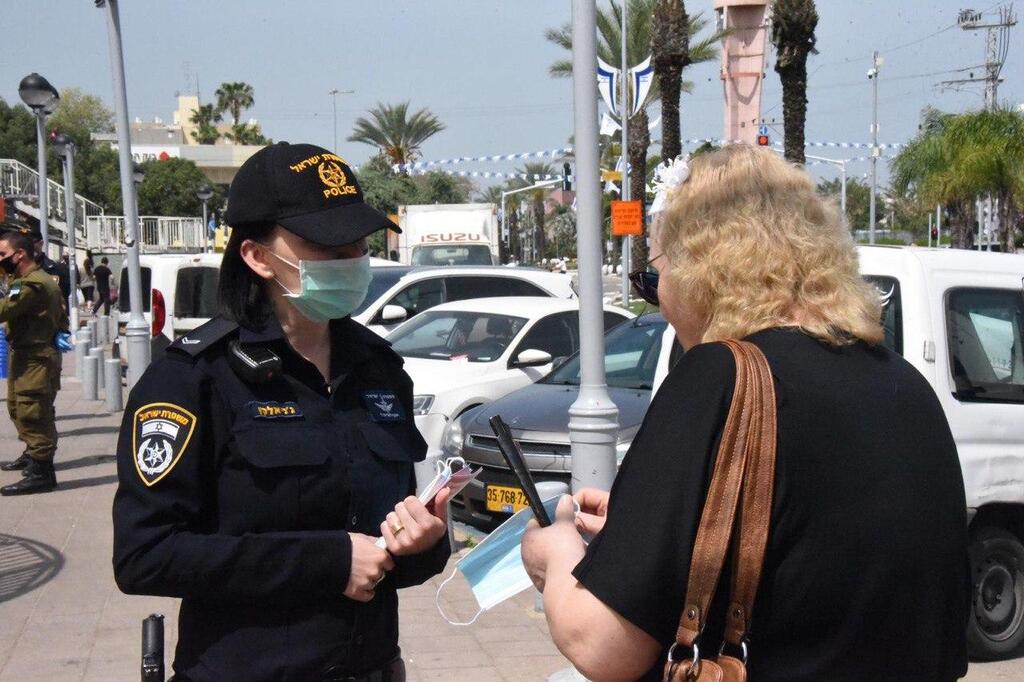
A police officer enforces the order to wear a mask in public
(Photo: Israel Police)
In Israel, the default is to find a way around the law. You see it on TV news reports about new regulations. A reporter invariably comes along to tell us where the loopholes are and how hard it will be to enforce. It’s assumed that the people will try to evade it.
The government contributes to the mentality by illogical regulations and badly written laws. Examples include the “additions” to paychecks in the ‘70s – like car allowances even if you don’t have a car, clothing allowances, per diem for travel even if you don’t travel, and all of them exempt from income tax. That thankfully ended in the ‘80s.
No one was fooling anyone – this was out-and-out tax evasion. It reinforced the mentality of finding ways around the law. The behavior might have had its origins in Eastern Europe, where governments were murderously hostile to Jews, and Jews had to employ every trick in the book just to survive.
But now we’re living in our own state, and that mentality is killing many of us. The fact remains that if everyone would wear a mask properly, maintain social distancing, avoid crowds, and wash hands frequently then the coronavirus would not spread as rapidly, and we wouldn’t need lockdowns at all.

A police officer in Tel Aviv enforces public health regulations
(Photo; Moti Kimchi)
So how do we make that happen?
The best way is a combination of enforcement and local empowerment. In other words – make it worthwhile to follow the regulations, until it becomes natural.
We have a scale that denotes where the disease and the virus are concentrated the most. The “red” areas are outlined on a map. So are the relatively clear “green” areas, as are the categories in between – orange and yellow.
So, let’s quarantine the red cities and towns hermetically. That means even someone who knows someone who knows the mayor’s driver doesn’t get out, and the mayor’s secretary’s sister-in-law doesn’t get in. The only exceptions would be ambulances and hearses.
Food and supplies would be delivered Gaza-style: trucks back up to a crossing, they are unloaded into the quarantined area, and the goods are distributed by the people inside.
Preventive measures and medical treatment could be concentrated in areas where they are needed the most.

Israeli business owners protesting in Holon against the national lockdown
(Photo: Yariv Katz)
Here’s the key: Red cities and towns are not all red. People in neighborhoods where compliance is high and illness is low would be trapped behind the quarantine wall along with the violators.
They would quickly pressure their municipality to get the situation under control, force compliance in the rest of the city, or take action themselves to get the quarantine lifted.
Eventually, compliance would become voluntary. In the meantime, though, no wildflowers would be picked. That is to say, the virus would be contained in the red areas, the rest of the country could be open, and the rate of infection would drop.
And it’s likely that vaccination rates would increase, as people recognize that the only way out of this is to be virus free.
There are obvious problems. First, it would have to be ensured that no one is gaming the system – hiding corona cases or scamming the testing process.

Ministers meeting in Jerusalem to discuss coronavirus mitigation efforts
(Photo: GPO)
Also, the government would have to stop making its decisions six hours before (or after) they go into effect, and stop adopting arbitrary rules like the 1,000-meter limit for travel from your house.
The Ohio-Indiana speed limit study applies here – nonsensical regulations lead to disregard of justified ones.
And there’s the issue of collective punishment. This system would confine lawbreakers and law-abiders together.
But Israelis are known to come together in crises, large and small. So instead of calling that collective punishment, let’s call it what it actually is: collective responsibility.