

A senior health official said Tuesday evening that Israelis may be able to have a "normal" Passover later this month if the public adheres to coronavirus restrictions.
Health Ministry's Head of Public Health Dr. Sharon Elroy-Preis told a press briefing that it would be unnecessary to impose restrictions during the Jewish holiday - set to begin March 27 - if new infection numbers continue to dwindle.
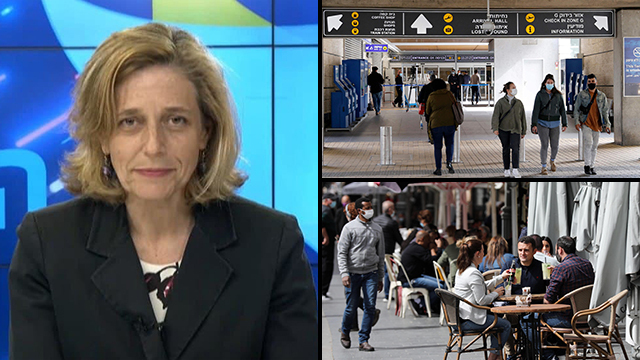
"I do not think it is necessary at the moment to talk about restrictions on Passover, everything could change by then," Elroy-Preis said. "If this continues, there will be no need for restrictions. If we keep wearing masks and keep our distance… we will have a normal holiday."
Dr. Elroy-Preis also said that Israel has yet to see a surge in coronavirus infections following Purim and the illegal mass parties held during the holiday, but added that it was still too early to conclude that the country has made it through the festivities unscathed.
Israel this week began the third phase of its lockdown exit plan, lifting a host of major restrictions, including some in place since September. Dr. Elroy-Preis the country should continue lifting the restrictions as planned.

Bars and restaurants reopen across the country
(Photo: AFP)
"We're definitely seeing a drop in the number of patients in serious and critical conditions. In recent weeks, we've been actually seeing an upwards trend in serious morbidity among young people," she said. "Most people connected to heart-lung machines are under the age of 60 and some are even under 40. All in all, every death is painful, but we've been seeing less and less of it. Looking at the whole picture, we conclude that we can continue opening up."
When asked about the U.S. Centers for Disease Control and Prevention (CDC) decision to let individuals fully inoculated against COVID-19 meet in small groups with other vaccinated people without face masks, Dr. Elroy-Preis said that it was still early to follow in the U.S.'s footsteps.
According to her, Israelis will be able to walk in public without wearing a face cover once data about the efficacy of the vaccine in preventing further spread of the virus, becomes available.
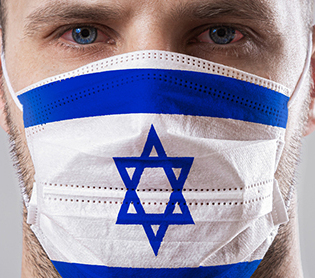
Man wearing a face mask with the Israeli flag
(Photo: Shutterstock)
Also on Tuesday, the head of Israel's national coronavirus response center expressed optimism that the country had apparently managed to avoid a surge in coronavirus infections following the Purim holiday at the end of February.
Tomer Lotan said that there has been a substantial decrease in the country's reproduction (R) number, which indicates how many other people someone who carries the virus has infected, despite widespread Purim celebrations that violated health regulations.
"Our R number currently stands at 0.95, exactly 10 days after Purim. We were afraid of a higher number at this point, and when I saw that number today, I calmed down a bit," Lotan said.

An illegal Purim party in Tel Aviv's flea market
(Photo: Itay Blumenthal)
According to Lotan, the decrease is even more impressive given recent steps to reopen large swathes of the country's economy and education system, both of which could have had an adverse impact on Israel’s infection rate.
"We would have expected, should any significant outbreak occur, to see some sort of upward trend in this 10-day period. And yet in the last two days in particular we have seen the R number begin to decline," he said.