

Most Palestinians expect a Democratic takeover of the White House on November 3. It is not clear whether this assessment is more wishful thinking or is based on objective data coming from the United States.
A poll conducted by the Palestinian Center for Policy and Survey Research in September shows that 61% of the Palestinian public believe that U.S. President Donald Trump will lose the upcoming election.
Gallery

Democratic nominee Joe Biden, Palestinian Authority President Mahmoud Abbas and U.S. President Donald Trump
(Photos: AFP, Reuters)
The four years of the Trump administration saw the Palestinians' greatest fears all come to pass.
The U.S. recognized Jerusalem as the capital of Israel and moved its embassy there from Tel Aviv; froze its annual financial aid to the Palestinian Authority; ended its aid to UNRWA, the UN agency for Palestinian refugees; shuttered the Palestinian Liberation Organization (PLO) mission in Washington and expelled Palestinian Ambassador Hossam Zumlot; and halted security coordination with the Palestinian security forces.
However, to the Palestinians, these blows all pale in comparison to Trump's self-styled "deal of the century" Mideast peace plan, which paved the way for Israel to extend its sovereignty over large swathes of the West Bank and buried deeply an concept of the Jewish state making territorial concessions in exchange for peace.
The only solution that the PA has ever supported since its inception - which includes Israel withdrawing from territories it captured from Jordan and Egypt during the 1967 Six-day War - is no more.
"We are under siege these days," says Palestinian publicist and former lawmaker Ashraf al-Ajrami.
"The siege will continue if Trump wins and extends his regime. He will give Israel a green light to keep annexing if Palestinians don’t show up to talks based on the U.S. peace plan, and be in no doubt about it, the Palestinians will not."
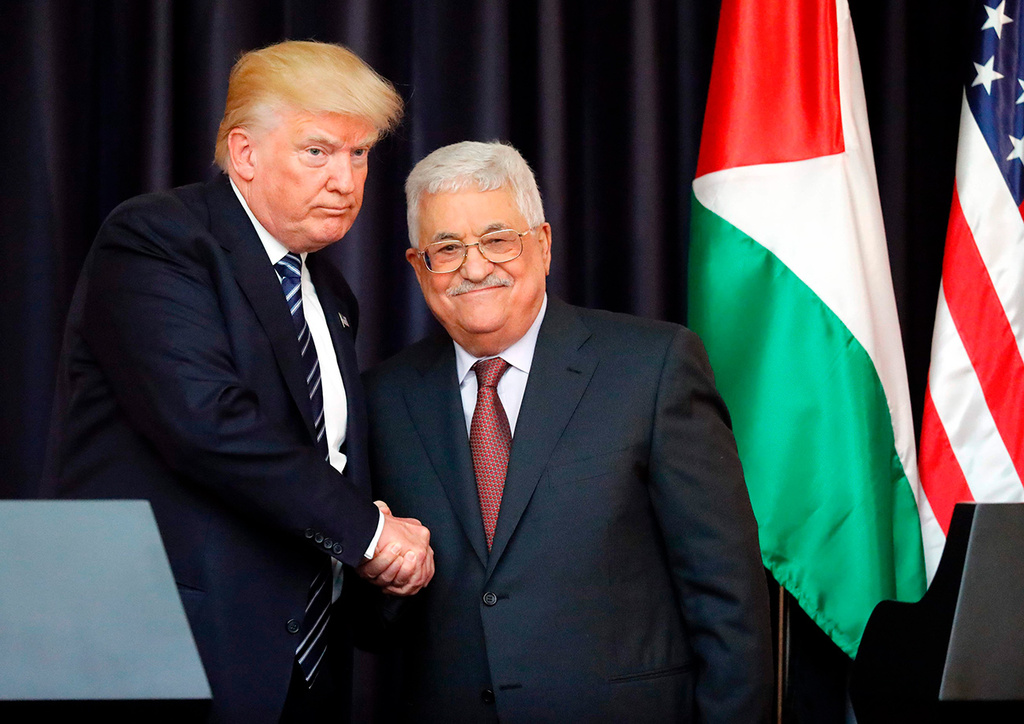
U.S. President Donald Trump meeting with Palestinian President Mahmoud Abbas in Bethlehem in 2017
(Photo: AFP)
Meanwhile, while businesses are operating only partially, traffic on the streets of Ramallah remains sparse compared to regular days. People prefer to stay home as much as possible as coronavirus hogs most of the attention.
Almost no one talks about the upcoming elections in the United States. Even the Palestinian media is far more preoccupied with the spread of the disease in Israel than with polling data from the U.S.
Former president of the Al-Quds University in Jerusalem, Prof. Sari Nusseibeh, one of the most prominent Palestinian intellectuals, published an article last month that summarizes best the Palestinian mindset at the moment.
As more doors continue closing to the Palestinians – be it the Arab world, the political process, the U.S. and even the internal conflicts between Palestinian factions Fatah and Hamas – all they can do is hold onto the land and wait for the storm to pass.
American bludgeoning, European passivity and the collapse of the Arab Peace Initiative -which conditioned normalization between Israel and the Arab world on reaching a solution with the Palestinians – pushed Palestinian President Mahmoud Abbas to tighten relations with the Muslim Brotherhood axis of Qatar, Turkey and Hamas.
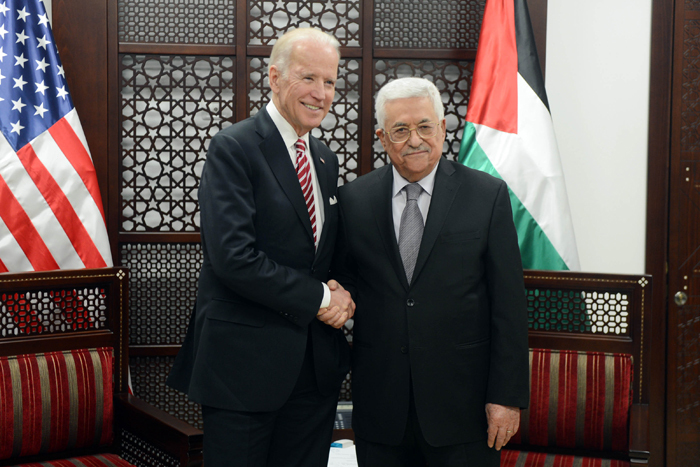
Then-Vice President Joe Biden meeting with Palestinian President Mahmoud Abbas in Ramallah in 2016
(Photo; Archive)
Talks between the Fatah-dominated PA and rival faction Hamas have deepened in recent months, leading to an agreement to hold elections for the Palestinian parliament at a still undecided date. It seems that the Fatah leadership is trying to hold off on a decision until after the results of the U.S. elections.
Meanwhile, it seems like Hamas is trying to press all of Fatah's sore spots to make sure the election does take place.
"The U.S. administration officially contacted us to hold a direct meeting with us, but we immediately refused," senior Hamas official Saleh al-Arouri announced this week in a televised interview.
"This happened at a time when severe pressure was being exerted on the Palestinian Authority and the purpose of the appeal was to further deepen the divisions [between Fatah and Hamas]."
Arouri knows well how dearly Abbas values the title of "the only legitimate Palestinian entity with whom political contacts can be made."
His boasting about the American overture to Hamas was aimed right at the president's heart to make sure he will not cave in and thaw relations with the United States again.
Arouri also said no outcome of the election, whether Biden or Trump emerges victorious, will affect the reconciliation process between the two Palestinian factions.
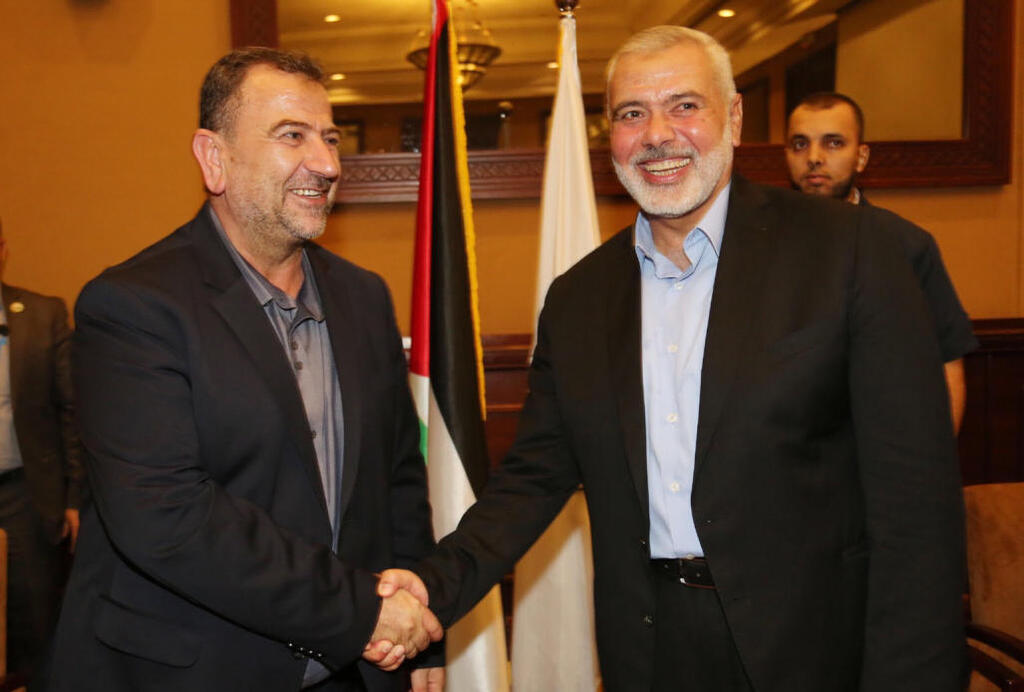
Senior Hamas official Saleh al-Arouri and Hamas leader Ismail Haniyeh
(Photo: EPA)
Over the years, the Palestinians used to convey neutrality regarding election campaigns in countries where a change of administration may affect them, rather than expressing support for one candidate or another.
This was the case with Israel, as well as with U.S. elections.
Yet the hostility toward the Trump administration makes it difficult this time for the Palestinians to appear neutral. This hostility is also why ex-lawmaker Ajrami emphatically declares that the Palestinians hope for a Democratic victory on Tuesday.
"If Biden wins, he will return to the old two-state format political process within the 1967 borders, he will return funding to the Palestinian Authority and aid to UNRWA," he says.
However, it is clear to Ramallah that the Trump administration has created a reality that is partly irreversible.
"A victory for the Democrats will not bring the embassy back from Jerusalem to Tel Aviv because it is a closed issue," Ajrami says.
"Biden will not turn the wheel back, but he will stop the pressure on the Palestinian Authority."
But is it possible that the Palestinians have set their hopes too high that a Biden victory will completely change their reality? Depends on who you ask.
"When Barack Obama won the first time, we felt a honeymoon-like euphoria, but nothing happened in the end," says a senior political source in Ramallah who spoke on condition of anonymity.
"Even if Democrats do win, we'll probably won't see any significant change unless the regime in Israel changes. But we do expect the American pressure on the Palestinian Authority to be lifted and get some economic relief. We believe that a Democratic administration will pressure Israel more as it pertains to annexation and settlements."
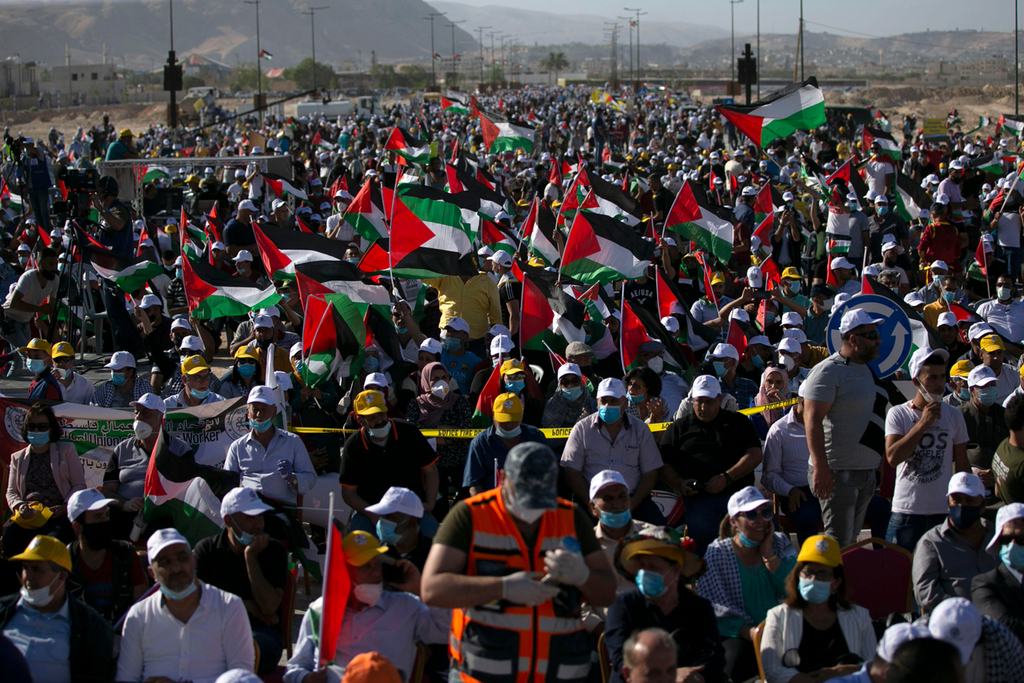
Palestinians in Jericho protesting against Israel's now-suspended plan to annex parts of the West Bank
(Photo: AFP)
Ajrami also believes a Trump victory will set the Palestinians on a collision course with the U.S. and Israel, but admitted that he did not see calls by the Palestinian leadership to escalate violence against Israel necessarily receiving widespread popular support.
The Ramallah source's remarks are further evidence of the growing mistrust of the Palestinian people in the long-standing leadership of the Palestinian Authority.
This was evident earlier this summer, as Fatah failed to lead a popular protest campaign against Israel's intentions to extend sovereignty over West Bank lands. The protest amounted to one lackluster rally in Jericho. The Palestinian public has shown complete indifference to the struggle - even while agreeing with it.