


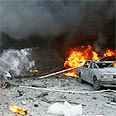
Beirut bombing scene
צילום: איי אף פי
Who killed Rafik Hariri?
Did his confrontation with the Syrian regime bring about his demise, or was al-Qaeda involved in today’s assassination in Beirut?
TEL AVIV - He was always an outsider. The mustachioed, Sunni billionaire who made his fortune in Saudi Arabia and later become prime Minister was an anomalous figure in a Lebanon attempting to recover from its war wounds.
His supporters said he played a significant role in the economic recovery sweeping through the country’s north, and particularly in the Beirut region. His rivals, meanwhile, said many of the fruits of recovery flowed into his own pockets.
Either way, one of Lebanon’s and the Middle East’s most colorful figures was assassinated in Beirut today. But was the path to his demise foretold?
The snowball started rolling several months ago. The 51-year-old Hariri’s resignation from the Lebanese premiership late in 2004 put an end to more than a decade of political service. Moreover, during his career, he clashed with various local elements.
The resignation largely stemmed from the extended term accorded to Syrian puppet President Emile Lahoud, but at the eye of the storm was Hariri’s stance against the Syrian military presence in Lebanon in recent years.
Hariri deplored the continued Syrian military-backed economic dominance of Lebanon and undertook what was seen as a “suicidal” step by explicitly supporting the United Nation’s decision calling for a Syrian withdrawal from the country.
The Syrians naturally saw him as a bitter ideological foe - a significant about-face considering the Syrian support for his appointment, which even received the late Syrian President Hafez Assad’s blessing.
However, Syria’s iron grip on Lebanon, which provides a means of living for tens of thousands of Syrians, and particularly the Israeli pullout from Lebanon, brought a change in both parties’ views.
Villa near Beirut and two private jets
Still, Hariri was not the epitome of innocence. The humongous company he owned made millions from rehabilitation and construction projects across Beirut. Accordingly, he owned two private jets and a magnificent villa near the capital, and loved traveling throughout the world, accompanied by dozens of bodyguards.
The capitalistic doctrine espoused by Hariri aroused additional criticism. Many in Lebanon argued that his policies widened the gap between rich and poor and created a distorted society. He was also charged with flawed planning of mega-projects, whose collapse led to giant losses for the State.
Did the clash between Hariri and the Syrians reach a boiling point and prompted Damascus to act? Or was it his affinity to the West (and particularly Europe) that aroused the fury of al-Qaeda? Did his resignation from the premiership several months ago turn him into an Average Joe, thus dooming him to death?
In his country, and elsewhere in the world, attempts will be made to make sense of the puzzle surrounding Hariri’s assassination.
In any case, it will not be the last one in Lebanon.
Guy Benyovits is Ynet's News Desk Editor
