


Dozens of meetings and hours of discussions have taken place at UN headquarters since the war began regarding the humanitarian situation in the Gaza Strip.
While Israel has acknowledged the situation is exceptional and difficult, an examination of UN World Food Programme (WFP) data against UN discussions reveals staggering disparities between the severity and scope of the crisis and the Security Council's disproportionate focus on it.
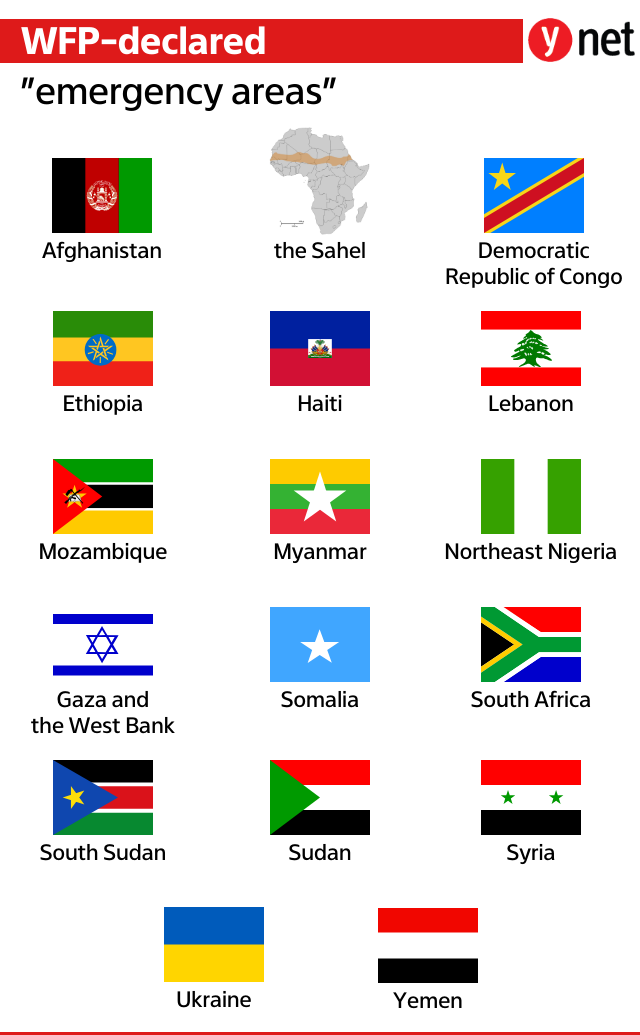
The WFP operates in 120 countries worldwide, including 17 designated as "emergency" situations — among them "Palestine." According to the data, 5.5 million Palestinians live in Gaza and the West Bank, with an estimated 640,000 facing starvation. This compares to approximately 215.9 million people at risk in other countries designated as "emergencies." Beyond emergency cases, dozens of additional countries where the WFP also operates house hundreds of millions of people at various risk levels.
The WFP says $334 million is needed this year for required operations in Gaza and the West Bank. This emergency situation greatly preoccupies the UN Security Council (UNSC): since November 2023, the UN Security Council has held at least 60 discussions on the humanitarian situation in Gaza, during which serious accusations were leveled against Israel.
The figure is more than triple that of Sudan, the second most-discussed country, where the UNSC has convened just 19 times on an emergency affecting 24.6 million people — roughly 38 times the number impacted in the top-ranked case.
This is also six times more than in Haiti, where conditions are alarming: 5.7 million face acute hunger out of a population of approximately 11.77 million, yet Haiti ranks third with 10 discussions over the past two years.
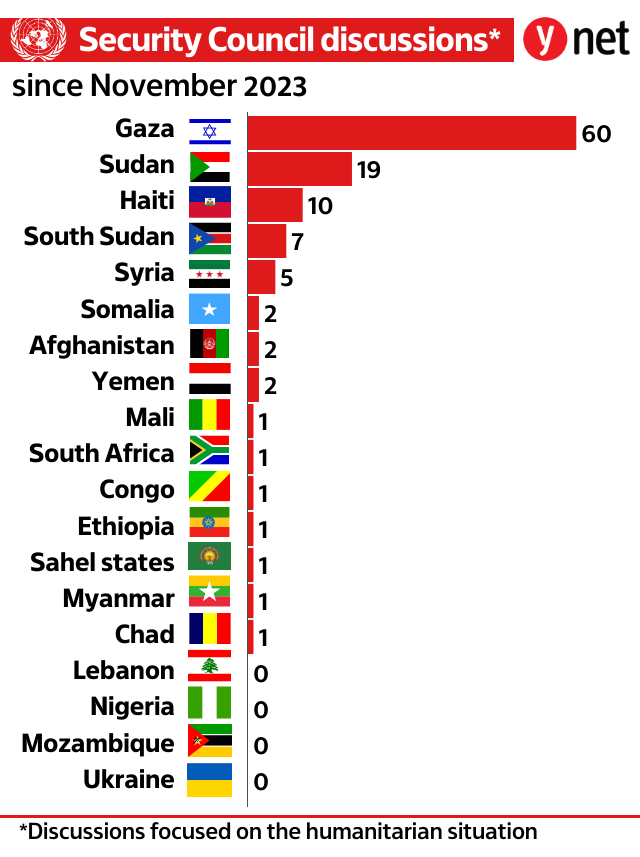
UN Security Council discussions since November 2023
What about the 14 additional countries that, according to WFP data, face significantly more severe "emergency" situations affecting far more people? Apparently, this matters less to the international community.
One need not look far to find UN hypocrisy in its different treatment of countries — even those bordering Israel are designated as "emergencies" but haven't received attention at UN discussion tables.
In neighboring Lebanon, for example, out of approximately 5.8 million residents, 2.5 million need UN support in the coming year, and more than one million are "struggling to put food on the table." To address Lebanon's crisis through at least the end of this year requires more than $200 million, according to the WFP. Despite this "terrible emergency," the UNSC hasn't discussed Lebanon's humanitarian emergency in two years.
Syria's emergency situation received some Security Council attention — but only five times since November 2023. This despite serious data showing more than nine million people in Syria suffer from food insecurity, with 3.6 million additional people supported by the World Food Programme last year. Now, $335 million is needed to restore World Food Programme operations in Syria this year.
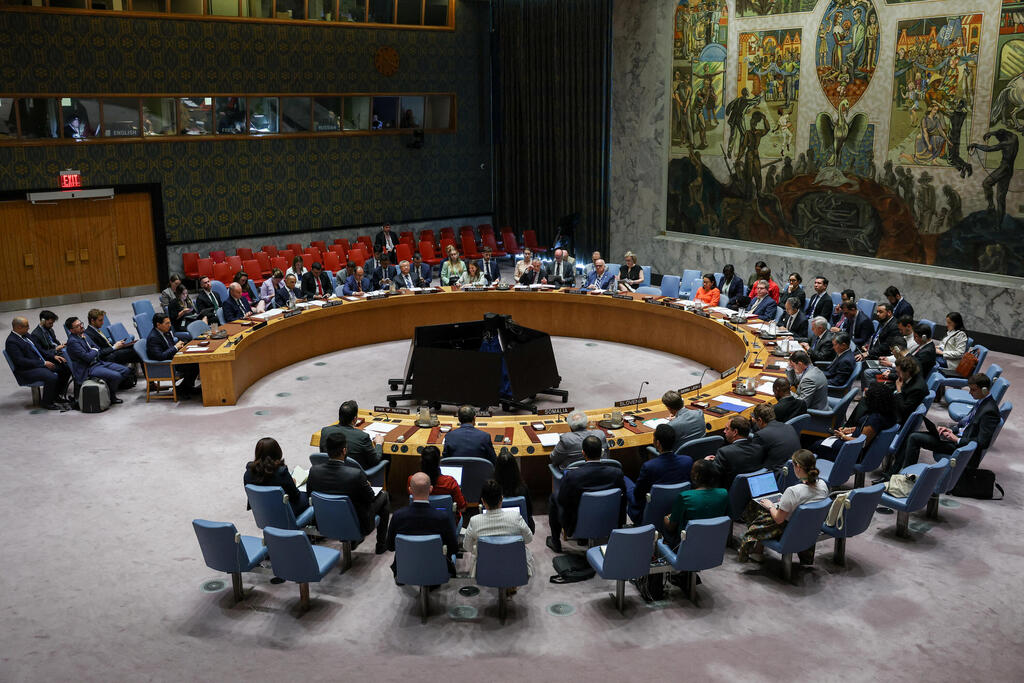
United Nations Security Council (UNSC)
(Photo: REUTERS/Kylie Cooper)
In Yemen, where Iran-backed Houthis rebels actively participated in the war against Israel, the "emergency" affecting approximately 40 million residents is far more severe and significant. WFP data show more than 17 million people suffer from food insecurity and 19.5 million need humanitarian assistance.
Funding WFP activities for the next two months requires $577 million. Yet this serious situation occupied the UNSC only twice in the past two years.
Ukraine, which has been at war with Russia for more than three and a half years, is also declared in a state of "emergency." Five million people need food and livelihood assistance, with an additional one million supported monthly by the WFP.
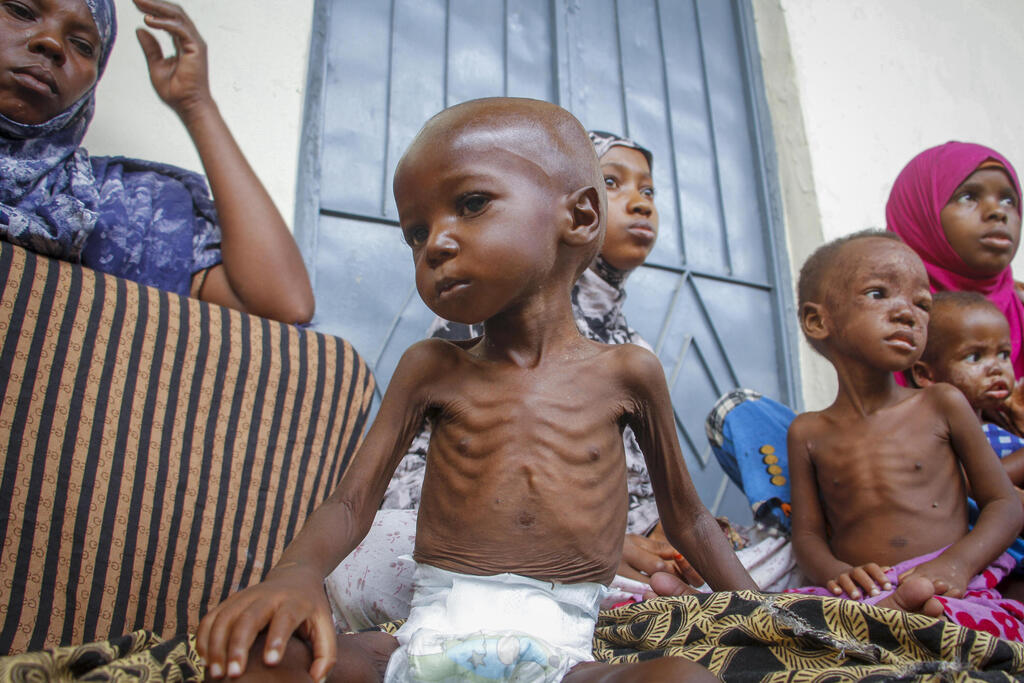
Famine in Mogadishu, Somalia
(Photo: AP)
Continuing operations in the country this year requires an additional $270 million. Yet Ukraine's acute humanitarian situation apparently hasn't occupied the UNSC in the past two years, possibly due to sustained U.S. and Western support.
Remember Afghanistan?
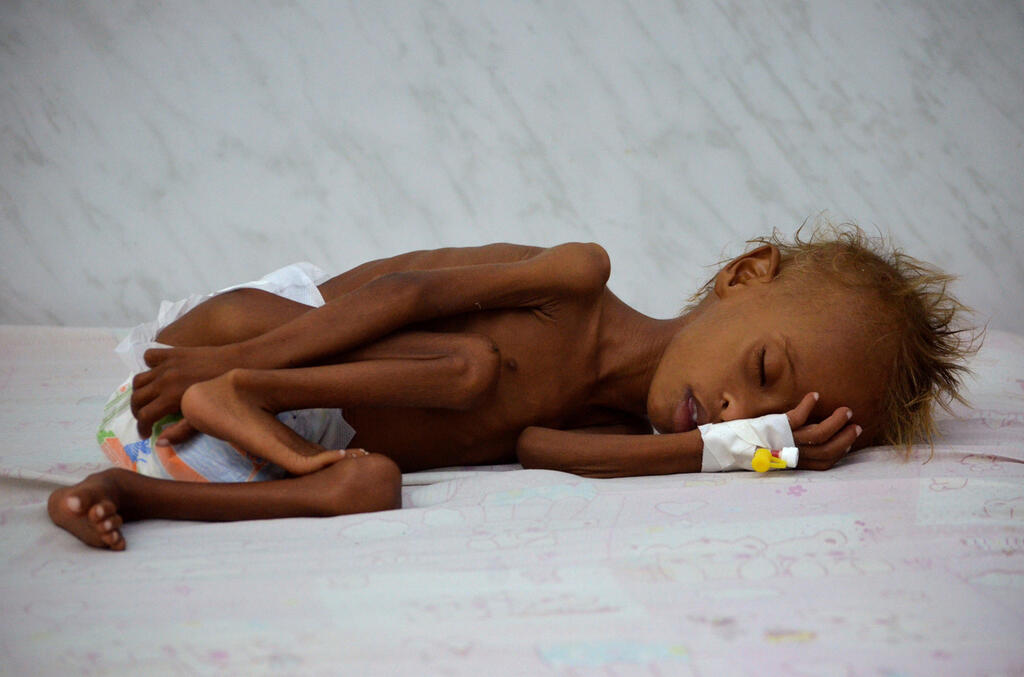
The countries most severely impacted by hunger, according to the WFP, are Sudan, South Africa, Nigeria and the Democratic Republic of Congo. In Sudan alone, 24.6 million people suffer from acute hunger, with two million additional people facing starvation or famine risk. Continuing to fund operations there for the next three months requires $645 million.
South Africa, which has lodged a war crimes complaint against Israel with the International Court of Justice for its military campaign in Gaza, faces equally dire conditions: 21 million children suffer from malnutrition, and 27 million people face food insecurity. Given the situation, the UNSC has discussed South Africa once in the past two years.
(Photo: Reuters)
In Nigeria, meanwhile, 30.6 million people in the country's northeast suffer from "acute food insecurity." Additionally, 2.3 million people were displaced from their homes in the region due to violent conflicts. Yet this troubled the UNSC less over the past two years.
In the Democratic Republic of Congo, according to the WFP, 28 million people suffer from "acute food insecurity." Beyond them, nearly five million children under 5 face or are expected to face acute malnutrition. Continuing operations there for the next two months requires $433 million. Consequently, they also received one formal UNSC discussion.
Myanmar, Ethiopia, Afghanistan and Sahel region countries in Africa also face significant "emergency" hunger situations. In Myanmar, 16.7 million people suffer from food insecurity, an issue that troubled the UNSC only once in the past two years.
The UNSC also addressed Ethiopia only once, despite more than 10.2 million people suffering from "acute food insecurity," with the WFP supporting 3.5 million people last year. To continue providing "life-saving assistance and strengthen resilience" this year, the WFP would require $150 million.

Taliban security forces, Afghanistan, at the Islam Qala border crossing, where Afghan refugees and migrants were deported from Iran, June 28.
(Photo: Wakil Kohsar / AFP)
In Afghanistan, taken over by the Taliban just two years before the outbreak of the Gaza war in October 2023, the numbers are significant. Out of approximately 42.65 million residents, 9.5 million suffer from acute food insecurity, with nearly 5 million women and children needing malnutrition treatment. Continuing operations until February 2026 would "urgently" require $568 million. Afghanistan's situation has occupied the UNSC twice since October 2023.
In Sahel countries, 10 million people suffer from "acute hunger," and the WFP needs $620 million to continue operations. The UNSC discussed the situation there once in the past two years.
Haiti, Mozambique, Somalia and South Sudan were also added to the World Food Programme’s emergency list. In Haiti, 5.7 million people face acute hunger, yet the WFP, which assisted 1.7 million last year, says it needs $46.4 million to sustain aid next month. Despite the scale, Haiti has been discussed only 10 times in the Security Council over the past two years — a fraction of the 60 sessions devoted to Israel.
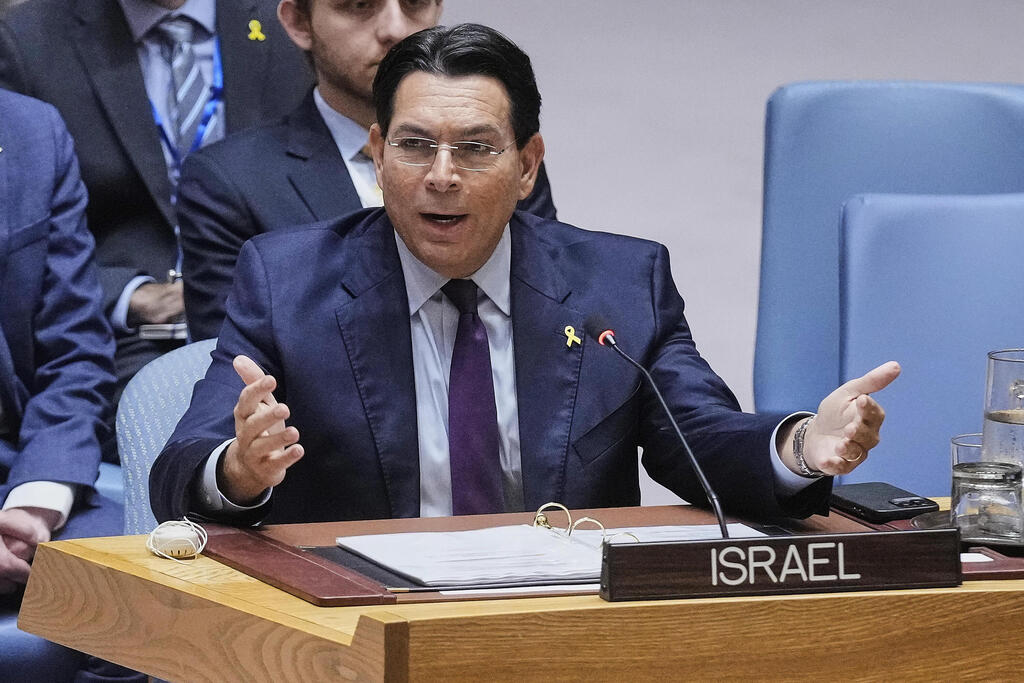
Danny Danon
(Photo: AP Photo/Richard Drew)
In Mozambique, five million people suffer from food insecurity, requiring $147 million for "emergency response" through next month. Somalia occupied the UN twice, where 4.6 million people suffer from "high levels of acute food insecurity," and 1.8 million children under five suffer from acute malnutrition. Continuing operations through year-end would require $266 million.
In South Sudan, 7.7 million people face acute food insecurity, with famine threats in two provinces. World Food Programme operations there need $274 million through year-end. Over the past two years, South Sudan's situation has occupied the UN seven times.
"Since October 2023, dozens of dedicated UN discussions on Gaza's situation have taken place, sometimes more than one per week," Israeli UN Ambassador Danny Danon said. "The scope and intensity of focus on Gaza are unprecedented compared to other humanitarian crises defined by UN agencies themselves as far more severe: in Sudan, Congo, Ethiopia and Yemen, where millions face starvation and death. Virtually no Security Council discussions occurred on these countries' situations in the past year.
"Instead of fulfilling its role as an international body that distributes attention equally among crises, the UN chooses to focus obsessively on Gaza in numerous, lengthy discussions that always present a one-sided picture blaming Israel while completely ignoring Hamas's responsibility. This isn't universal humanitarian concern but cynical use of the UN to serve political purposes."
First published: 12:50, 09.13.25