

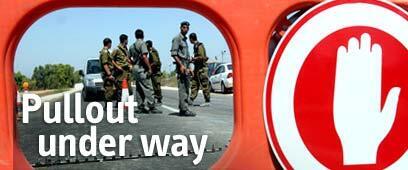
GAZA - Thousands of soldiers and police officers took position in a 2-4 kilometer (1.2 – 2.4 miles) area surrounding the Gaza Strip Wednesday following Prime Minister Ariel Sharon's decision to shut down the Gaza Strip down to all non-Gush Katif residents, and to block or assess incoming traffic to Gush Katif.
The IDF has determined that Gaza
residents are defined as people who have moved to the area prior to March 17, 2005.
IDF Chief of Staff Dan Halutz said the IDF decided to close down Gush Katif "as a preemptive measure and in a bid to thwart any illegal attempts at foiling the disengagement."
"We have nothing against the residents of Gush Katif," he said. "We will do all that is possible to complete the mission."
All those who wish to enter Gush Katif will encounter several roadblocks where security personnel will determine the purpose of the trip.
Roadblocks were positioned in three key strategic points - near the Karni, Erez and Kisufim crossings, and vehicles will be permitted to pass by these roadblocks with special permits only.
According to the plan, police officers situated near the Kisufim and Sufa crossings will block the roads leading into the Gaza Strip, in order to prevent pullout objectors from entering the area via the crossings or through Gaza's security fences.
The IDF has set up a center responsible for providing special permits to citizens who request to enter Gush Katif.
Relaxed policy
The permit center, located near Ofakim, is manned seven days a week, 24 hours a day, by IDF soldiers and can be reached through a hotline.
For information regarding Gush Katif entry permits, please call: 08-992-7272.
The permit center is intended for Gush Katif residents who wish to invite friends or family to their homes, a senior IDF official said.
The Gush Katif residents themselves will receive permanent passes that will enable them to cross through the roadblocks en route to their homes.
People who wish to enter Gush Katif without an invitation must submit their request a week prior to their scheduled trip to the area.
Brigadier-General Guy Zur, head of the IDF's Southern Command Headquarters, said that initially the IDF will incorporate a relaxed policy, since he does not expect members of the public to take advantage of them in order to remain in Gush Katif.
During the operation's initial phase, the IDF will allow 72-hour family visits to Gush Katif. The permit system will allow the IDF to detect whether or not the visitor has left Gush Katif once his permit has expired, and the system will allow the IDF to know the number of people staying in the area.
"Any change in policy depends on assessments made according to developments on the ground," Zur said. "Of course we would not be able to tolerate a situation where thousands of people would enter and not leave (Gush Katif); in such a case we will limit the number of visitors."
First published: 18:57, 07.13.5