

VIDEO - The Israel Defense Forces' operation in the northern Gaza Strip entered its second day Friday. As part of the operation, which is part of a larger move in the Strip following the kidnapping of IDF soldier Gilad Shalit, the forces are attempting to take over Qassam launching sites and restore clam, even temporarily, to Gaza vicinity communities, in the meantime to no avail.
Another Qassam rocket landed near Sderot Friday morning, joining another 10 rockets fired at Israeli territory since the operation was launched.
The ground operation is accompanied by massive aerial activity, which has so far claimed a heavy price on the Palestinian side. The Palestinian Authority reported that one Palestinian was killed every hour since IDF soldiers entered the Gaza Strip territory.
According to the IDF's data, more than 30 terrorists were killed since the northern Strip operation was launched.
IDF Chief of Staff Lieutenant General Dan Halutz arrived at the Gaza Division on Friday morning and was briefed by soldiers and commanders. The Israeli side spoke about stubborn fighting and a lot of explosive devices and weapons in the Strip, the result of 10 months of Israeli absence.
In the meantime, it is difficult to estimate when the operation will end and it is also difficult to accurately define its objectives.
According to Gaza Division Commander Brigadier General Aviv Kochavi, the IDF does not plan to reveal how long the operation will last and what methods are being used by the soldiers, in a bid to surprise the other side.
"We are determined to create a professional chaos, to jump from one place, to emerge, to use this method or another, to leave the territory and enter it again after a while," Brigadier General Kochavi told Ynet.
"We will take advantage of all the advantages of this method, which is a 'raid' rather than an 'occupation.' Meaning, don’t to base ourselves or wallow in the Strip. All this is aimed at creating the understanding among terror organizations that firing Qassams is not worthwhile," he explained.
"The operations we are carrying out in a number of centers have several aims," Kochaci said. "First, we want to harm the terror organization's infrastructures. We are talking about operation of uncovering tangles areas, dunes and other places from where terror cells are operating."
The division commander clarified that each operation has been legally validated "and is not the decision made by a battalion commander or by myself. This can also provide us with an advantage in the future in dealing with the Qassams by using different technologies," he said.
Will this completely prevent the fire? "Not necessarily, but one must add to this the number of terrorists killed in such an operation and the general atmosphere – electricity blackouts, damaging routes – this is what may eventually bring about an understanding on their part that firing at Israel is not worthwhile; that this is not an equation that they should be part of."
Creating a critical mass
Brigadier General Kochavi remembers the previous operations in Gaza, before the disengagement, which did not succeed in completely halting the fire.
"It is true that there were activities and operations also in the past, it is true that quite a few terrorists were also killed then, but eventually a critical mass is created which leads the Palestinians to stop and rethink – this is what we are trying to create," he said.
The forces were not surprised by the magnitude to the terrorists' resistance.
"Gaza was always violent, and Gaza in the past 10 months was also with an open pipe to Philadelphi (route), where numerous weapons have passed. The place is totally breached. We knew that there would be a lot of fire. The anti-tank missiles are not new, but their scope is big," Kochavi explained.
Referring to the connection between the IDF operation and the fate of kidnapped soldier Gilad Shalit, the division commander said: "There is a chance that the pressure caused by the operation will lead the terror organizations to an understanding that Israel does not plan to give up easily on this matter. Already now we have identified a great surprise among the Palestinians in terms of our response – they are in shock. They did not expect a series of such long operations over time."
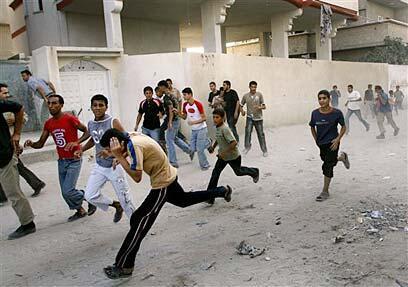
'They didn’t expect.' Panic in Beit Lahiya (Photo: AP)
But not only the Palestinians are paying a heavy price. On Thursday, First Sergeant Yehuda Bassel of Moshav Yinon was killed inan operation carried out by the Golani Brigade's Batallion13 in the al-Atatra area. He will be laid to rest on Friday at the military burial plot in the Kfar Warburg cemetery.
The IDF is still not convinced whether it was a Palestinian sniper who fired an accurate bullet and hit the soldier's head, or whether it was another tragic incident in which a soldier was accidentally killed by one of his fellow troops.
According to Brigadier General Kochavi, due to the fact that the soldiers are still in the field, the army is unable to conduct a comprehensive inquiry of the incident.
"We will thoroughly look into the issue," he promised. "One must remember that the fighting is very complicated, using various techniques, and a lot of shooting incidents. The initial inquiry does not reveal that our troops were the ones who fired, but it is possible, definitely in this intensive fighting. It happened in the past and happens in many armies. The issue will be investigated to the fullest."
The Gaza operation is of course more than just military operations. It has already been rejected several times, changed and re-planned. It appears that Prime Minister Ehud Olmert is directly involved in it. Brigadier General Kochavi does not feel chocked or bound.
"The army works for the State, not the other way around. The State should set objectives and what effects it wants to reach. We must remember that the military operation does not stand in itself. There are many other considerations here- economic, diplomatic and others. I am not exposed to everything," he concluded.
Ali Waked contribute to the report