

On July 7th 2005 the Islamic terror threats turned into a bloody reality in the capital. Four suicide bombers exploded in three subways and a bus, killing 52 people, wounded hundreds and leaving deep scars in the heart of the Kingdome.
The commemoration ceremonies and rallies were launched with two moments of silence at 11 a.m., representing the complete contrast to the explosions and the ambulance wails that filled the air last year in the midst of the horror, before the smoke cleared and the sad reality became clear.
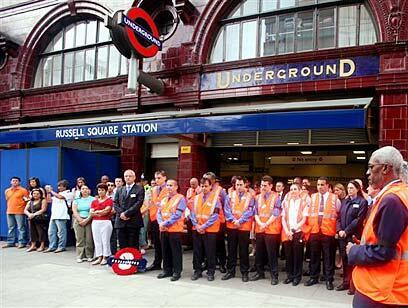
Ceremony at Russell Square (Photo: AP)
One year later Britain has recovered and went on, but one wound remains open and bleeding: The British have difficulty understanding how four young Muslims, part of the UK melting pot, could wake up one morning and detonate themselves among people they may have cheered for the local football team with just 24 hours earlier.
'Tougher anti-terror laws'
What caused the four men to detonate themselves in the capital? Was it the feeling of discrimination, or maybe their anger over Britain's involvement in the war on Iraq and Afghanistan, or Britain's overall view on Islam?
"Here is a group of people that was born here, this is their home, they are English, and still, they feel foreign and discriminated against. How did this happen?" asked Jackie Putnam, a survivor of the terror attacks.
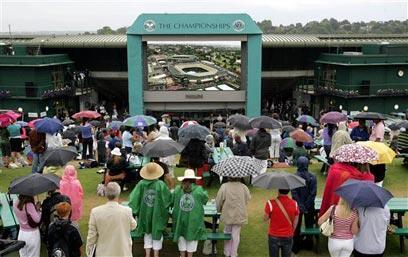
Tennis fans during moment of silence at Wimbledon (Photo: AP)
The British government reluctantly disclosed the possibility that its foreign policy may have contributed to the home-grown extremism, but despite protests and decreasing numbers in polls, 10 Downing Street still goes hand in hand with Washington.
The terror attacks resulted in tougher anti-terror laws and stricter immigration laws, and feelings of discrimination and inequity among the 1.6 million Muslims living in Britain, about three percent of the population, persist.
In a poll published this week, four out of five Muslims said thy have felt amplified feelings of hostility toward them since the terror attacks. Some 74 percent said they feel UK citizens treat them with suspicion, 81 percent believe that the authorities’ suspicious treatment of Muslims following the attacks is unjust, and only one third believes that the laws on the war on terror are implemented fairly on their community.
On the other hand, many believe that the heightened suspicion has its place. They point to other data from the same poll in which 13 percent of Muslims in Britain said they view the suicide bombers as "martyrs", and 16 percent said that although they don't agree with attack, as far as they are concerned, the cause was justified.
'I know another attack is coming'
Prime Minister Tony Blair called on moderate Muslims to fight radicalism in their communities and not to expect that the government's security laws to carry out the task. Blair's statement angered some Muslims, who said that such statements only enhance the stigma of Muslims as being extreme.
Many in Britain are convinced that the terror threat has not disappeared. Since the attacks dozens of people were interrogated on suspicions of terror activity, and police said that it has foiled at least three or four additional attempts to carry out terror attacks.
Seventy terror related cases, in and outside Britain, are investigated by various British establishments these days. Officials in Britain emphasized the fact that most terrorists had no combat experience and that the "operation" cost only 8,000 pounds; many view this statement as proof of the relative ease in which the attacks were carried out.
The British are also angered over reports that two of the suicide bombers were "marked' by the security agencies but were deemed "harmless." Similar reports surfaced in past weeks about warnings sent by American security officials to their British counterparts regarding arch-terrorist Muhammad Sadik Khan.
Victims' relatives have demanded the establishment of an official and independent investigative committee on the intelligence glitch that allowed the attack to be carried out despite warnings and foiling attempts. According to them, such a committee is necessary not only to investigate the past but also to learn lessons for the future.
"I know that another attack is coming and that we are no longer safe as in the past," Rachel North, whose life was saved in the attack in Russell Square, told Reuters. Twenty-six people were killed in the specific attack.
Unlike the United States, which thoroughly investigated the September 11 terror attacks, Britain continues to refrain from conducting an in-depth investigation. Ministers claim that such investigation will keep the security services busy at a time when they have to concentrate their efforts on thwarting terror activity, adding that that the results will not reveal any new findings about the attacks.
For families of the victims and the wounded, but not only for them, these profound questions remain unanswered.