

One of five Muslims in Israel resides in Jerusalem ,data published Tuesday by the National Bureau of Statistics for Eid al-Adha determined. Some 288,000 Muslims reside in Jerusalem – 35% of the city's population. The second largest Muslim population resides in Rahat ,with 57,000 Muslims; Nazareth with 51,000 and Umm al-Fahm with 49,000 Muslims.
At the end of 2012, the Muslim population in Israel was 1,388,000 people, a rise of some 34,000 residents in comparison to 2011. The increase rate of the Muslim population is slowing down: From 3.8% in 2000 to 2.5% in 2011. Still, the growth rate in the population is the highest in the country, as the Jewish population registered a growth rate of 1.7%, the Druze of 1.5% and the Christian population of 1.7%.
Related stories:
The fertility rate – the average number of children a woman is expected to have in her lifetime – was 3.5 children per woman in 2012 in the Muslim population, compared to 4.7 children in 2000.
Despite the decrease in fertility rates, Muslim women have a higher fertility rate than any other religious group in Israel, and than some Arab countries: Jewish women are expected to have 3.0 children, Druze women 2.3%; Christian women 2.2; Syrian women 3.0; Egypt and Algiers 2.9; Saudi Arabia 2.8;Turkey :2.0; and Lebanon 1.9 children.
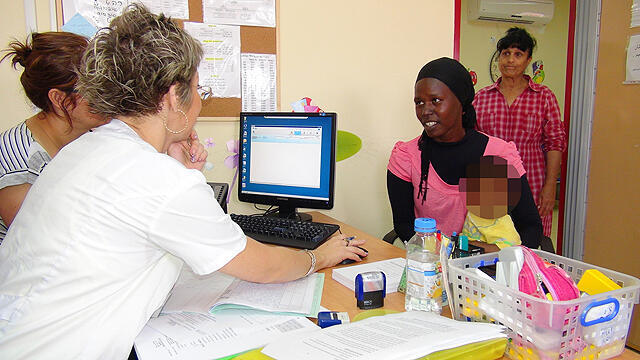
Rahat (Photo: Efraim Barel)
Additionally, Muslim households are larger than Jewish ones. Some 39% of Muslim households are made up of six people or more, compared to only 9% of Jewish households.

Umm al-Fahm (Photo: Hassan Shaalan)
The Muslim population is young: It's made up of a high percentage of children and a lower percentage of elderly. Some 38% of the Muslim population in Israel is aged 0-14 (about 256,000) and only 4% are over 65 (some 50,000).
The data show that the majority of Muslim women do not work. In 2012, work rate among Muslims of 15 and older was 44.5% – 65.2% among men and 23.7% among women. These percentages are significantly lower compared to percentage of working Jewish (64.3%), Christian (48.1%) and Druze (36.7%)women.
63% of Muslim employees work in four major finance branches: 19% in construction, 18% in retail and mechanics, 13% in education and 13% in the industrial branch. CBS data also showed that 38% of employed Muslim women work in education.