

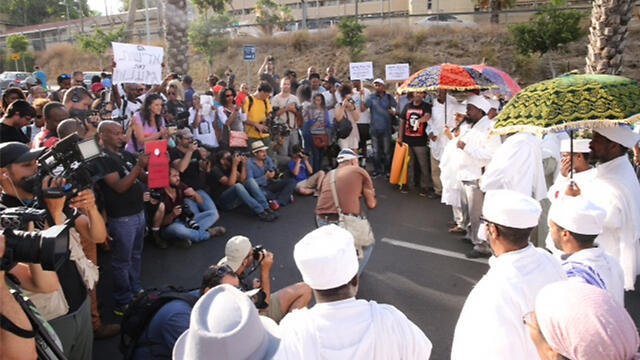
Hundreds of Israeli Ethiopians returned to the streets of Tel Aviv on Monday afternoon to continue their protest against discrimination after the attorney-general decided not to prosecute a police officer documented beating an Ethiopian soldier.
Protesters marched from the Azrieli Center on Kaplan Street, blocking it in both directions and calling out "A violent cop must be locked up!" One protester was arrested after lying on the road and blocking traffic.
8 View gallery

Clashes between police and protesters near Rabin Square (Photo: Motti Kimchi)
(צילום: מוטי קמחי)
As the protests progressed and moved into Rabin Square in the evening hours, violent clashes began erupting and at least 17 protesters were arrested. Protesters were hurling objects, and damage was caused to the Landwercafe near the square.
8 View gallery

Police arrest a protester during the demonstration (Photo: Motti Kimchi)
(צילום: מוטי קמחי)
The Ethiopian community's protest broke out last month after security footage was released showing a police officer beating IDF soldier Damas Pakada, who is of Ethiopian descent. Several large demonstration took place since, the biggest of which was on May 4, when clashes broke out between protesters and police.
8 View gallery

Ethopian Israelis protest against police brutality (Photo:Moti Kimchi)
(צילום: מוטי קמחי)
"The decision to close the investigation (against the police officer) proved that Ethiopians in Israel have no basic human rights," Yaiyo Avraham, one of the protest's organizers, told Ynet. "We will fight for our rights following the cowardly decision of the attorney-general and consider turning to international courts because here we are not getting justice."
8 View gallery

Community members speaking at the protest, with signs behind them that say 'We are the sons of Israel, no one can take that identity from us!' (Photo: John-Michael Kibrick)
(צילום: ג'ון-מייקל קיבריק)
Former Yesh Atid MK Shimon Solomon told Ynet that "Our main problem is that the court is disconnected from our suffering. We need to cry out. We are not new immigrants, this is our country. A country that was established on the ruins of racism, and that is why all of the people of Israel need to cry out with us. We need to say we can no longer keep our heads down and be nice. The court cannot protect the guilty. There isn't one person here who hasn't experienced racism. We need to protest and demand change. We have a responsibility to heal this country of racism."
A joint committee of representatives from the Ethiopian community and the police recommended on Monday to turn 64 criminal cases involving members of the community to rehabilitative cases with the objective of "returning these minors to a normative path."
8 View gallery

Protesters hold sign saying 'Racism in the name of the law' (Photo: Motti Kimchi)
(צילום: מוטי קמחי)
The committee, which was formed by Police Commissioner Yohanan Danino after the beginning of the Ethiopian community's protest, released its findings on Monday. While the committee does include representatives of the community, some of them resigned in protest when the committee started its probe.
The committee examined 300 criminal cases and did not find evidence of discrimination or violations of rights of youths from the Ethiopian community.
8 View gallery

Large police forces look on as protesters block a major road (Photo: Motti Kimchi)
(צילום: מוטי קמחי)
"The committee placed special emphasis on the involvement of teens and youth from the community in its extensive examination of hundreds of cases," the committee's report said.
Among the committee's recommendation was to further clarify procedures and guidelines on handling youth, as well as placing an emphasis in policemen's training on gaps in worldview and language existing between them and some members of the community. To that end, the committee also recommended to assign police officers who speak the Amharic language to all police stations, as well youth investigators who speak Amharic in areas where there is a large presence of the Ethiopian community.
8 View gallery

Protesters hold sign saying 'I got to make a dream of generations come true, but with time I turned into a victim of culture' (Photo: Motti Kimchi)
(צילום: מוטי קמחי)
The committee further recommended providing forms in Amharic and other languages spoken by minorities both at police stations and online so members of these minorities who are not fluent in Hebrew would be able to file a complaint against police officers when the need arises.
Another recommendation called to increase transparency on disciplinary action taken against police officers, by informing the complainants of the findings of the investigation made against those officers.
The report noted that "the committee members expect support from the community and its trust to finish the process."
Police said Monday that these recommendations require additional manpower and finances.
First published: 19:02, 06.22.15