

Supreme Court Chief Justice Esther Hayut announced Sunday that her predecessor Miriam Naor will head a state commission of inquiry into the stampede at Mount Meron on Lag B'Omer that killed 45 people and injured more than 100 others.
The panel investigating the circumstances of the stampede will also include the former mayor of Bnei Brak, Rabbi Mordechai Karelitz, and Maj. Gen. (ret.) Shlomo Yanai.
Gallery
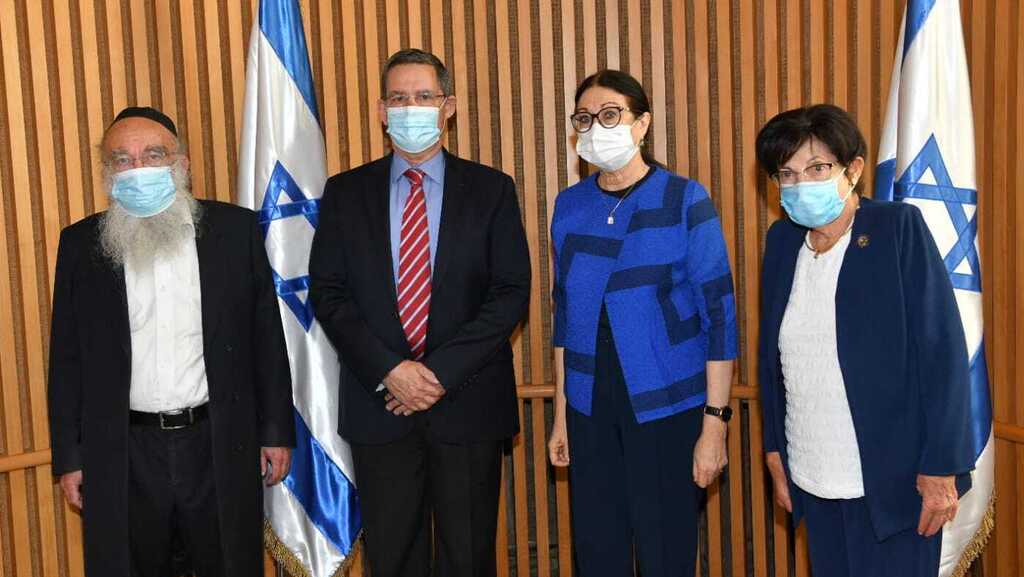
L-R: Rabbi Mordechai Karelitz, Maj. Gen. (ret.) Shlomo Yanai, Supreme Court Chief Justice Esther Hayut and former Supreme Court chief justice Miriam Naor
(Photo: Courtesy)
"The establishment of a state commission of inquiry by an independent body is intended to ensure its independence and the public's trust in its work and conclusions," Hayut said.
The chief justice added that she chose Naor, Karelitz and Yanai specifically "due to the magnitude of the disaster and the sensitivity of the issues that need clarification."
Regarding Naor, who served as chief justice of the Supreme Court from January 2015 to October 2017, Hayut said: “She has vast judicial experience and knowledge. She has served for years in all courts and discussed cases that are among the most complex the state has known."
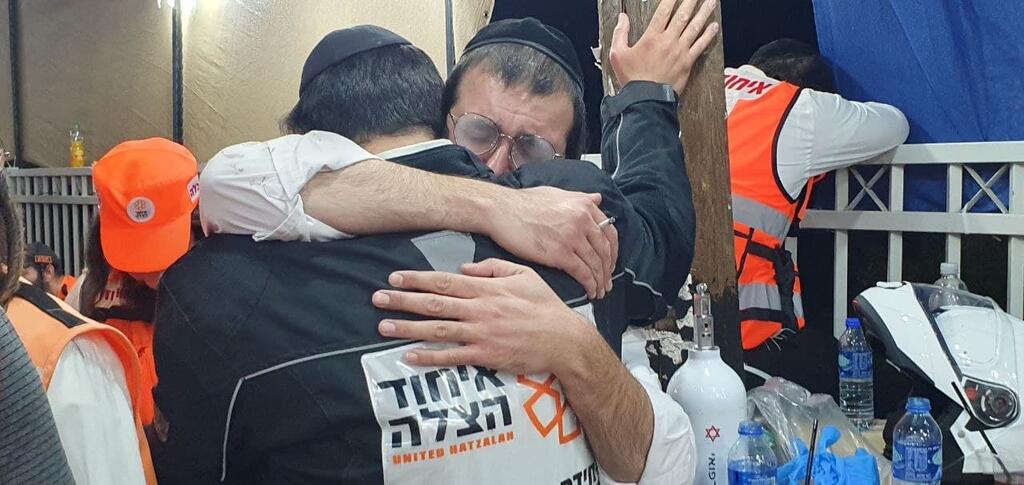
Rescue workers embrace after 45 people died in a stampede on Mount Meron, April 30, 2021
(Photo: Moshe Mizrahi)
Hayut also explained her decision to put Karelitz on the commission, saying he had vast experience in dealing with the ultra-Orthodox community.
"He has extensive knowledge and practical experience in the fields of planning and construction. He previously served as a member of the Tal Committee to formulate the appropriate arrangement regarding the recruitment of yeshiva students to the IDF. He also possesses great knowledge regarding the [Lag Ba'Omer celebrations]."
Hayut added that she chose Yanai, who served as GOC Southern Command and head of the General Staff's Planning Division, due to his vast knowledge in the fields of logistics and planning.
“Since retiring from the IDF, Yanai has been managing leading companies in the economy. He also serves as chairman of the Elem Association that aids at risk youths," said Hayut.
“May this committee whose members are appointed here today work to repair and stabilize both the societal and safety issues. I would like to thank you, the members of the committee, for taking on this complex task, and wish you much success,” said Hayut.
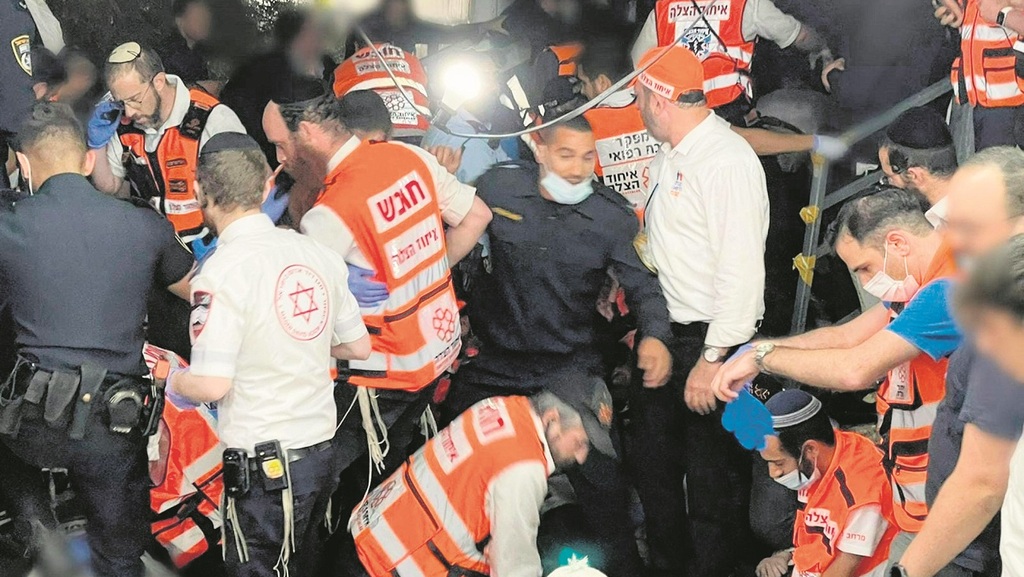
Rescue teams aid victims of the stampede at the Lag B'Omer event on Mount Meron
(Photo: AFP)
The commission of inquiry was approved by Prime Minister Naftali Bennett’s new government during its first cabinet meeting last week, approximately 52 days after the disaster itself took place.
"The government's decision to establish a state commission of inquiry into the disaster, as well as other risks that exist in similar events, proves that this is an issue of vital public importance that needs to be addressed," Hayut said.
"The government's decision also stipulates that the committee will recommend the correct way to hold mass events, especially in places of religious worship, and in particular regarding the necessary changes to the site of the Lag B'Omer celebrations on Mount Meron and its infrastructure.”
The commission will focus on the decision-making process that led to the approval of the event; the conditions under which the event was to be held; professional and legal questions regarding safety at mass events, including those of a religious nature; the locations used for public events, in particular those with large numbers of participants.
Defense Minister Benny Gantz, who pushed for the formation of the commission, welcomed Hayut’s choices for the panel.
"Naor is one of the most senior state and judicial figures in the State of Israel, and I am sure that the committee headed by her will lead to conclusions that will save human lives in the future," Gantz said.
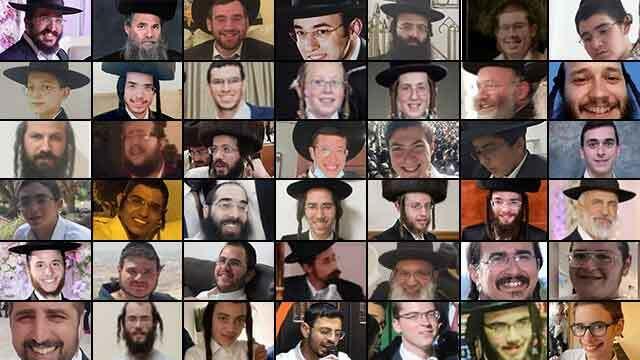
The 45 victims of the Mount Meron disaster
Benjamin Netanyahu, who was prime minister at the time, had promised a thorough investigation, but his cabinet, which included ultra-Orthodox ministers, never took formal action.
Some Israelis have questioned whether the former government and the police were reluctant to limit the crowd size at the site because of pressure from influential ultra-Orthodox religious leaders and politicians.
Powerful ultra-Orthodox lawmakers and lobbyists have been accused of intervening to ensure that there were no limits on crowd size at the event, despite health and safety rules and coronavirus regulations.
The members of the less rigorous investigation would have been appointed by former interior minister Aryeh Deri, the leader of the ultra-Orthodox Shas party, who was responsible for the administration of the site in particular during the annual Lag B'Omer celebrations.