

Turkish authorities have detained more than 200 people in a sweeping investigation into an alleged international investment fraud network that prosecutors say operated from Turkey and defrauded victims around the world of more than $3 billion.
The Istanbul Chief Public Prosecutor’s Office said the network operated through companies posing as call centers, consulting firms and tourism businesses. Turkish authorities allege that Israeli-linked figures dominated the companies’ ownership and ultimate beneficiary structures, describing some of those behind the operation as “Israeli fraud barons.”
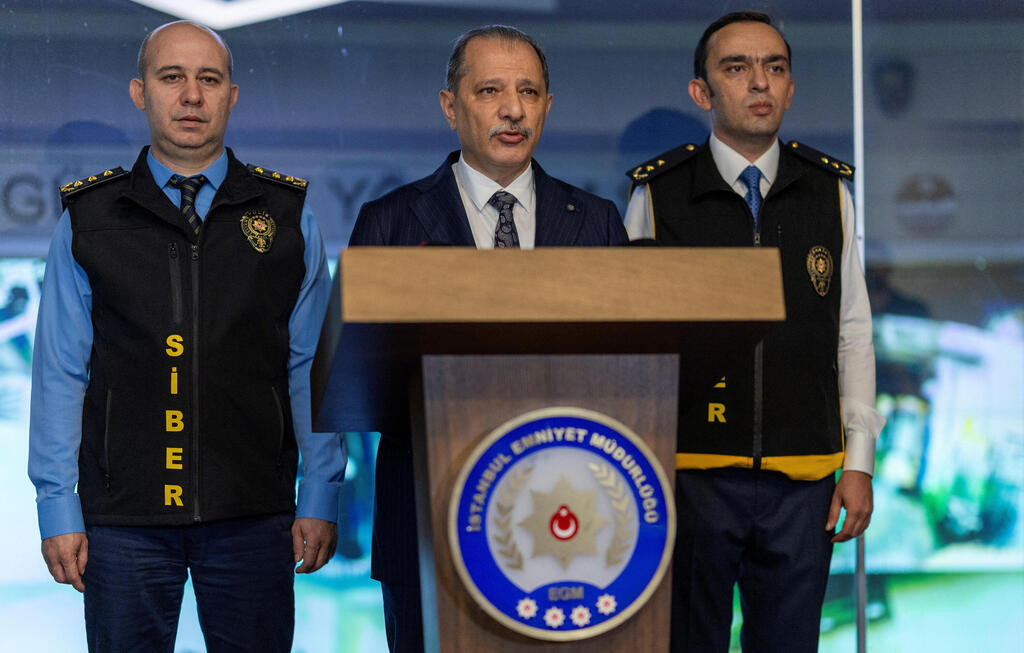
Istanbul police chief announces sweeping arrest operation yesterday
(Photo: REUTERS/Umit Bektas)
As of Saturday, 201 people had been detained in the investigation, including nine Israeli citizens, according to Turkish reports. One of the Israelis reportedly also holds a Portuguese passport. The investigation involves 248 suspects, with authorities continuing efforts to locate those still at large.
Turkey’s Justice Minister Akın Gürlek announced the operation on Friday. It was carried out by the Interior Ministry, Turkey’s National Intelligence Organization, known as MIT, the Financial Crimes Investigation Board, or MASAK, Istanbul police and Interpol.
According to Turkish prosecutors, the network operated through 29 companies and 44 call centers that presented themselves as legitimate businesses offering consulting, tourism and customer services.
Potential victims were allegedly recruited through advertisements on social media, search engines and websites promising high returns from foreign currency and cryptocurrency investments.
People who responded were connected with representatives who spoke their native language and initially persuaded them to deposit relatively small amounts of money, prosecutors said. They were then shown fictitious profits on trading platforms controlled by the network and encouraged to invest increasingly large sums.
When investors attempted to withdraw their money, they were allegedly told their accounts had been “blocked” and that additional payments, described as taxes or fees to remove the restriction, were required before their funds could be released.
In reality, Turkish authorities allege, the money was never invested and was instead transferred to bank accounts and cryptocurrency wallets controlled by the network outside Turkey. Prosecutors also allege that those running the operation explicitly instructed employees not to defraud Israeli or American citizens.
Among the countries whose citizens were described as major targets were the United Arab Emirates, Britain, Canada, Australia, Ireland, Russia, Singapore, Malaysia, China, Switzerland, Belgium, Sweden and South Korea.
According to findings by MIT cited by Turkish prosecutors, Israeli figures behind the operation began moving their activities to Turkey and other countries after Israel outlawed the binary-options industry in 2017.
Turkish authorities said investigators raided 286 addresses in Istanbul and the southwestern province of Muğla as part of the operation.
Real estate, vehicles, bank accounts and cryptocurrency assets suspected of being linked to the proceeds of crime were seized or frozen. The Interior Ministry said assets worth approximately 1.5 billion Turkish liras, about $31 million, were targeted, including 80 vehicles and 12 properties.
Authorities have not released a comprehensive official breakdown of the suspects’ identities. Turkish reports, however, said 156 of those detained were Turkish citizens and 45 were foreign nationals.
The foreign detainees reportedly include nine Israelis and 11 Pakistanis; two citizens each from Azerbaijan, Syria, Jordan, Ukraine, Thailand, Indonesia and Morocco; and one each from Kazakhstan, the Philippines, Iran, China, Lebanon, the Palestinian territories, Mexico, Egypt, Mozambique, Argentina and Bangladesh.
The nationality figures are based on Turkish reporting and have not been independently confirmed. Turkish authorities have also not publicly identified the Israeli-linked figures they allege controlled the companies or clarified whether those individuals are among the detainees.
Both Gürlek’s initial announcement and subsequent statements by Turkish prosecutors focused on what investigators described as the network’s ownership and ultimate beneficiary structure, saying figures with links to Israel played a dominant role in the companies behind the alleged scheme.