


The IDF said some of the incoming missiles may be equipped with cluster munitions — warheads designed to disperse multiple smaller explosives over a wide area — raising concerns about expanded blast zones and unexploded ordnance. The Home Front Command stressed that residents must remain in protected spaces until receiving explicit instructions to leave.
Under updated emergency guidelines, gatherings are prohibited, schools are closed until further notice and only essential workplaces may operate. The restrictions are in effect through 8 p.m. Saturday, March 7. All Purim celebrations have been canceled as a result.
Documentation of a strike in Tehran at the start of the attack
(Video: Sabereen)



Beginning at 8 a.m. Saturday, the Home Front Command shifted the entire country from full activity to what it defined as essential activity only, banning educational activities, public gatherings and nonessential work.
The Home Front Command outlined a three-stage civilian alert system, similar to the one used during the 12-Day War in June:
Preliminary alert: A loud cellphone notification based on location, warning of a missile barrage about 10 minutes before impact.
Siren alert: Standard air raid sirens sounding about 90 seconds before missiles are expected to arrive.
All-clear notice: A cellphone message instructing residents when it is safe to leave protected spaces.
Authorities also reiterated the order of priority for selecting a protected space:
Reinforced security room (mamad), floor-level protected space (mamak) or institutional protected space (mamad institutioni): These are fortified rooms built to Israeli safety standards. Residents should shut and lock the door, turn the handle 90 degrees and ensure both the external steel window and internal glass window are closed. Sliding glass panes should be removed in advance and placed outside the room until the emergency ends.
Shelter: A shared building shelter, if reachable within the available warning time, or at any time if accessible through an internal, windowless stairwell. A public shelter may also be used if it can be reached in time.
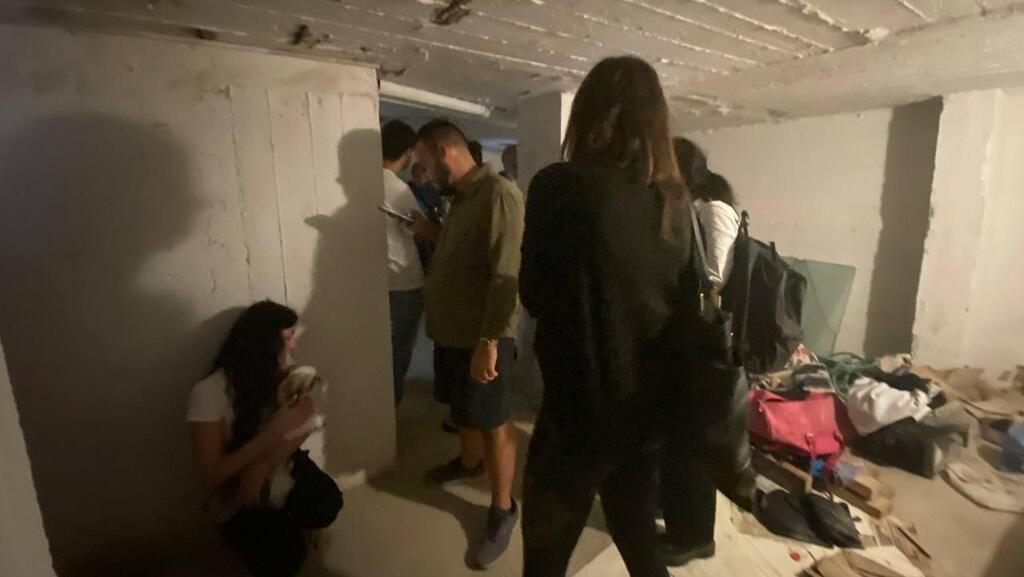
(Photo: Gilad Carmeli)
If none of these options is available, residents should choose an interior stairwell without windows or exterior walls and stand in the middle, avoiding the top and bottom floors. As a last resort, they should select an interior room surrounded by as many walls as possible and with minimal windows or openings, avoiding areas with ceramic tiles, porcelain or glass that could shatter.
During an alert, residents should sit against an interior wall, below the window line and not facing a door, due to the risk of blast waves and shrapnel. Entryways to buildings should not be used because of the danger from nearby impacts.
Officials emphasized that the innermost room in a home offers greater protection from blast effects and fragments because it is shielded by surrounding walls and rooms. Residents in reinforced security rooms must keep the steel and glass windows sealed until the emergency situation ends.