


The Knesset gave final approval Monday evening to the Basic Law: Torah Study, passing the softened measure in its second and third readings by a vote of 63-52.
Prime Minister Benjamin Netanyahu did not attend the vote, marking another absence from a controversial coalition ballot. He also skipped the first reading of legislation concerning a politically appointed inquiry into the October 7 massacre.
Gallery

Prime Minister Benjamin Netanyahu did not attend the vote, marking another absence from a controversial coalition ballot
(Photo: Yair Sagi, Reuven Castro, Amit Shabi, AFP, Alex Kolomoisky, Yoav Dudkevitch, AP)
Two members of Netanyahu’s Likud party, Yuli Edelstein and Dan Illouz, voted against the measure.
The law could help ultra-Orthodox parties defend a future military draft exemption before the High Court of Justice. At the request of Haredi lawmakers, it became the first bill to receive final approval under a coalition deal previously revealed by ynet.
The original draft stated that the value of Torah study should be balanced against other values. However, after the Knesset’s legal advisers warned that such wording could lead to benefits for Torah students similar to those granted to IDF service members, the text was amended.
Under the final version, Torah study is enshrined as a fundamental value, without explicitly stating that it should be weighed against competing principles.
Even in its softened form, however, the law is expected to serve as a counterweight to equality and other principles derived from the Basic Law: Human Dignity and Liberty. That is a central objective of the Haredi parties, which hope to use the measure against legal claims that draft exemptions discriminate between Torah students and those required to serve.
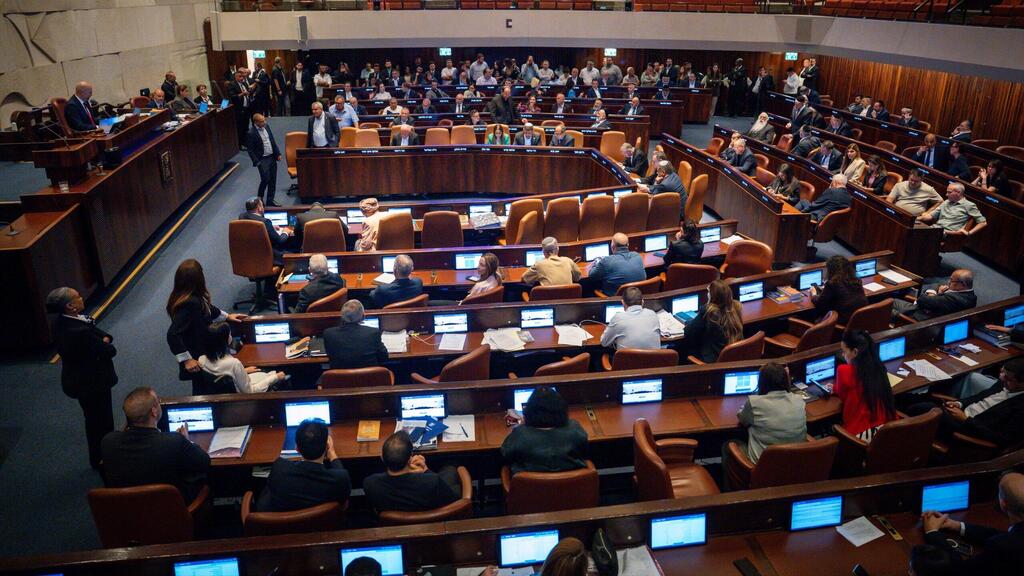
The Knesset
(Photo: Shalev Shalom )
Earlier Monday, IDF Chief of Staff Lt. Gen. Eyal Zamir sent an unusual letter to Netanyahu, Defense Minister Israel Katz and Foreign Affairs and Defense Committee chairman Boaz Bismuth.
Zamir asked them to remove a provision from separate legislation freezing the arrest of draft evaders. That clause would require the IDF to determine who qualifies as a yeshiva student and is therefore entitled to a suspension of enforcement proceedings.
The chief of staff warned that freezing arrests, investigations and criminal proceedings would send the message that those who fail to report for military service will face no consequences.
“It provides an incentive not to report for military service, since it would grant immunity from prosecution and criminal proceedings,” Zamir wrote. “The proposal is therefore clearly and unequivocally inconsistent with the IDF’s needs.”
Before the vote, opposition party leaders issued a joint statement urging coalition lawmakers to reject the legislation.
“We, the undersigned party leaders, call on coalition members to act responsibly and not vote for a severe blow to the IDF during wartime and in defiance of the chief of staff’s dramatic warning,” they said.
“The list of shame of those supporting the evasion law will remain forever before the eyes of Israel’s citizens who serve and work.”
The statement was signed by opposition leader Yair Lapid, Yashar chairman Gadi Eisenkot, Beyachad chairman Naftali Bennett, Yisrael Beytenu chairman Avigdor Liberman, Democrats chairman Yair Golan, Chili Tropper and the Reservists party led by Yoaz Hendel.
Shas chairman Aryeh Deri rejected the opposition’s criticism, saying the law preventing the arrest of Torah students would not harm the IDF.
“The joint statement by opposition leaders against the law preventing the arrest of Torah students, a law that does not harm the IDF at all, has one purpose: to thwart the law splitting the attorney general’s role and preserve the power of the judicial junta,” Deri said.
His remarks were widely understood as a warning to coalition partners that if they failed to support the Torah study legislation, Shas could withhold support from other bills sought by the government.
Under the coalition agreement, the Haredi parties abandoned efforts to pass a daycare subsidy law during the current Knesset term. In return, they are expected to secure passage of the Torah study Basic Law, legislation preventing the arrest of draft evaders and a kosher certification law.
The Haredi factions, for their part, will support legislation splitting the attorney general’s position, which is expected to advance through its second and third readings. They will also back the first reading of a bill establishing a political commission of inquiry into the October 7 massacre.