

During a pause in late-night meetings with President Donald Trump’s senior advisers Steve Witkoff and Jared Kushner, Prime Minister Benjamin Netanyahu also met overnight (Sunday to Monday) with a delegation from the Yesha Council that flew to the United States after Trump said he would not allow Israel to annex parts of Judea and Samaria — a statement that shattered their hopes for a historic announcement from Washington.
The meeting had been scheduled for 8:30 p.m. New York time (3:30 a.m. Israel time) but was delayed as talks with the Americans on a deal to end the war in Gaza continued. Before meeting Netanyahu, the Yesha delegation met with New York Consul General Ophir Akunis. Participants in the meeting with the prime minister included Yesha Council chairman Yisrael Gantz and Samaria Regional Council head Yossi Dagan.
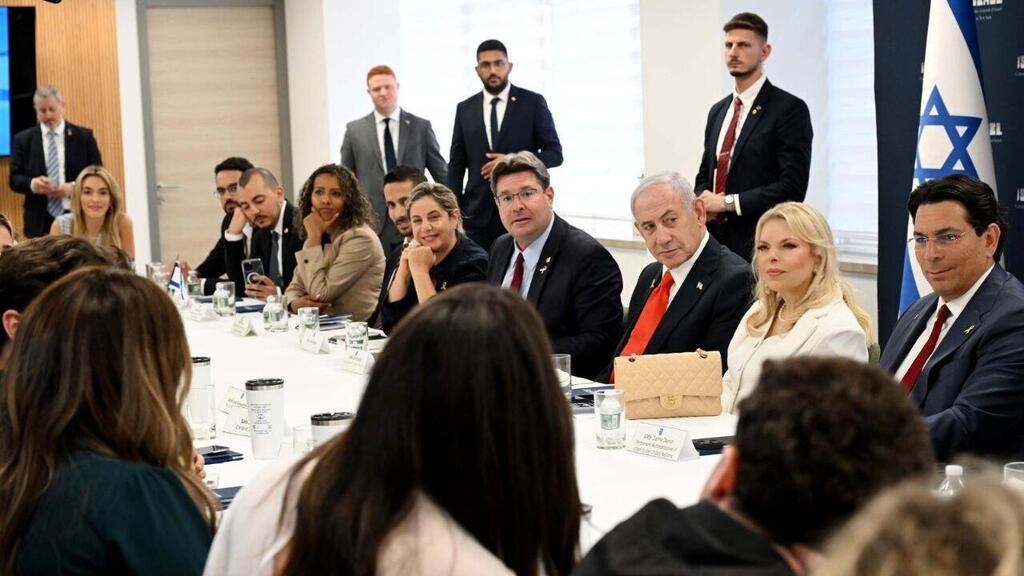
Prime Minister Benjamin Netanyahu had his wife, Sara, meet with representatives of the YESHA council in New York
(Photo: Avi Ohayon/GPO)
The discussion lasted about two hours. Netanyahu told them he would “raise the issue of sovereignty with the president,” but stressed that “we must navigate a complex reality.” He said: “There is a sympathetic president; remember the Obama era when he said we would not build even one brick.” The settlement leaders told Netanyahu the moment was a “one-time opportunity” to apply sovereignty, partly in reaction to French President Emmanuel Macron’s initiative to recognize a Palestinian state and the support that has followed. They also said some left-leaning local leaders privately told them they back measures to “surround Samaria,” but would not say so publicly.
Sara Netanyahu, the prime minister’s wife, also attended the meeting.
Yesha leaders asked Netanyahu to tell Trump that “sovereignty must be applied.” Netanyahu said he would find a way to express that “Judea and Samaria are part of the Land of Israel.” Participants said Yesha officials left “very disturbed” that Netanyahu did not set a timetable for when sovereignty would be applied. Another attendee said “the matter is very complicated,” adding: “We came to breathe new life into the move after the heartache Trump caused.”
After the meeting, Kedumim Regional Council head Uziel Vatik said he was verbally attacked with antisemitic slurs by an American woman on a New York street. According to the council’s statement, Vatik was briefed on details of the terror attack that occurred near his community when the woman noticed him and shouted anti-Israeli slurs. The Israeli consulate in New York was notified.
'Expect Netanyahu to apply sovereignty'
Yossi Dagan, head of the Samaria Regional Council and a participant in the meeting, told Ynet’s studio Monday morning that “Netanyahu listened and the meeting was substantive, but we left troubled despite the open discussion. In the end the prime minister did not say when sovereignty would come.”
He said: “This government could be the one that signs on to the creation of a Palestinian state. That is Macron’s goal and that of others; they are trying to pressure against sovereignty. A Palestinian state in Judea and Samaria is like October 7 all over again. Neither Hamas nor the Palestinian Authority hide their support for the massacre. The prime minister can apply sovereignty; that is what we expect of him. He is a historic leader and knows there are moments in a nation’s life when the leader must do what saves the nation.
“I hope this is not an attempt to string us along. We agreed we might meet again later. We did not come to meet Trump but to meet Netanyahu. He and his government can apply sovereignty. The one who will decide is Netanyahu, not the United States. Trump loves Israel, he is a miracle for Israel, but even among friends there can be disagreements. The ball is in Jerusalem's court.”
Was the hope dashed?
On Thursday the U.S. president told reporters in the Oval Office that he would not allow Israel to annex Judea and Samaria. “I will not let Israel annex the West Bank. I will not let it. It’s not going to happen,” he said after speaking with Netanyahu and after a meeting with Turkish President Recep Tayyip Erdogan. “Whether I spoke with Bibi or not — I did — but I will not allow Israel to annex the West Bank. That’s enough. It’s time to stop now,” he said.
Trump: 'I won't let Israel annex Judea and Samaria'
(Video: Reuters)


Trump’s victory in the U.S. presidential election last November had raised hopes among settlement leaders that the returning president would advance annexation of West Bank territory. Yesha Council chairman Israel Gantz tweeted at the time: “One strong Trump - One Jewish state.” The leadership has strengthened ties in recent years with figures in the U.S. Republican Party, some of whom had close relations with the first Trump administration, and they believed his return to the White House would realize the aim of annexing parts of the West Bank.
The settlers’ leadership wants — and still seeks — to legalize outposts, expand existing settlements and advance stalled construction permits, remove sanctions on settlers, initiate sovereignty steps and even “take territory” toward establishing outposts in the northern Gaza Strip amid the ongoing war.
The current U.S. administration, unlike its predecessors, has at times expressed support for annexation. After Trump’s election and before he took office, U.S. Ambassador to Israel Mike Huckabee said he “would regularly visit Judea and Samaria, and I believe Israeli citizens deserve a safe country. Anything I can do to help achieve that would be a great honor.” He added then that “Trump sets policy and I will act accordingly,” and last month he told The Washington Post that “October 7 changed everything” and that “annexation would be Israel’s decision.”
Efforts to advance annexation have continued since Trump’s return to the White House, and as the fighting in Gaza deepened and Israel faced a diplomatic tsunami including an international isolation that brought waves of recognition for a Palestinian state, settlement leaders urged Netanyahu to apply sovereignty in the West Bank.
Meanwhile, several Likud Knesset members expressed support for the Yesha “emergency delegation” and sent Netanyahu a letter saying: “In the name of the people of Israel for generations, do not yield to international pressures. Stand firm against demands for dangerous concessions. Make the historic decision required — apply full Israeli sovereignty over all the lands of Judea and Samaria. Sovereignty over the Land of Israel is not a political matter but the historic and exclusive right of the people of Israel to their land. This is our duty to previous generations.” The letter was signed by Knesset members Yuli Edelstein, Amit Halevi, Dan Illouz, Boaz Bismuth, Moshe Saada, Sasson Guetta, Eti Attia, Galit Distel and Eliyahu Revivo.