

A blunt social media post by social activist Hila Tov sparked a major uproar over the weekend and reflected fears among some secular Tel Aviv residents of a possible “religious takeover” of the city.
Alongside a photo of two national-religious men wearing kippahs, one of them carrying a rifle, Tov wrote: “In a troubling and repulsive way, Tel Aviv is being conquered by kippah-wearers with weapons, and by women wearing bobo-style head coverings. And don’t start with ‘Israel is a place for everyone’ — because it isn’t. Look at what is happening in Arad, for example. The takeover of Tel Aviv is deliberate and systematic. If not to stick a finger in the eye, why choose to settle specifically in the heart of secularism?”
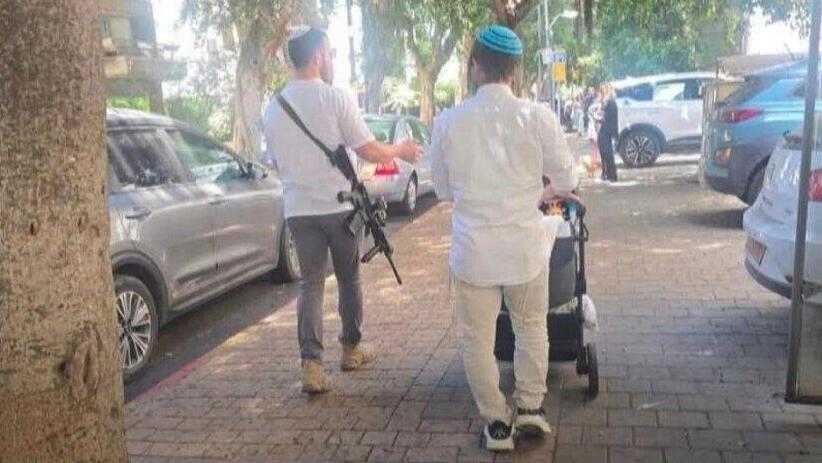
Many users accused Tov of spreading hatred and even self-antisemitism. Despite the harsh responses, Tov has stood by her remarks and did not retract them.
Asked about the source of her opposition to two random people photographed in the street — at least one of whom appears to be protecting Israeli civilians as part of his military service — Tov told the ynet studio: “These two people are, of course, a symbol. This is a struggle over the public space, and these two people were photographed from behind in the public space only as a symbol. It is not about these two specific people. Ultimately, there is a struggle here. Political and public.”
Meir Dizengoff, Tel Aviv’s first mayor, supported preserving the character of Shabbat and acted against public Sabbath desecration. Today, there is public transportation on Shabbat, everything is open on Shabbat, and there does not appear to be any intention to end that.
“Yes, no intention? No intention to end it?” Tov said. “Look, in this country, Bibi’s government funds Torah organizations with 170 million shekels a year, 12 of which operate in Tel Aviv. I have no problem with religious people, I have no problem with kippah-wearers. My problem is with the trend, with the political project being carried out on our backs, with a smile and under the guise of democracy and the idea that everyone is allowed to be wherever they want.”
And is that not true? Is it democracy only when it suits us?
“No, absolutely not. On the contrary. There are wonderful people here, including religious neighbors of mine, and I have nothing against them. Let every man and woman do whatever they want in their private space. Ultimately, what are we fighting for? We are fighting for the status of women in Israel and in Tel Aviv, because they are trying to drag us into gender segregation. We are fighting for public transportation on Shabbat, because they are trying to prevent it. We are fighting over life-cycle ceremonies, the status of the LGBTQ community, the character of Shabbat and education. Near my home there is a Chabad yeshiva. The 12-year-old children there go out and offer their friends, children their own age, to put on tefillin. They simply walk around the streets and offer people to put on tefillin.”
What is the great drama in a Jew putting on tefillin?
“There is no great drama, but it cannot be done as a political project. If a boy or young man, any person who wants to — woman or man — wants to put on tefillin, I have no problem with that.”
If these were two young men with Arab Muslim symbols, would you post a picture and warn about a takeover of the public space, or does that apply only to Jews?
“I am not familiar with the motivation of a Muslim organization in Tel Aviv that wants to take over the public space. I am familiar with (the Orthodox Jewish outreach organization) Rosh Yehudi and its friends, who say: Anyone who wants support for activity in Hebron and the West Bank must settle in Tel Aviv. That is the central motivation. That is what we are talking about.”
So you are saying Rosh Yehudi is more dangerous than Muslim movements?
“Certainly. I don’t know what ‘Muslim movements’ means, and I reject that definition. I also don’t say ‘Jewish movements.’ I say political Jewish projects of religious Zionism.”
Rosh Yehudi chairman Israel Zeira said in response: “Rosh Yehudi works with educated young men and women from age 19 and up on Torah study and deepening Jewish identity in a free and profound way, without a drop of coercion and out of free choice. The lectures require payment. It is sad that there are those for whom any connection to Torah arouses imaginary fears and false anxieties about exclusion from the public space. Tel Aviv will continue to be a city of freedom and will also find a warm place within it for those — and there are many — who thirst to study Torah, those who did not have the privilege of learning in childhood and are now closing the gaps. Ms. Tov’s liberalism ends when it comes to her brothers among the people — and in arms. After the Simchat Torah War, we should all adopt more love of Israel and release the hatred that mainly comes from lack of familiarity. This evening, for example, I am holding a meeting with David Schocken at Rosh Yehudi for a unifying conversation. Until we receive the millions she talks about, Rosh Yehudi lives on donations.”
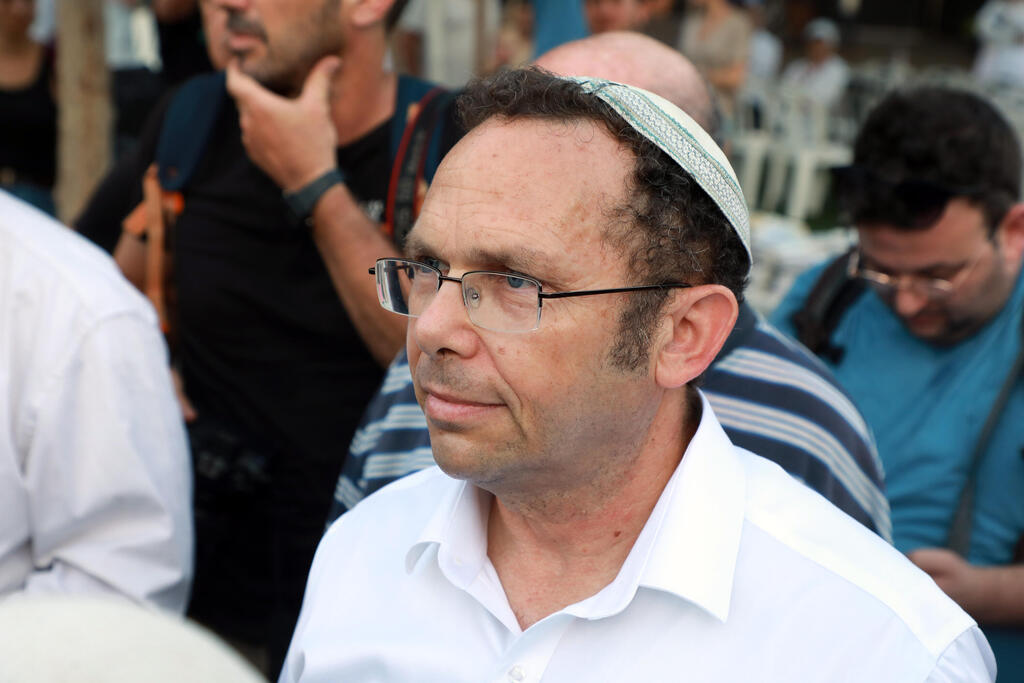
Israel Zeira, chairman of the Rosh Yehudi organization
(Photo: Dana Koppel)
'There have always been religious communities in the city'
Tel Aviv Deputy Mayor Haim Goren, chairman of the Ma’aminim faction and who wears a knitted kippah, responded to the controversial post: “Unfortunately, such religion-phobic outbursts are something I encounter in the city from time to time. Fortunately, it comes from a minority, from very few people who for some reason really find it difficult to see religious people in the city. I will remind you: A large share of the founders of the first Hebrew city were religious, and my children are fourth-generation Tel Avivians.”
Goren added: “There have always been religious communities here in the city. To go after someone specifically because he has a weapon? This morning I went out into the street and met a friend of mine, a religious man who lives near me. He walks around with a grenade launcher, a very heavy weapon for those familiar with it. It is not because he wants to walk around with a weapon in the heart of Tel Aviv. It is because he is in the reserves. He is about to enter Lebanon, at 43 with four children, and what can you do when army orders say such a weapon cannot be left at home without a special safe, which most people do not have. These are people who ultimately do reserve duty even at older ages, with children and everything. Even the reference to people’s external appearance is so old-fashioned, so unnecessary, so un-Tel Avivian.”
Regarding claims of a takeover of public space, Goren said: “Ultimately, what does ‘taking over public space’ mean? The public space in Tel Aviv-Jaffa has actually crossed the status quo in recent years in a very secular direction. Let’s remember that in recent years the supermarkets law passed, which in effect permitted for the first time the opening of businesses on Shabbat. The whole issue of Naim Busofash — the Tel Aviv municipality’s public transportation system, with buses on Saturdays and holidays — also passed. Other municipalities operate it too, and it keeps growing. The Pride Parade became Pride Month, with many events around it. Tel Aviv’s public space is very, very pluralistic and enabling. To say that it is undergoing some hostile takeover by religious people is simply not to understand or know Tel Aviv.”

Tel Aviv municipality’s public transportation system operates buses on Saturdays and holidays
(Photo: Courtesy of the Tel Aviv Municipality)
“It disappoints me,” he added. “I have one of Hila’s books at home. I like reading, and it is truly disappointing to see people who are fearful. Just as there are Haredim in Bnei Brak who believe that if they go to the army, God forbid they will become secular, there are Tel Aviv Haredim for whom seeing kippah-wearers walking around the city means that’s it — the city has become religious, the story is over and there is no place for us.”
On gender segregation, Goren said: “If Hila lives in Tel Aviv, she knows very well that there is no segregation in the city’s public space, except for something the High Court approved once in an exceptional case — a Yom Kippur prayer service — and even that was not done in an exclusionary way, but in a way that gave completely equal space to women alongside men, and I think it was done beautifully and respectfully. The fact is that it passed smoothly, and many people came, including completely secular Tel Avivians who supported it. If Hila opposes one political project or another, let her oppose the political project; she should not post pictures of people, of human beings, turn them into a symbol and say ‘they are not wanted here, they are not OK, there is no place for them here.’ Because that is what she wrote, that they have no place, without knowing who these people are. Address the issue itself. You oppose the State of Israel giving funding to one thing or another? Fine, say that. I also oppose many other things, but not like this, not in a way that explicitly tries to exclude religious people from the city.”
Tov responded sarcastically: “I understand that you have taken the practices you are trying to insert into public education and are now using them to educate me. I will consider this education. Thank you.”