

For many prospective olim, one of the biggest questions is not where they will live but whether the careers they spent years building abroad will translate to Israel.
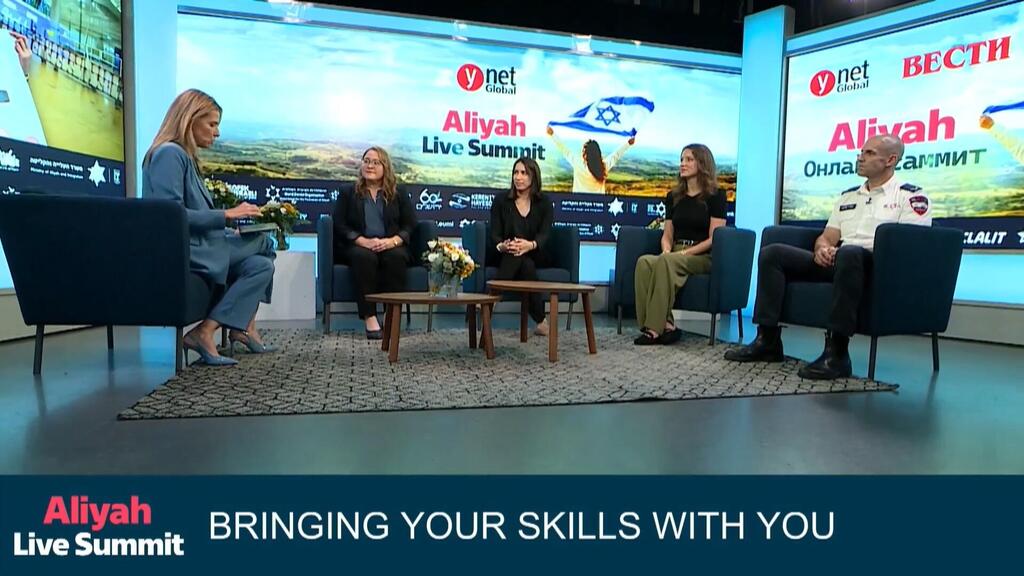
At ynet Global’s Aliyah Live Summit, representatives of the Aliyah and Integration Ministry, professional networks and Magen David Adom joined recent immigrant Melissa Buccino to discuss how newcomers can turn overseas experience into careers — and why finding the right professional network can be just as important as having the right résumé.
Bringing your skill with you panel
(Video: Lior Sharon, Tal Azulay, Tal Saar)


Buccino, who made aliyah from the United States in March 2025, said she knew she wanted to enter Israel’s competitive high-tech sector but worried that she lacked the connections Israelis often develop through school, university and military service.
“I didn’t grow up here. I didn’t do the army here. I didn’t go to university here,” she said. “All of those natural places that you might go to try to find some resources, some people to connect you, just weren’t available to me.”
Rinat Shafran, deputy director general for Growth and Development at the Aliyah and Integration Ministry, said that concern is common.
From CV to community: How olim can build careers in Israel
Beyond understanding Israeli bureaucracy, olim frequently worry about professional licensing, networking and the timing of their job search.
“Israel is a very network-based market,” Shafran said. “People know each other. It’s a very small country. Olim obviously don’t have that.”
Start the job search before aliyah
One of the ministry’s main goals, Shafran said, is to move more of the employment process to the period before immigrants arrive.
That includes allowing prospective olim to upload their résumés to the ministry’s Aliyah Job platform, bringing Israeli employers to aliyah fairs overseas and, in some professions, enabling candidates to begin licensing procedures or take exams before moving.
There is often a practical mismatch, she noted: olim want to secure employment before relocating, while Israeli employers frequently want candidates who can begin work immediately.
“We really ask people to start as early as possible,” Shafran said.
The ministry also plans to bring major public- and private-sector employers to aliyah fairs in Paris and London to meet candidates whose skills are in demand in Israel.
Shajar Epsztein of Nevo network said newcomers often arrive with substantial professional experience but without the local context needed to understand where those skills fit.
“You can come with 10 years of experience, but you don’t know what industry is right for you or where to find it,” she said.
Professional communities can shorten that learning curve by connecting olim with Israelis and other immigrants who have already navigated the system.
‘You need to talk to people’
For Buccino, personal connections ultimately became the key to finding her footing.
She attended networking events, relied on other olim and asked Israeli friends for introductions and advice.
“Applying on LinkedIn just is not the way to do it,” she said. “You have to call people, email people, talk to people.”
At first, she worried that repeatedly reaching out might come across as intrusive. Her Israeli contacts told her otherwise.
“That’s the way it works,” she said. “You’ve got to get your email in their inbox. You’ve got to be in front of them.”
She also found Israeli workplace culture less divided between the professional and personal than she had been accustomed to.
“Everybody wants you to bring your real, authentic self,” she said.
Volunteering as a route into Israeli life
Not every skill has to enter Israeli society through paid employment.
Uri Shaham of Magen David Adom said volunteering can give olim both practical skills and a direct route into Israeli society.
“Being a volunteer in Magen David Adom is actually being involved in the Israeli experience, in the Israeli culture,” he said.
With tens of thousands of volunteers from across Israeli society, MDA can expose newcomers to people and communities they might otherwise never meet.
“It’s the best integration into Israeli society,” Shaham said.
Shafran agreed that volunteering can play a significant role in absorption because employment and volunteering both create a sense of belonging.
“It’s the manner of feeling part of something, involved in something,” she said.
Continue your career — or reinvent it?
The panelists also addressed a question many olim face: should they insist on continuing the career they had abroad, or treat aliyah as an opportunity to start again?
Buccino suggested a middle ground.
“You can absolutely bring the skills that you have and also be flexible and keep an open mind,” she said.
Her own goal was to work in marketing within high-tech, but she remained flexible about which part of the technology sector she would enter.
Shafran said many immigrants fear that moving to Israel will force them to restart their careers from zero, but that is not necessarily the case. Israel also needs expertise that is scarce locally, she said, pointing to infrastructure fields where professionals trained abroad can bring knowledge unavailable in Israeli universities.
“Israel, especially at this point, offers both a mission and opportunities,” she said.
For some, however, aliyah can also become an opportunity to pursue an entirely different professional path.
“We see that a lot,” Shafran said. “It’s an opportunity to become a new you also in the professional field.”
The challenge, Epsztein added, is not simply finding any job.
“I would not ask, ‘What are my opportunities as an oleh?’” he said. “I would ask, ‘Where can I contribute?’”
The panel closed by asking what every oleh should bring to Israel besides a résumé.
Shafran chose faith, Epsztein curiosity, Buccino an open mind and Shaham aspirations.
“Some of the most fun and interesting things that have happened to me since I got here were not things that I had planned,” Buccino said. “I kept an open mind.”
First published: 18:35, 09.08.26