

French President Emmanuel Macron on Saturday declared July 12 a French day of national commemoration for Alfred Dreyfus, the French army captain wrongly convicted of treason in 1894 due to overt antisemitism.
“From now on, there will be a commemoration ceremony every July 12 for Dreyfus, for the victory of justice and the truth against hatred and antisemitism,” Macron said in a statement published by his office.
The first such day would be celebrated in 2026, the 120th anniversary of France’s highest appeals court recognizing Dreyfus’s innocence, Macron said.

On July 12, 1906, the French Court of Appeal declared Dreyfus innocent, and next year will mark the 120th anniversary of that ruling. July 12 is also the date that Dreyfus died in 1935 at the age of 76.
In his statement, Macron said France must be vigilant about the problem of antisemitism. The announcement of Dreyfus Day comes at a time of growing concern about hate crimes against Jews in France, the country with the largest Jewish community in Europe.
Anne-Cecile Levy, a great granddaughter, told AFP that creating a commemoration day would help young people to remember the chapter in French history.
“I’m very happy that we’re finally rehabilitating the memory of this great man who was a hero and not a victim, or at least a heroic victim,” Levy said.

Alfred Dreyfus was a captain in the French Army
(Photo: AFP)
Michel Dreyfus, a great grandson, said that Dreyfus was “a hero by fighting to regain his honour and even just by surviving the terrible ordeal he endured.”
“It is also the rule of law that we are celebrating, and that is important at this time because it is being challenged in several countries,” he said.
Last month, the French parliament approved the posthumous promotion of Dreyfus to the rank of brigadier general. The French embassy in Israel said of the decision: "The French nation is imbued with justice and does not forget, and it is promoting Alfred Dreyfus to the rank of brigadier general posthumously. To right a wrong. To pay tribute to a warrior. To emphasize that the anti-Semitism of yesterday, as of today, has no and will never have a place in the Republic."
Get the Ynetnews app on your smartphone: Google Play: https://bit.ly/4eJ37pE | Apple App Store: https://bit.ly/3ZL7iNv
Dreyfus was born in 1859 to a wealthy assimilated family, and after studying at the prestigious Polytechnic School, he enlisted in the army. In 1892, he received the rank of captain and was assigned to the General Staff. At the time, he was the only Jew there. In 1894, French intelligence obtained a document sent by a French officer to a member of the German embassy in Paris, and suspicion fell on Dreyfus, who was court-martialed.
In December 1894, Dreyfus was convicted of treason, and a month later he was sentenced to be stripped of his rank and sentenced to life imprisonment on the "Isle of Devils" in French Guiana. The trial itself was not properly conducted, and no real evidence of his guilt was presented, but antisemitic elements in the army and the general public incited public opinion against him.
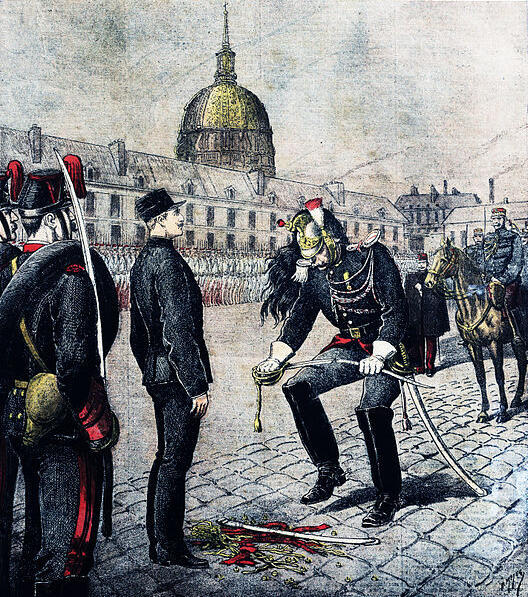
The public Order of Dishonor on January 5, 1895, in which the ranks were torn from Dreyfus' uniform and his sword was broken
(Photo: Wikipedia)
In January 1898, the writer Émile Zola published a public letter entitled "J'accuse," in which he denounced the slander against Dreyfus. The affair continued to resonate around the world and heated controversy erupted in France, which was divided into two camps: for and against Dreyfus. In the summer of that year, after evidence was uncovered proving his innocence, the verdict was overturned, and in September 1899 Dreyfus was brought to a retrial.
The army officers repeated their arguments and the court found Dreyfus guilty, but sentenced him to only 10 years in prison. The controversy continued, and in 1906 the Court of Appeals ruled that the evidence against Dreyfus was baseless. He was reinstated in the army with the rank of major, served in World War I, and, as mentioned, died in 1935.

Alfred Dreyfus on trial
(Photo: Getty Images)
The public outcry that the affair aroused, and especially its antisemitic roots, shifted the discussion to the broader plane of solving the 'Jewish problem.' Benjamin Ze'ev Herzl, who was an Austrian journalist at the time of the trial and covered the trial, conceived the idea of Zionism from his experiences at the time. He was particularly shocked by the antisemitic hateful cries that accompanied the public "Order of Dishonor" on January 5, 1895, in which the ranks were torn from Dreyfus' uniform and his sword was broken. Later, the "Dreyfus trial" became a term representing the accusation of the innocent, and the entire affair - a symbol of antisemitism and hatred of Jews everywhere.
Between January and May this year, 504 antisemitic acts were reported in France, according to interior ministry figures.
France is home to the world’s largest Jewish population outside Israel and the United States.