

The Board of Peace plan to disarm the Gaza Strip, delivered to Hamas by international envoy Nickolay Mladenov, has sparked uproar in Gaza. It remains unclear when Hamas will respond. Palestinian sources said three terror groups in the enclave, including Islamic Jihad, have already rejected the plan’s principles.
According to a Reuters report, the disarmament process would be overseen by a Palestinian technocratic committee. It would last eight months and be divided into five phases under the principle of “one authority, one law, one weapon,” meaning only the committee would determine who is permitted to bear arms.
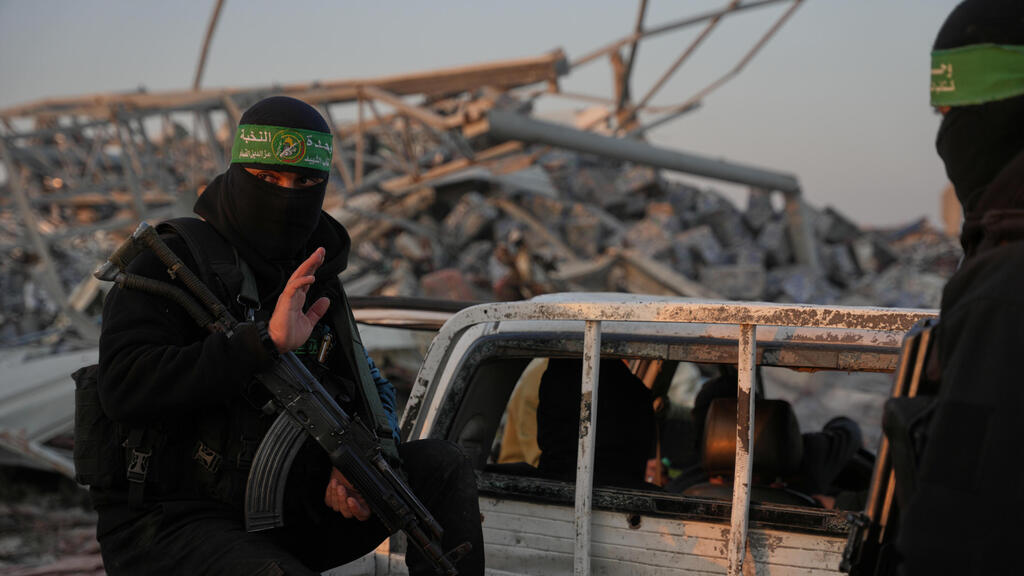
Hamas terrorists
(Photo: AP Photo/Abdel Kareem Hana)
In the first phase, lasting 15 days, the technocratic committee would assume security and administrative control of Gaza. During the second phase, about six weeks long, Israel would dismantle heavy weapons in areas under its control and an international force would deploy. In the third phase, lasting about 60 days, Hamas would hand over its heavy weapons and tunnels would be destroyed.
The fourth phase, expected to begin about three months into the plan and last roughly five months, would focus on collecting small arms held by Hamas, alongside a gradual withdrawal of Israeli forces. In the final phase, set to begin 250 days after implementation, full verification of disarmament would be carried out, Israel would complete its withdrawal and reconstruction of Gaza would begin.
Reuters reported that the plan was presented to Hamas last week by President Donald Trump’s Board of Peace. A senior Palestinian official told ynet that Hamas may take a different approach than in the past.
“Hamas will play this correctly this time, not like before the war,” the official said, adding that the group may return to a general agreement on disarmament but seek to redefine its scope.
According to the official, one of Hamas’ key concerns will be the definition of “weapons.” “A Kalashnikov does not threaten Israel,” he said, suggesting the group may agree to certain concessions but not a full dismantling of its capabilities.
Strike on Hamas terrorists in the Gaza Strip
(Video: IDF Spokesperson’s Unit)


Beyond that official, reactions across the Palestinian arena were swift and forceful, criticizing the plan for prioritizing disarmament over reconstruction and Israeli withdrawal, and for not addressing the establishment of a Palestinian state. Groups such as Islamic Jihad and the Popular Front for the Liberation of Palestine have already announced their rejection.
They argued that disarmament contradicts the Palestinian people’s “right to resistance.” Islamic Jihad official Ismail Sandawi said weapons are a “direct result of the occupation” and would not be surrendered without full rights being achieved. The Popular Front warned that disarmament without ending the occupation and establishing a Palestinian state would pose an “existential threat” and allow Israel to act without constraints.
Within Hamas, criticism has also emerged over linking reconstruction, Israeli withdrawal and the deployment of international forces to the issue of disarmament. Senior Hamas official Basem Naim said the approach contradicts previous understandings and international resolutions.
Hamas has not yet issued a final official position, and it remains unclear when it will do so.