


Israel’s Foreign Ministry is working to assist 20 Israelis stranded in northern Ethiopia as fighting between federal government forces and rebels has shut airports and made road travel dangerous.
The Israelis are currently in Lalibela along with about 30 tourists from other countries. One member of the Israeli group told ynet that they had issued an urgent appeal to the Foreign Ministry to examine safe evacuation options.
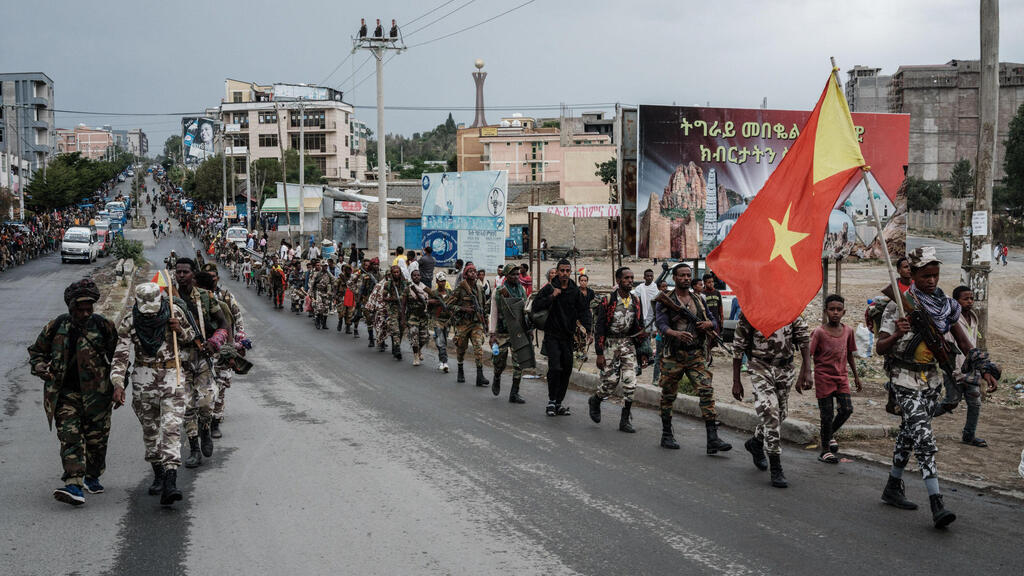
Tigray People’s Liberation Front (TPLF) fighters march in Mekelle, capital of Ethiopia’s Tigray region, June 30
(Photo: Yasuyoshi Chiba / AFP)
In a letter sent to the ministry, the Israelis described deteriorating conditions on the ground, including concerns over the health of some travelers and shortages of food, fuel, electricity and communications.
“Flights have been canceled indefinitely, and this is no longer a delay of just a few days,” they wrote. “Fuel, food and cash supplies in the city are extremely limited, according to local residents and hotel staff.”
The group also warned that communications could be cut entirely, as had happened a day earlier in the Tigray region.
“There is concern about a complete communications blackout, which could undermine our ability to contact both the embassy and our families in Israel,” the letter said.
Some of the Israelis and Americans currently in Lalibela are elderly, the group said, and could require medical attention if they are not evacuated soon. Among the stranded foreign tourists are also people suffering from asthma.
‘We cannot know which routes are safe’
The travelers said they have no reliable way to determine which air or land routes are currently safe.
They argued that the Israeli Embassy and government are better positioned to communicate directly with Ethiopian authorities, Ethiopian Airlines, local armed groups and other relevant parties to verify and coordinate a safe route out.
The group urged Israel to act before conditions deteriorate further or communications are completely severed.
They pointed to previous Israeli evacuation operations in Ethiopia, including efforts to rescue citizens from fighting in the Gondar and Amhara areas in August 2023, as evidence that such an operation could be mounted even under difficult conditions.
The Israelis had initially remained in a protected hotel in an area affected by rebel activity and were instructed to stay inside, where conditions were relatively calm.
But the situation changed when their guide decided Saturday to begin driving toward the capital, Addis Ababa.
Several members of the Israeli group opposed the decision, leading to a dispute. Shortly after the journey began, shells started falling nearby, according to the Israelis.
The group sought shelter at another hotel. A mortar round exploded not far away, killing a rebel fighter, they said.
“We hear lots of explosions, and we can smell gunpowder,” members of the group said.
Foreign Ministry: ‘Intensive efforts’
The Foreign Ministry said its department for Israelis abroad, situation room and embassy in Addis Ababa were conducting intensive efforts and maintaining contact with Israelis in areas affected by the security escalation.
“The Foreign Ministry, the Department for Israelis Abroad, the Situation Room and the Israeli Embassy in Addis Ababa are leading intensive efforts, closely monitoring the condition of Israelis staying in areas where the security situation in northern Ethiopia has escalated and remaining in contact with the groups and relevant authorities,” the ministry said.
Officials are continuously examining possible routes out of the area together with local parties and in accordance with developments and security conditions on the ground, the ministry added.
“The Foreign Ministry is acting and will continue to act to assist Israelis in the area as much as possible, while giving the highest priority to their safety and security,” it said.