


Iranian media reported Friday evening that a facility producing uranium concentrate, known as “yellowcake,” was struck in the Yazd region, with no release of radioactive material detected following the attack.
According to the reports, the site is used to produce uranium powder in the early stages of the enrichment process. At this stage, uranium ore is converted into “yellowcake,” which is later transformed into a gas known as uranium hexafluoride, or UF6. The gas is then fed into cascades of centrifuges, where it is spun at high speeds to increase uranium concentration. At higher enrichment levels, the material can be used for nuclear weapons.
Gallery
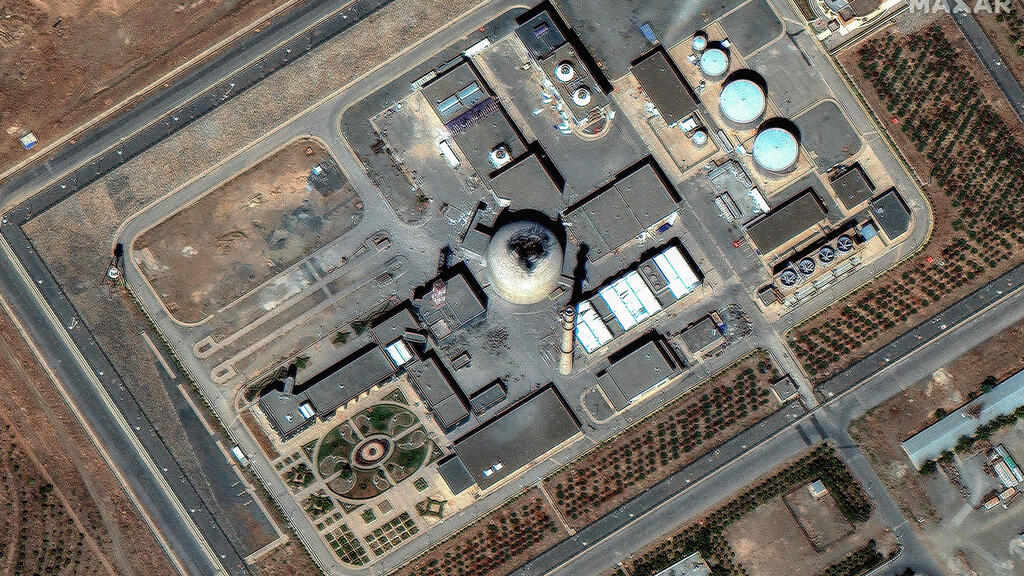
The Arak nuclear facility during an Israeli Air Force strike on June 19 in Operation Rising Lion
(Photo: SATELLITE IMAGE ©2025 MAXAR TECHNOLOGIES / AFP)
There was no immediate confirmation of the strike from Israeli officials.
The reported attack comes hours after the IDF struck two of Iran’s largest steel plants, in what Israel’s defense establishment said could cause billions of dollars in damage to the Islamic Republic’s economy.
According to Iranian reports, the targets were the Mobarakeh Steel Company in Isfahan and the Khuzestan Steel Company in Ahvaz, near the Iraqi border. Israeli defense officials said the facilities are part of Iran’s military-industrial supply chain and are partially owned by the Islamic Revolutionary Guard Corps.
Defense Minister Israel Katz said earlier that Israeli strikes in Iran would “intensify and expand to additional targets and sectors that support the regime in building and operating weapons used against Israeli civilians.”
“We warned the Iranian terrorist regime to stop firing missiles at Israel’s civilian population,” Katz said following a security assessment with senior IDF officials. “Despite the warnings, the fire has continued. They will pay increasingly heavy prices for this war crime.”
Mobarakeh Steel has been under U.S. sanctions since 2018, with the Treasury Department describing it as the largest steel producer in the Middle East and North Africa and a central pillar of Iran’s economy.
Footage released by hackers in 2022
(Video: X)


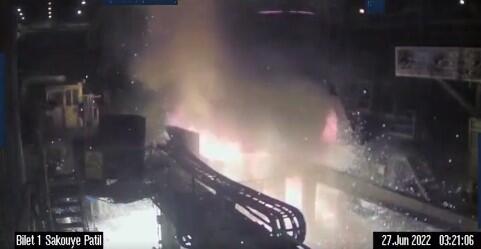
The alleged damage at the Khuzestan steel plant
According to U.S. findings, the company is part of a network supporting the Basij militia, which operates under the Islamic Revolutionary Guard Corps, and serves as a key source of funding for Iran’s security apparatus. The sanctions were aimed at disrupting what U.S. officials called the Basij’s “financial empire,” linked to internal repression and recruitment efforts.
Khuzestan Steel was previously targeted in a 2022 cyberattack attributed to a group calling itself “Predatory Sparrow,” believed to be pro-Israel. At the time, Iran said it had thwarted the attack but acknowledged that production at the plant had been halted.
Hackers later released footage purportedly showing damage inside the facility, including a sudden burst of light from one of its installations. The group said the operation was carried out carefully to avoid harming human life.
Steel production is considered a critical sector in Iran’s economy. The country is the leading steel producer in the Middle East and ranks among the world’s top 10 producers. In recent years, the industry has been affected by increased Russian competition following Western sanctions imposed over the war in Ukraine.