


Marking 30 years since the assassination of Prime Minister Yitzhak Rabin, the IDF Archives at the Defense Ministry on Sunday released rare audio recordings of Rabin from 1967 to 1977, revealing his views on diplomacy, security, Israel’s borders, and the country’s reliance on American support.
The recordings, preserved for decades in safes, feature Rabin speaking in his calm, deliberate manner about the Arab-Israeli conflict, the balance between military might and political dialogue, Israel’s sense of isolation after the Six-Day War, and the need to strengthen the army’s ground forces. The tapes include remarks he made as IDF chief of staff following the 1967 victory and as prime minister after the 1973 Yom Kippur War.
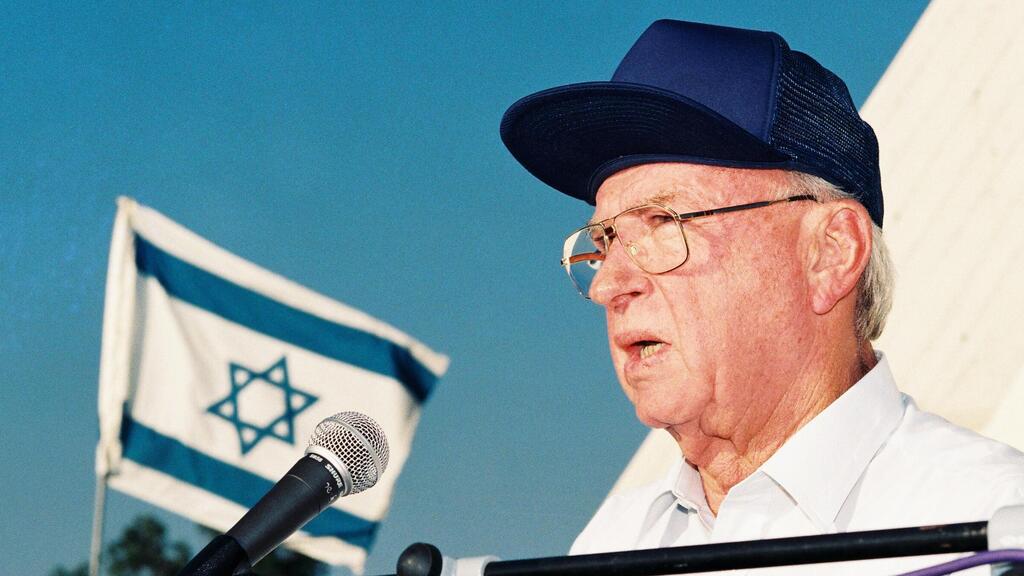
One of the most striking recordings is from June 21, 1977, a month after the political upheaval that brought Menachem Begin to power. Having resigned as prime minister, Rabin addressed a farewell meeting of the General Staff Forum and assessed Israel’s security situation.
“The Middle East, or for that matter the Arab-Israeli conflict, can exist in one of two realities — not in form, but in substance,” he said. “Does one give priority to the political negotiation process or to the military process? It’s neither simple nor clear-cut, because no Arab leader, at least since the Six-Day War, believes he can advance a political process without military strength. They assume — and not without justification — that Israel won’t concede an inch unless there’s power to make it happen. No one has an ideology of territorial concession.”
Addressing Israel’s borders, Rabin reflected on how they were shaped by circumstance rather than ideology. “I don’t know of a single line that ever served as a border between Israel and the Arab states that had an ideology behind it. Not the 1947 partition plan that the Jewish leadership accepted, not the 1949 armistice lines, and not the lines that were created after the Six-Day War,” he said. “No one had an ideological commitment to borders — they were formed out of circumstance, not as predetermined goals. Therefore, Israel’s willingness to make territorial concessions, or the Arab belief that only military force can bring compromise, ensures the continued existence of a military option, even during political negotiations. Israel, too, cannot exist without military strength — in the simplest sense of the word: political and physical survival.”

(Photo: Yaakov Saar/ GPO)
Rabin also spoke of his vision for peace and negotiation with the Arab world. “Negotiations as a central goal doesn’t necessarily mean achieving peace,” he said. “It means shifting priorities — from military confrontation to the possibility of dialogue. Anyone who says this automatically means peace is wrong. The preferred goal is peace, but a comprehensive interim agreement is also possible. I wouldn’t rule out other arrangements either. The first step is to embark on the path of negotiation.
“The second goal is ensuring military strength. A policy that seeks negotiations without ensuring parallel military buildup has no right to exist. The third goal is to guarantee the ability to secure foreign financial assistance. Israel today cannot, and there’s no point denying it, maintain both strong military power and its social and economic aspirations without outside help — just as the Arab world cannot.”
He went on to stress the need for calm and security stability. “All of this, if possible, should come with quiet — with calm from terrorist activity inside Israel, abroad, and along our confrontation lines,” Rabin said. “These are the objectives we set for ourselves, or at least as I saw them. In the face of Arab hostility, none of us would say peace is within reach. But to sustain ourselves in this reality, especially after the Yom Kippur War, we must have a strategic understanding with the United States. Without it, three of these goals — and consequently the fourth — cannot be achieved.
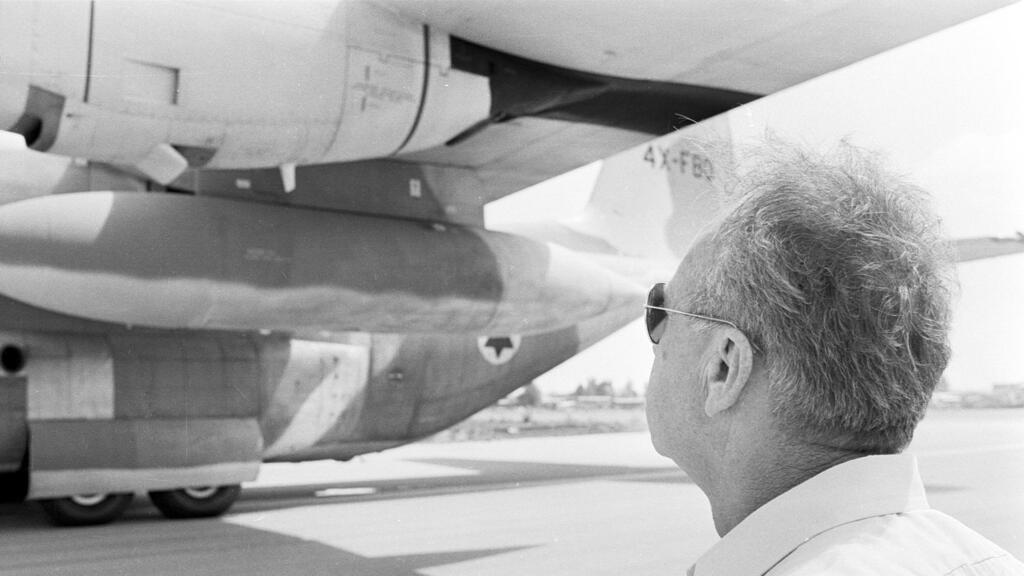
Yitzhak Rabin welcomes the planes returning from Entebbe raid
(Photo: Ori Herzl Zahik/ Defense Ministry)
“Without American arms supplies and financing, we cannot achieve the necessary military buildup. Fifty percent of Israel’s weaponry comes from the United States — it’s the core of the IDF’s arsenal. I once told U.S. diplomat Joseph Sisco that a Middle East where only Israel remains aligned with America will not interest Washington.”
In a separate recording from November 1976, Rabin told senior IDF officers that Israel must always operate on two parallel tracks — one focused on long-term planning and one on handling unpredictable developments. “Israel has always lived and will continue to live along two parallel paths,” he said. “One demands planning and foresight; the other requires readiness for unforeseen changes. The ability to manage both without letting one override the other is essential.”
On prospects for peace, Rabin said, “I believe that a comprehensive peace agreement, meaning true peace, is not within reach in 1977. However, I don’t rule out achieving an agreement focused on ending the state of war. I’m willing, through negotiations, to explore both possibilities.”
In another recording made shortly after Israel’s victory in the Six-Day War, Rabin, then IDF chief of staff, spoke to brigade commanders about the future of the army. “If anyone leaves this meeting thinking the era of the infantry is over, he’s drawing a wrong, dangerous, and unrealistic conclusion,” he said. “Our task now is to make the infantry even better.”
At a 1967 paratroopers’ conference, Rabin discussed Israel’s dependence on the United States, quoting then–U.S. Secretary of State Dean Rusk: “‘If you want us to be with you in a crash landing,’ he told me, ‘please consult us during takeoff.’ In other words, if you want us with you in wartime, involve us early — in your navigation, your planning, and your direction. But when Rusk sits at the controls of our plane, we won’t be flying wherever we please.”
He also addressed Israel’s growing diplomatic isolation after the Six-Day War, despite the military triumph. “Since the war ended on June 11, our loneliness has only deepened,” Rabin said. “Few extend a helping hand to our Zionist aspirations. Not all Jews are Zionists — and even fewer gentiles are. We must ask ourselves to what extent we can expect help or partnership in our vision for Jerusalem, the Golan Heights, the West Bank, or Sinai. Our isolation grows, and with it come pressures and accusations. I can’t even say for certain that the military phase of this struggle is over. Maybe in months, maybe longer — wars can last.”
Rabin ended his talk to the paratroopers on a hopeful note. “Despite this deep and difficult loneliness and the pressures that come with it,” he said, “I believe that if this generation fully recognizes its responsibility and the opportunities before it, we can withstand the pressures and achieve our goals.”