

A team of expert Finnish divers believes it may have solved the mystery surrounding the deaths of five Italian divers who perished while exploring an underwater cave in the Maldives, suggesting that a “sand wall illusion” may have caused the group to take a wrong turn while trying to exit the cave.
The five, all from Italy, entered the cave system in Vaavu Atoll last Thursday but never resurfaced. The body of diving instructor Gianluca Benedetti was found near the entrance to the Thinwana Kandu cave on the day the group disappeared, while the remaining four bodies were located on Monday in the cave’s third and final chamber at a depth of about 165 feet.
The tragedy, described as the worst diving incident in the island nation’s history, has raised questions over how a group of experienced divers became trapped in the cave system. Investigators are now examining several possible explanations, including whether the divers became disoriented, encountered poor visibility or were drawn deeper by a strong current.
The Finnish recovery team, working for DAN Europe, a medical and research organization focused on scuba diving health and safety, recovered the bodies this week and believes the divers may have taken the wrong tunnel on their way out of the cave. According to Italy’s La Repubblica, the bodies were found in a dead-end corridor inside the cave complex.
“There was no way out from there,” DAN Europe CEO Laura Marroni was quoted as saying.
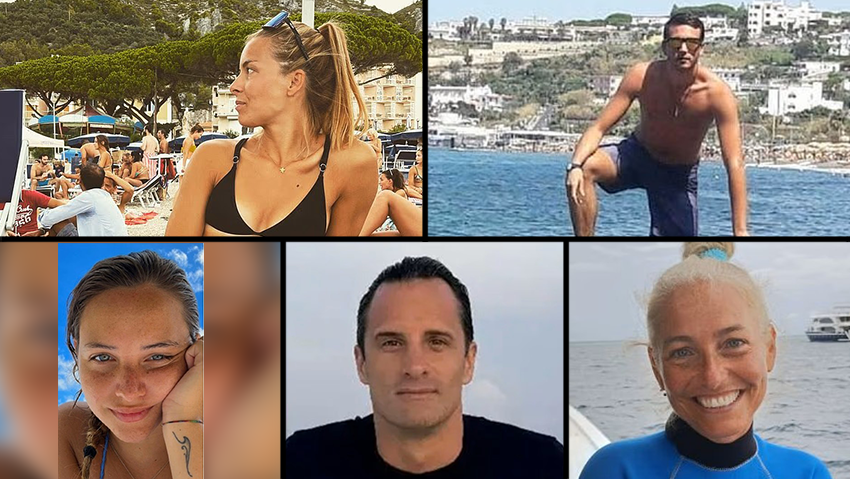
The group included Monica Montefalcone, 51, a respected marine biologist, television personality and professor of Tropical Marine Ecology and Underwater Science at the University of Genoa; her daughter, Giorgia Sommacal, 22; researchers Federico Gualtieri, 31, and Muriel Oddenino, 31; and Benedetti, 44, their Maldives-based guide.
(Photo: Daily Mail )
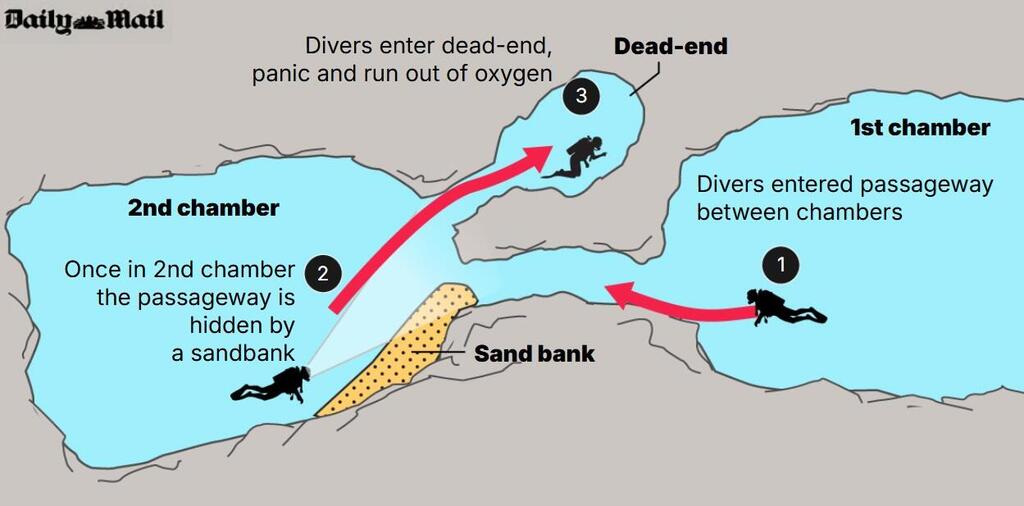
According to Marroni’s reconstruction, the cave near Alimatha begins with a large, bright chamber with a sandy bottom. At the end of that chamber is a corridor with little natural light, though visibility with artificial lighting was described as excellent.
The corridor, nearly 30 meters long and three meters wide, leads to a second chamber, a large round space with no natural light. Between the corridor and the second chamber is a sandbank.
The Finnish divers believe that while the sandbank was easy to cross when entering the second chamber, it may have appeared like a wall when the divers turned back to leave, hiding the corridor they had come through. To the left of the sandbank was another corridor, only a few dozen meters long, but it led to a dead end.
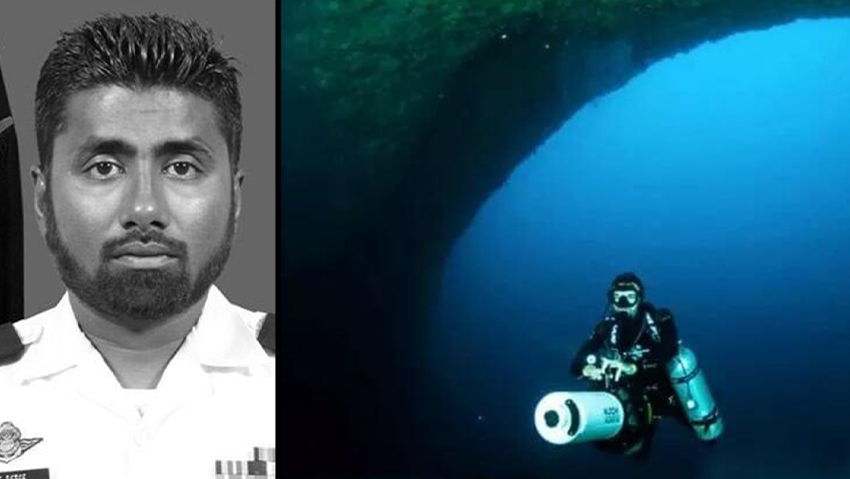
Maldivian coast guard diver Sgt. Maj. Mohamed Mahudhee who died during the recovery operation
“The divers’ bodies were all found inside, as if they had mistaken it for the right one,” Marroni told the paper.
If the group did take that corridor by mistake, she said, “then it would have been very difficult to return, especially with the limited air supply.”
The divers were using standard tanks, giving them very little time at that depth. “We’re talking about 10 minutes, maybe even less,” Marroni said.
“Realising that the path is the wrong one and having little air, perhaps after going back and forth, is terrifying. Then you breathe quickly, and the air supply decreases,” she added.
The Finnish divers also recovered technical equipment from the cave, including GoPro cameras worn by some members of the group. Authorities hope the footage will provide a clearer picture of how the dive went wrong.
The bodies of the last two divers, Sommacal and Oddenino, were recovered Wednesday, ending the recovery operation.
Montefalcone’s husband, Carlo Sommacal, told Italian media that his wife would never have put their daughter or anyone else in danger. He described her as “one of the best divers in the world,” saying she had completed about 5,000 dives and was “always conscientious” and “never reckless.”
“I’m sorry, I wasn’t there, and I’m no expert, and from what I’m seeing and reading, even the experts don’t have definite answers but are merely making hypotheses — lots of them,” he told Reuters in a WhatsApp message.
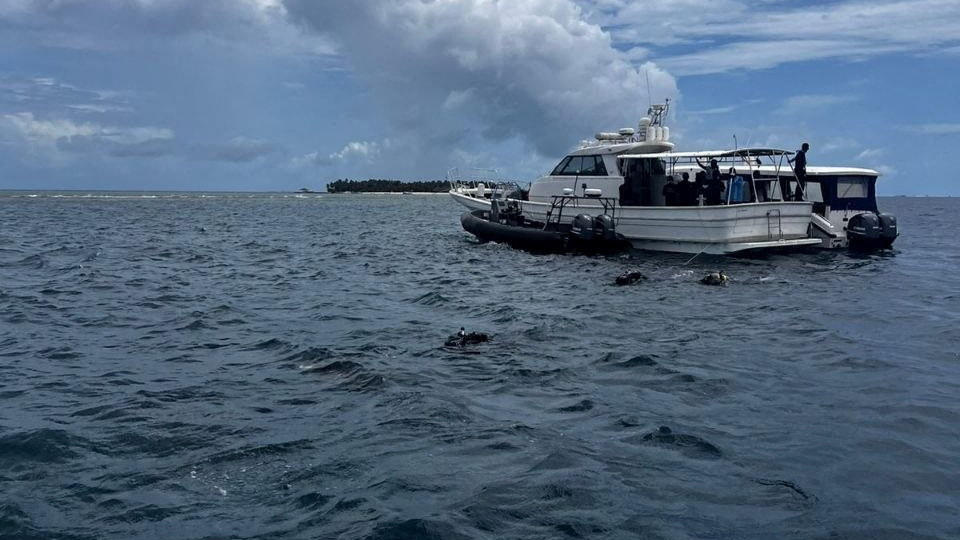
(Photo: Maldives President’s Office / Handout via REUTERS)
Sommacal said footage from a GoPro camera could help explain what happened.
“Monica usually had a GoPro when she went diving,” he told La Repubblica. “I don’t know if she had one the other day. If they find it, maybe from there we can understand what happened.”
“She would never have put our daughter’s life or that of others at risk... something must have happened down there,” he said. “Maybe one of them had trouble, maybe the oxygen tanks, I have no idea.”
He also described Benedetti as a meticulous diver. “He checked everything: the tanks, the weather conditions. He’s not a fool,” Sommacal said. “It must have been fate; they took every precaution possible.”
Authorities in the Maldives are investigating how the group was allowed to descend to nearly 200 feet, when local regulations permit tourists to dive to a maximum depth of 98 feet. Dives beyond that limit require special authorization from Maldivian maritime authorities.
The Italian tour operator that managed the diving trip has denied authorizing or knowing about the deep dive, which exceeded local limits. Orietta Stella, a lawyer representing Albatros Top Boat, told Corriere della Sera that the operator “did not know” the group planned to descend beyond the recreational diving limit and “would have never allowed it.”
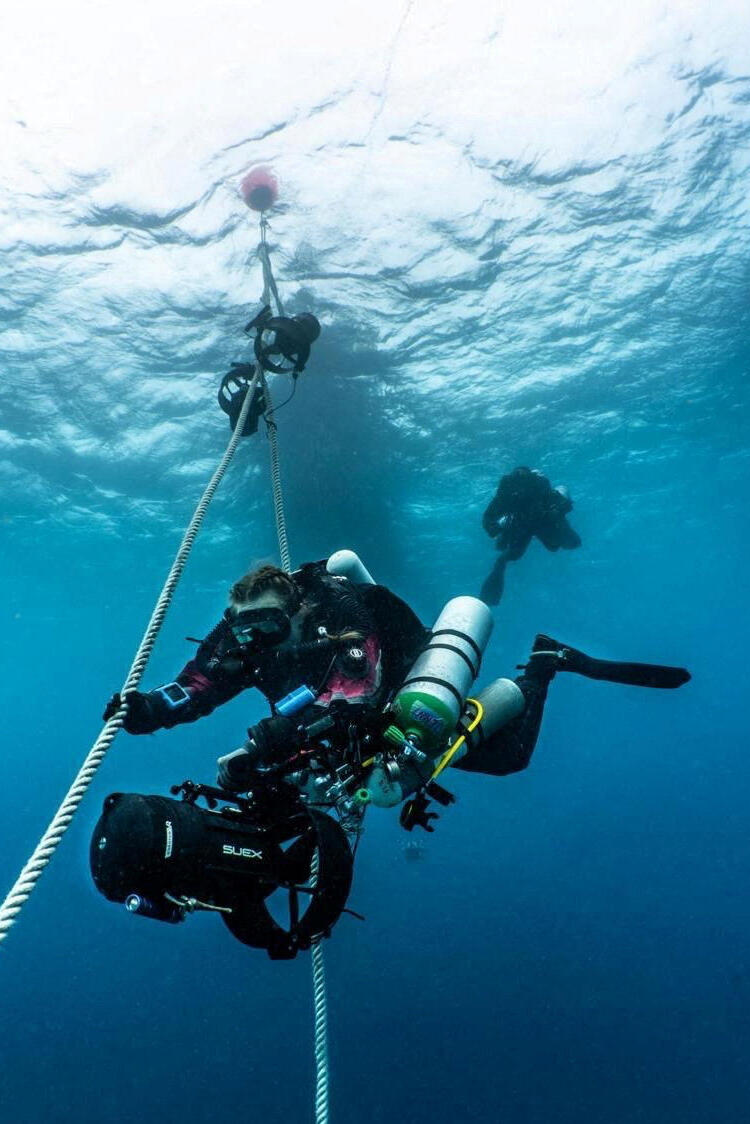
Finnish divers searching for the bodies of the divers in the Maldives
(Photo: DAN Europe/Handout via REUTERS )
The dive also exceeded what had been planned for the scientific cruise, which focused on coral sampling at standard depths.
The boat operator of the MV Duke of York, Abdul Muhsin Moosa, said the vessel had permission for recreational dives up to 98 feet. He said the divers had been briefed on arrival about the Maldives’ diving limits and told they were not allowed to go beyond that depth.
Experts cited in the report said that standard compressed air is used for recreational dives up to the local limit, but deeper dives require different gas mixes and specialized equipment. For depths of at least 164 feet, divers are generally advised to use at least two cylinders of specialized air each.
The victims were experienced divers, but the equipment they used appeared to be standard recreational gear rather than technical equipment suited for deep cave diving.
Investigators are also examining whether the group had flashlights and whether they used “Ariadne’s Thread,” a guide rope required for deep-sea cave expeditions. Another theory under review is that a powerful current may have pulled the divers into the cave through a phenomenon known as the Venturi effect, in which water accelerates through a narrow passage and creates suction.
Italian authorities are arranging for the bodies to be repatriated for autopsies to determine the cause of death.
The recovery operation also claimed the life of Maldivian coast guard diver Sgt. Maj. Mohamed Mahudhee, who died Saturday from decompression sickness while trying to recover the bodies. His death highlighted the extreme danger of diving at such depth and inside a cave system.
Maldives presidential spokesman Mohamed Hussain Shareef said the cave “is so deep that even divers with the best equipment do not try to approach.”
The Maldives, made up of 1,192 coral islands across the Indian Ocean, is a luxury holiday destination popular with divers, many of whom stay at secluded resorts or on dive boats. Diving and water-sport accidents are relatively rare in the country, though several fatal incidents have been reported in recent years.