

While Israelis have grown accustomed to campaign promises bearing little resemblance to reality, Finance Minister Bezalel Smotrich has shown that, when it comes to the West Bank, he can deliver results.
Even when he failed to achieve his goals formally or produce the headline he sought, Smotrich established facts on the ground, openly declaring that his intention was to dictate policy for future governments.

He did not succeed in applying Israeli sovereignty to the West Bank, despite declaring a “year of sovereignty” following Donald Trump’s election. But he did advance a series of measures that, only a few years ago, would have seemed little more than a wish list among settlers.
In the settlements, Smotrich’s moves are seen as the fulfillment of a vision. Critics, however, say the finance minister, who has devoted considerable time and state resources to the settlement enterprise, largely exploited the war to establish irreversible facts on the ground.
They argue that these policies, particularly at a time when global public opinion has turned sharply against Israel, could become, or may already have become, a double-edged sword. The international community, for example, could exact a price over actions it views as violations of international law.
Critics warn that the measures could leave Israel facing unprecedented isolation, damage its standard of living and undermine relations with its principal allies. They say a form of anarchy is already taking hold in the West Bank, reflected in the inability of the military and police to prevent repeated clashes between Jews and Palestinians.
On one point, there is little dispute: The reality in the West Bank has changed over the past four years, and that change will be difficult to reverse.
Closing the Civil Administration and applying sovereignty
Although the Civil Administration is still headed by an Israeli military officer with the rank of brigadier general and remains responsible for civilian matters including development and construction in the West Bank, Smotrich has led its de facto civilianization.
In 2023, following a prolonged power struggle, Smotrich, serving as a minister in the Defense Ministry in addition to his position as finance minister, signed an agreement with Prime Minister Benjamin Netanyahu and then-Defense Minister Yoav Gallant authorizing the transfer of powers related to the Civil Administration.
The entire administration was not transferred to civilian control, but a substantial share of its authority was. The administration is also being moved from a military base to the Sha’ar Binyamin industrial zone.
Smotrich also failed to fulfill his pledge to apply sovereignty, but several measures advanced during the government’s term have shown that the prospect is no longer entirely far-fetched.
One of the main arguments against the restructured Civil Administration, or in its favor, from Smotrich’s perspective, is that it amounts to accelerated “de facto annexation” of parts of the West Bank. Critics say the process violates international law and has provoked anger toward Israel in the West.

Additional settlements are expected to be established in the area this summer; Homesh in the northern West Bank
(Photo: Shaul Golan)
Opponents warn that transferring powers such as land management and planning to civilian control and placing them under a politically directed Settlement Administration strips the Israeli military of its role as the sole governing authority in the territory and creates an indirect political chain of command.
They argue that this politicization is intended to legalize outposts and expand settlements while seriously harming the rights of the local Palestinian population. They also warn that it could disrupt the military’s decision-making process, fuel a security escalation and deepen Israel’s diplomatic and legal isolation internationally.
To some extent, several of those developments have already occurred. Smotrich argues that the more facts Israel establishes on the ground, the less choice the international community and the Palestinians will have but to accept them.
Recognition of unauthorized outposts
Smotrich had promised to recognize unauthorized outposts commonly described by settlers as “young settlements.” Even he could hardly have imagined the scale of the progress he would make.
The current government has approved 103 new communities, including previously unrecognized outposts and sites classified as part of the “young settlement” movement.
Shortly after October 7, an association representing agricultural farms was established with the stated goal of securing control over open areas in the West Bank through farming.
The association works in full cooperation with state authorities and in close coordination with the military and security forces. The farms now cover more than 1 million dunams, about 247,000 acres, across the West Bank and continue to expand.
By comparison, all West Bank settlements and cities combined cover less than 200,000 dunams, or about 49,000 acres, illustrating the farms’ far-reaching effect on the territory.
The growth has been dramatic. There were about 50 farms in 2022. By 2026, the number was approaching 140.
Critics say the farm project has increased friction between Jews and Palestinians in recent years, leading to frequent confrontations that have sometimes ended with Palestinians killed or wounded by gunfire.
More recently, the violence included a deadly attack in which Maj. Yuval Ezra and Benayahu Malt, a member of the security team at Havat Gilad, were killed.
The terror attack in which Benayahu Malt and Yuval Ezra were killed


Repealing the Disengagement Law
A return to the northern West Bank was not an explicit campaign promise, but it falls within the broader settlement transformation Smotrich has pursued during the government’s term.
Additional settlements are expected to be established in the northern West Bank this summer. They will join Sa-Nur, which was reestablished about two months ago, and Homesh, an outpost that became a symbol of the settler campaign and has since been retroactively authorized.
Approvals for communities across the West Bank have accelerated over the past year amid concern among settlement leaders that the government could change.
The moves have drawn criticism, including from the anti-settlement group Peace Now.
“For almost four years, Smotrich has shown that he is the most sectoral minister in a government already saturated with sectoral politics,” the organization said. “He devoted all his energy to promoting settlements, funneling enormous budgets to them and deepening Israel’s international isolation.
“Four years of Netanyahu and Smotrich have left us with more settlers, more messianism, more extremism and more violence. Smotrich has shown that a country without clear borders can quickly descend into anarchy.”
More violence
The changes on the ground have also altered the security situation in the West Bank.
Terror attacks have declined following changes in the Central Command’s counterterrorism methods and an expansion of the military’s operational freedom. At the same time, nationalist crime and settler violence have increased.
In the past, such incidents typically involved small numbers of youths entering Palestinian villages, damaging vehicles and spraying graffiti. In recent years, larger groups of youths and adults have entered villages, sometimes in broad daylight and with little apparent fear of arrest.
The damage has also become more extensive and has included attacks on uninvolved civilians.
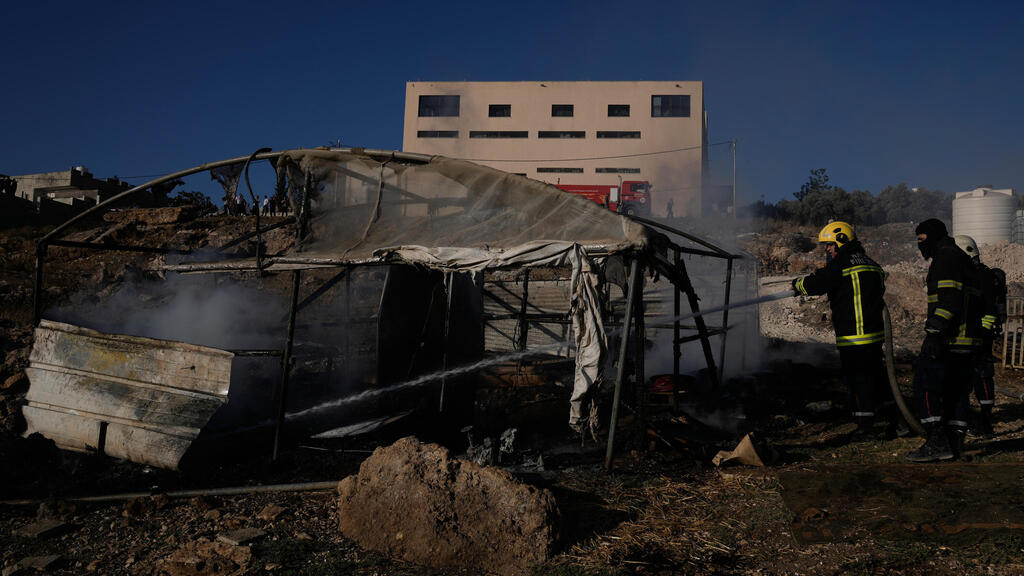
They enter Palestinian villages without fear, leaving extensive damage; destruction in the West Bank village of Sira
(Photo: AP Photo/Majdi Mohammed)
Police have also felt the change on the ground. The Judea and Samaria District examines each case individually, meaning not every confrontation between a Palestinian and Israeli troops is classified as a terrorist attack, and not every vehicle fire is classified as nationalist crime.
One development in recent years was the establishment of a joint interagency command. Led by Assistant Commissioner Yishai Shalem, deputy commander of the Judea and Samaria District, it works closely with the military and the Shin Bet security agency to thwart, prevent, investigate and solve nationalist crimes in the complex region.
Last week alone, seven indictments were filed in connection with two separate incidents.
Smotrich’s office said: “Throughout the four years of the current government’s term, Minister Smotrich has led a historic transformation in Judea and Samaria with one objective: to strengthen the security of the State of Israel and uproot the terrible idea of establishing a terrorist state in the very heart of Israel.
“As noted in the article, the settlement revolution is a central part of Minister Smotrich’s campaign promises, and it has been fulfilled in full and even exceeded.”