


Kuwait International Airport was shut down and several people were wounded after an Iranian missile and drone attack that began Tuesday night, AP reported Wednesday morning.
Kuwait’s military said on social media that “the Defense Ministry stated that several drones attacked Terminal 1 at Kuwait International Airport as part of the Iranian aggression. The attack caused significant material damage to the terminal and wounded several people, who received the necessary medical treatment.”
Interceptor debris in Kuwait overnight
(Video: Reuters)


Sirens sounded overnight in Bahrain and Kuwait about an hour after the United States announced it had struck an empty oil tanker in the Strait of Hormuz while it was on its way to a port in Iran.
Iran’s Revolutionary Guards claimed responsibility for missile and drone attacks in the Gulf, saying they targeted American bases. CNN described the overnight exchange as the largest series of attacks in weeks, as the ceasefire appeared increasingly fragile.
According to the Revolutionary Guards, the attack came in response to an American strike on Qeshm Island in the Persian Gulf, which the United States said came after an Iranian attack. Reuters had earlier reported explosions on the island, but there were no additional reports confirming whether any sites had been hit.
The missiles Iran fired at Kuwait and Bahrain overnight
At the same time, residents in Bahrain and Kuwait were told to remain near protected spaces because of the Iranian attack.
The U.S. military later confirmed it had carried out a strike on Qeshm Island but said Iran had attacked first. According to the military statement, Iran fired five ballistic missiles at neighboring states, three toward Bahrain and two toward Kuwait. The missiles fired at Bahrain were intercepted by air defense systems, while those launched toward Kuwait broke apart en route. The U.S. military also said it intercepted three drones. No casualties were reported in that statement.
In a statement, the Revolutionary Guards said: “In response to the aggression against the oil tanker, naval forces of the Revolutionary Guards attacked the American-Israeli enemy vessel Panaya with missiles. In a renewed attack, the American enemy struck a Revolutionary Guards communications tower in southern Qeshm Island. In response, we attacked with missiles and drones an air force base located in one of the region’s countries and the headquarters of the U.S. Navy’s Fifth Fleet. We have warned in the past that in the event of any aggression, the response would be different and far harsher, and that is exactly what we did.”
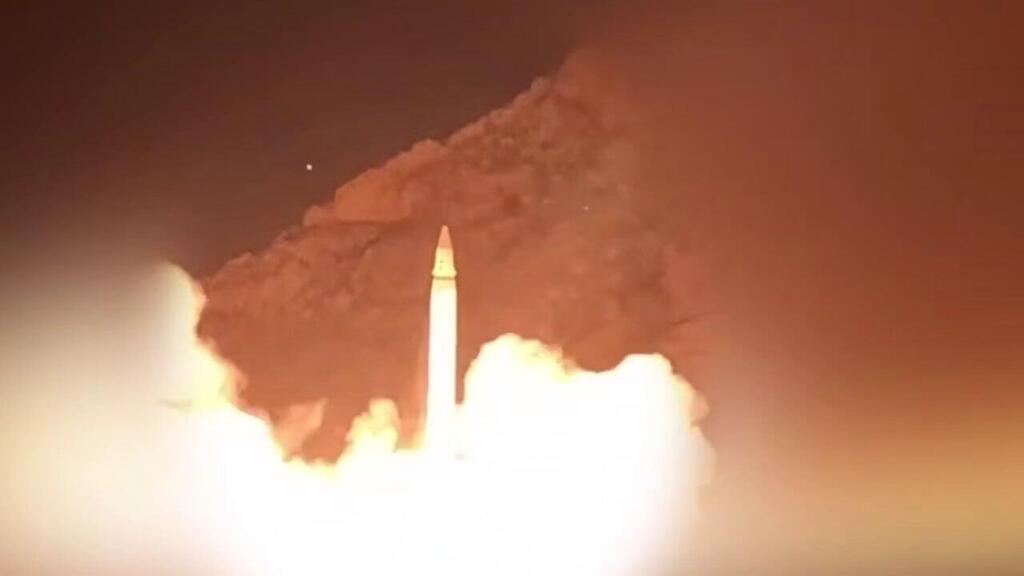
Iranian missile launched toward Kuwait
At around 11:50 p.m. Tuesday, U.S. Central Command said American forces had disabled the engines of the M/T Lexie, an oil tanker sailing under the flag of Botswana and heading to Iran.
According to CENTCOM, the crew aboard the tanker ignored repeated messages ordering it to turn around, prompting a U.S. aircraft to fire a precision missile at the tanker’s engine room.
The escalation came as contacts over a U.S.-Iran agreement continued and tensions on the ground remained high. Last Thursday, Iranian forces attacked American ships crossing the Strait of Hormuz, while Iran also reported explosions near Bushehr. Iranian reports claimed a “hostile American aircraft” had been downed in the area, but a U.S. official later denied the claim.