

The Old City was eerily quiet on Easter Sunday, April 5. An individual’s footsteps could easily be heard on the ancient stone as they made their way through the Christian Quarter.
Heavy metal curtains locked the stores and shops along the streets, and even the church doors, usually flung open in a festive welcome to passersby on such a holiday, were shuttered or barely cracked open, with guards blocking prospective worshippers from entering.
Gallery
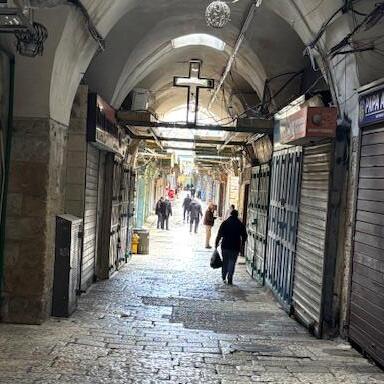
The streets of the Old City of Jerusalem are empty on Easter Sunday
(Photo: Maayan Hoffman/The Media Line)
It was a far cry from a traditional Easter holiday, when tens of thousands of locals and tourists would flood the Old City to dance, sing, and parade in celebration of the holiday that commemorates the resurrection of Jesus Christ three days after his crucifixion.
While many Christians in Jerusalem are Orthodox and mark April 5 as Palm Sunday, celebrating Easter on April 12, their day of fasting and prayer usually still brings crowds into the streets and churches.
“It’s not like previous years,” Jacqueline, a Syrian Orthodox Christian who asked that her last name not be used, said on Sunday. She was walking slowly up the stairs after visiting the church, which she said was almost empty. “There is no celebration. People feel very sad.”
She added that “you can tell when you see people that they are not happy. This is not Easter.”
Jacqueline recalled years when Christian scouts sang traditional songs in the streets and compared them to this year.
“It is so quiet,” she said. “There is nothing to do.”
Nearby, another local, Farah, expressed similar sentiments but shrugged his shoulders with little emotion.
“It’s a war,” he said, implying that this is to be expected.
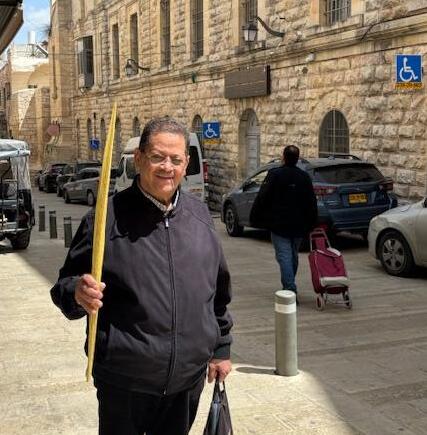
Farah carries his palm branch for Palm Sunday in the deserted streets of the Old City of Jerusalem on April 5
(Photo: Maayan Hoffman/The Media Line)
A member of the Greek Orthodox Church, Farah was carrying his palm branch for Palm Sunday. He said people are not only unable to go to church, but are also afraid to do so. He noted that the Church of the Holy Sepulchre was also closed to congregants, suggesting that everyone was being treated equally.
“We hope peace will come one day,” Farah said, who also asked that his last name not be used. “We are praying to God that next year will be better, that there will be peace in this land, the land of Jesus… Unfortunately, we have not seen peace until now.
The war with Iran, which began on February 28, has cast a somber shadow over the Old City. The area lacks adequate bomb shelters, discouraging visitors in the event of rocket fire. Police have been limiting entry mostly to city residents and shop owners since shortly after the war began.
At the Western Wall, only 50 people can pray at a time and, even then, only inside the covered Kotel tunnels, not in the open plaza.
Jerusalem is home to holy sites for all three major religions, and all have experienced close calls as rockets and debris have fallen nearby. An intercepted Iranian missile, for example, sprayed shrapnel onto the rooftop of the Greek Orthodox Patriarchate, close to the Church of the Holy Sepulchre. There have also been impact sites in the Jewish and Muslim quarters.
Last week, Israel Police prevented the Latin Patriarch, Pierbattista Pizzaballa, from performing the Palm Sunday mass at the Old City church, which led to an international uproar. However, the situation was later resolved, and on Sunday church leaders were able to use the facility.
(Photo: Maayan Hoffman/The Media Line)
On Sunday, the sense of being shut out from prayer was stronger than ever. Christians were blocked at the New Gate, with guards preventing visitors from entering, and on one of the intermediate days of Passover, police at Jaffa Gate also stopped Jewish worshippers, despite their pleas, from going in.
Vesna Pericevic Jacob was among the few tourists in the Old City on Sunday. Her bright blue eyes and gray hair made her stand out among the sparse crowd. She stood by the metal guard rails blocking entry to the Church of the Holy Sepulchre, holding a thin white candle.
Pericevic Jacob came to Israel from India, although she is originally from Bosnia. She flew from Mumbai to Amman and then crossed by land, the only way she could secure a ticket. It was her first time in Israel, and she said she felt compelled to come after praying and reflecting, believing she needed to be in Jerusalem to pray for peace this year.
“The world needs peace more than anything else,” Pericevic Jacob said. “This place is so powerful and holy for so many different religions and different faiths, which all actually have the same message of love. And yet, here we are.”
She said that she believes everyone is searching for acceptance and love, and that there is a piece of the Divine in every human being.
“Wars should be fought without weapons and without words, but through our own deeds, through kindness and being there for one another,” Pericevic Jacob said.
“I pray that we’re going to start seeing the truth,” she whispered with a sigh. Then she turned and faced the church once again.