

President Isaac Herzog warned Thursday that inflammatory political rhetoric can lead to deadly violence and declared that the assassin of former Prime Minister Yitzhak Rabin must never be released from prison, as Israel marked 31 years since the killing of the leader who pursued peace with the Palestinians.
Speaking at a state memorial ceremony at Mount Herzl in Jerusalem, Herzog appealed to politicians, commentators and voters to exercise restraint ahead of national elections scheduled in five days, invoking Rabin's final warning about the dangers of political violence.
Gallery
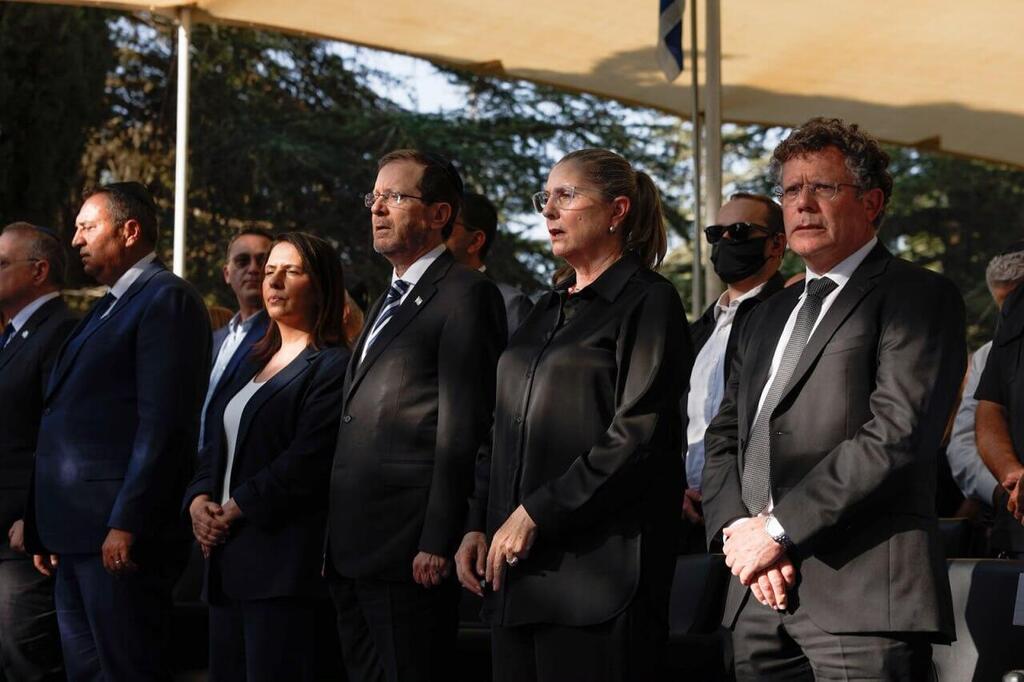
President Isaac Herzog, his wife Michal Herzog and Supreme Court Chief Justice Yitzhak Amit attend a state memorial ceremony for slain prime minister Yitzhak Rabin at Mount Herzl in Jerusalem
(Photo: Hillel Ben Or)
"I stand here and warn that words kill," Herzog said. "Candidates, leaders, opinion leaders and commentators — all of you — be careful with your words."
Addressing candidates from across the political spectrum, Herzog urged Israelis to remember Rabin's final public remarks, delivered shortly before his assassination at a peace rally in Tel Aviv on Nov. 4, 1995.
"Violence erodes the foundations of Israeli democracy," Herzog said, quoting Rabin. "Debate must be respected. Violence must be rejected. Elections are not a civil war."
The ceremony commemorated the 31st anniversary of Rabin's assassination and the 26th anniversary of the death of his wife, Leah Rabin.
Prime Minister Benjamin Netanyahu did not attend. The government was represented by Minister Gila Gamliel.
Other attendees included Supreme Court President Yitzhak Amit, military chief Lt. Gen. Eyal Zamir, Shin Bet security agency chief David Zini, former President Reuven Rivlin and political figures Gadi Eisenkot and Yair Golan.
Herzog: Rabin's assassin must die in prison
Earlier Thursday, Herzog delivered an equally forceful message at the annual "Candle for Yitzhak" state memorial ceremony at the President's Residence in Jerusalem, rejecting any possibility of clemency for Yigal Amir, the Jewish extremist convicted of murdering Rabin.
"The despicable murderer aimed his weapon not only at Yitzhak Rabin, but at the heart of the nation," Herzog said. "We lost our leader, and we nearly lost ourselves."
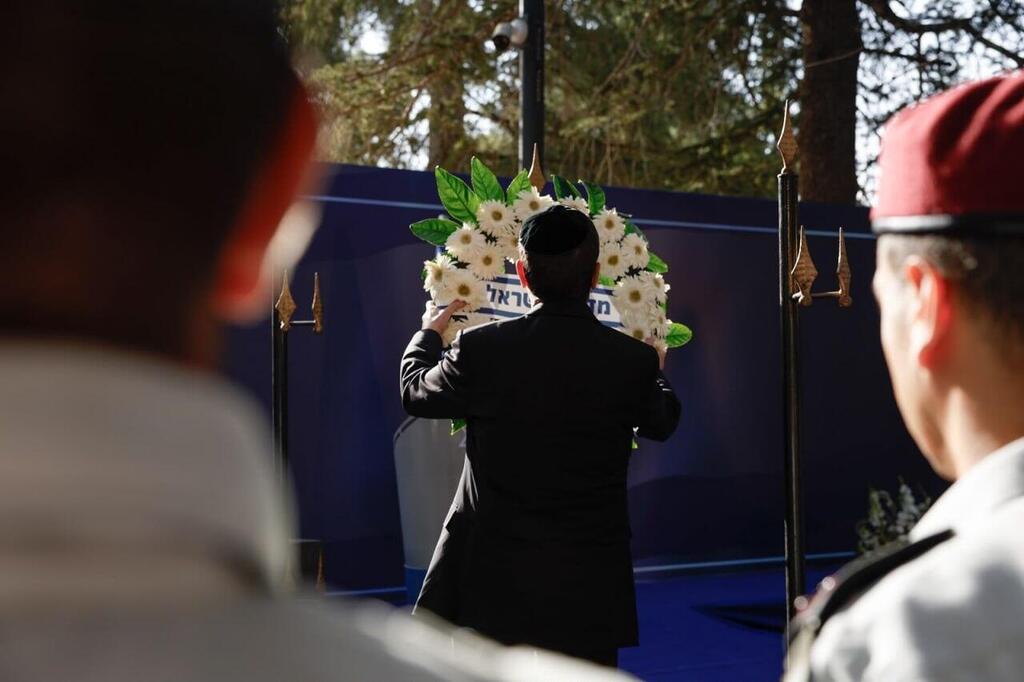
President Isaac Herzog lays a wreath at a state memorial ceremony for slain prime minister Yitzhak Rabin at Mount Herzl in Jerusalem
(Photo: Hillel Ben Or)
Herzog recounted recently seeing a billboard along Highway 1, the main road connecting Jerusalem and Tel Aviv, calling for Amir's release.
"The very possibility that such a call could appear in public and be met with a shrug should keep us awake at night," Herzog said. "We must not dismiss it as just another provocation."
He warned that calls for Amir's release risk undermining the fundamental principle that political assassination must remain an absolute red line in Israeli society.
"Behind the call to release the murderer lies the horrifying possibility that Israeli society will cease to regard his despicable act as absolutely forbidden, that, God forbid, it will stop treating it as a red line that must never be crossed," Herzog said.
"Thirty-one years are not a cooling-off period for the murder of a prime minister. And the passage of time does not diminish the gravity of the crime."
Herzog said the message passed down to future generations must be unequivocal.
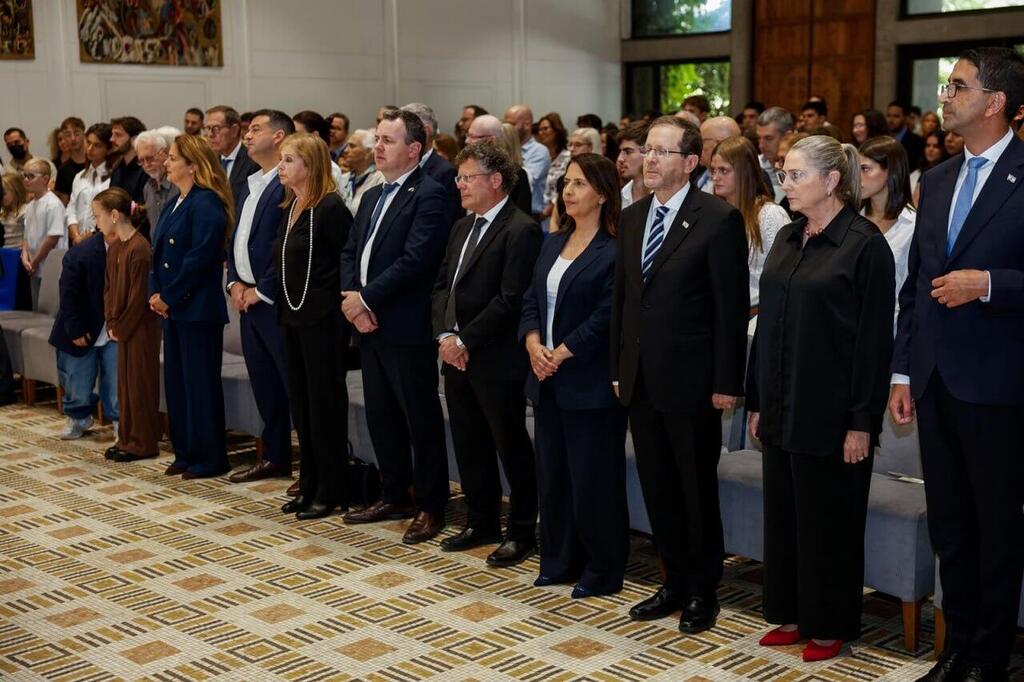
President Isaac Herzog, his wife Michal Herzog and other dignitaries attend a state memorial ceremony marking 31 years since the assassination of prime minister Yitzhak Rabin
(Photo: Hillel Ben Or)
"The murderer must never be released. He must end his life in prison. He must never receive any leniency or pardon whatsoever. There can be no questioning this under any circumstances," the president declared.
Amir, a right-wing Jewish extremist opposed to Rabin's peace efforts with the Palestinians, shot the prime minister after a peace rally in Tel Aviv in 1995. The assassination remains one of the most traumatic events in Israel's political history, exposing deep divisions over the Oslo peace process and the country's democratic institutions.
Rabin's grandson: His legacy belongs to all Israelis
At the Mount Herzl ceremony, Rabin's grandson, Yonatan Ben-Artzi, called for his grandfather's legacy to be remembered beyond partisan divisions.
"The memory of Yitzhak Rabin should not belong to one political camp," Ben-Artzi said. "His diplomatic legacy can be a matter of disagreement, and his actions deserve to be studied, appreciated and also criticized."
Ben-Artzi said the assassination was not merely a personal tragedy but an assault on democratic decision-making.
"The murder was not only a personal loss. It was a successful attempt to settle with bullets a disagreement that should have been resolved among citizens, in the Knesset and at the ballot box," he said.
He described Rabin as a leader defined by responsibility, hard work and difficult decisions rather than political slogans.
"He understood that leadership is measured not only by the ability to lead when everyone agrees, but also by the willingness to make difficult decisions and bear their consequences," Ben-Artzi said.
Rabin, who served as IDF chief of staff during the 1967 Six-Day War before entering politics, understood the human cost of armed conflict, his grandson said.
"He knew war firsthand. He understood its cost, the bereavement, the loss, the moral obligation to secure the release of prisoners of war and the heavy responsibility borne by those who send young people to fight on behalf of the state," Ben-Artzi said.
"He was first and foremost a fighter who struggled for the Jewish state, but he also had the vision and courage to fight for its democratic character."
Ben-Artzi said Rabin was neither naive nor under any illusion that Israel's enemies would necessarily become its friends.
"He understood that courageous decisions could provoke fierce opposition, both in combat and in the diplomatic arena," he said. "He saw and understood that Israeli society was divided over questions concerning its future, but he believed in his path and, above all, in his people."
Recalling remarks Rabin made minutes before his assassination, Ben-Artzi said his grandfather had emphasized that disagreements were legitimate in a democracy, but that political decisions must ultimately be settled through elections.
"It was as though he foresaw his fate and wanted us to remember, for the sake of our own future, that democracy does not require us to agree with one another," Ben-Artzi said.
"It allows us to disagree, argue, protest, criticize the government and try to persuade others. It requires all of us to agree on the fundamental principles of this place: Only free elections are the means by which the public grants its leaders the authority to govern. And once elections have been held, their results must be accepted."
Rabin's daughter: Israel is still struggling with the wounds of war
At the earlier ceremony at the President's Residence, Rabin's daughter, Dalia Rabin, described a country still grappling with the consequences of war and deep political divisions.
"Given what is happening in the State of Israel, this ceremony is not something we can take for granted," she said.
She recalled that the annual memorial had been especially important to her mother, Leah, who died in 2000.
"Thirty-one years, and we are in a difficult, painful and complicated period, on the eve of elections, licking the wounds of a war that has not ended," she said. "A country suffering from post-traumatic stress, with an uncertain future."
Dalia Rabin emphasized that her father's killing was a politically motivated assassination.
"He was murdered in a political assassination. A religious Jew wearing a skullcap emerged from the darkness and fired three shots into his back to stop a diplomatic process," she said.
With elections approaching and divisions in Israeli society at their peak, she said she felt a responsibility to preserve the nonpartisan character of the ceremony.
"The elections are in the air and the divisions in society are at their peak, and I, his daughter, am expected to maintain balance rather than speak candidly," she said. "So I accept the obligation of this house to preserve the dignity of the state and its institutions, as I have always done."
She said the memorial center established in her father's name was dedicated to democracy, tolerance and reducing political violence.
"We have not boycotted or disqualified any person or group," she said. "We have extended a hand to every segment of Israeli society."
Dalia Rabin also reflected on the qualities she hoped younger generations would remember about her father.
She said young visitors, tourists and Israelis frequently ask what she most wants them to take away from his legacy.
"Two elements were always there: an unwavering insistence on details before setting out, and an uncompromising demand for a serious and thorough investigation, because only through that can we learn lessons and do better," she said.
She added that learning from mistakes must go hand in hand with accepting responsibility.
"Yitzhak Rabin knew how to take responsibility for every action he regarded as falling within his authority, without compromise or exceptions," she said.
"That is also how he raised and educated us from an early age: to admit failure, learn lessons and take responsibility."
The ceremonies came as Israel prepared for another national election amid heightened political tensions.
For Herzog, the anniversary served as a warning that the country's democratic institutions depend not only on the outcome of elections, but also on the willingness of political leaders and citizens to reject violence and accept the legitimacy of their opponents.
His message was particularly stark in light of renewed public calls for Amir's release: The passage of three decades, he insisted, must not weaken the country's condemnation of political assassination.