

According to an Israeli official, the talks are taking place at the U.S. State Department and are expected to continue on Thursday and Friday. At the same time, Saudi channel Al-Hadath cited a source saying that “the atmosphere in the third round of negotiations between Lebanon and Israel is not optimistic. There are no indications of a significant breakthrough.”
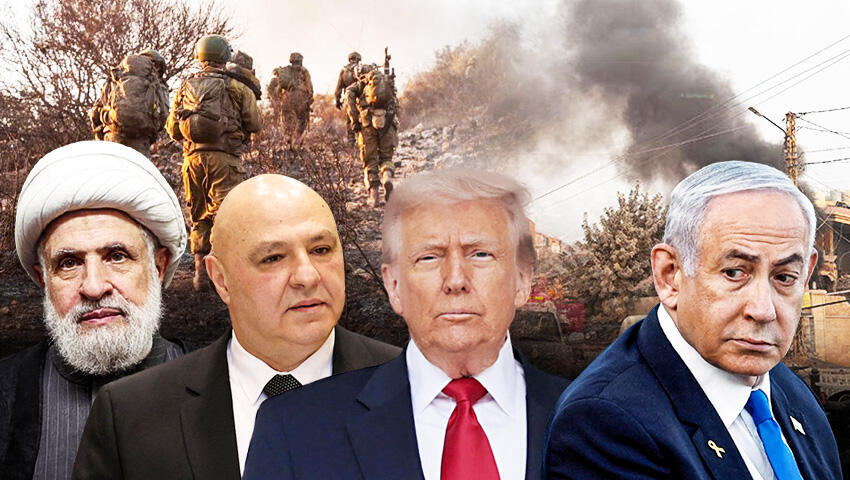
Naim Qassem, Joseph Aoun, Donald Trump and Benjamin Netanyahu
(Photo: Anwar Amro/ AFP, Amir Cohen/ Reuters, /Jessica Koscielniak/ Reuters)
According to the report, “Lebanon does not have much to offer regarding the security issues raised in the negotiations.” Lebanon’s message, the report said, was that any de-escalation could pave the way for strengthening the role of the state and the army.
Hezbollah’s parliamentary bloc responded to the talks, accusing Lebanon’s leadership of negotiating while Israel continues its military activity.
“The direct negotiations being conducted by the leadership with Israel are taking place while the enemy continues to commit its crimes and tries to expand its occupation of our land in the south of the country,” the bloc said. “This reaffirms the occupation’s exploitation of the negotiation meetings and its use of them to advance its own interests.”
According to Hezbollah, “the authorities continue to make concessions without even securing a ceasefire. This only worsens internal division and deepens the rift in society and state institutions.”
The group again called on Lebanese authorities “to abandon this disgraceful political path and return to the core principles of the constitution and the national covenant, in order to strengthen unity and national understanding.”
For the first time, senior representatives of the IDF and Israel’s National Security Council are taking part in the talks. Washington officials last week described the expected round as “intensive.”
Lebanon is expected to again demand an Israeli withdrawal from southern Lebanon, but Israel is expected to make clear that withdrawal is not on the table as long as Hezbollah continues firing and threatening Israel.
During the talks, the sides will discuss two parallel tracks: a diplomatic track aimed at reaching a peace agreement, and a military track aimed at disarming Hezbollah.
Israel’s delegation is headed by Israeli Ambassador to Washington Yechiel Leiter, who will continue to lead the talks. He will be joined by the embassy’s Middle East adviser.
For the first time, working teams from Israel will also join the delegation: Brig. Gen. Amichai Levin, head of the Strategic Division in the IDF Planning Directorate; Deputy National Security Adviser Yossi Draznin; and acting IDF attaché in Washington Brig. Gen. Erik Ben-Dov.
Last month, Prime Minister Benjamin Netanyahu said his directive to open negotiations came “in light of Lebanon’s repeated requests to begin direct talks with Israel.”
“The negotiations will focus on disarming Hezbollah and regulating peace relations between Israel and Lebanon,” Netanyahu said. “Israel appreciates the Lebanese prime minister’s call today to demilitarize Beirut.”