

Jerusalem is furious with German President Frank-Walter Steinmeier — widely considered a close friend of Israel — following controversial remarks in which he said the war by Israel and the United States against Iran is "illegal" and "unnecessary." In doing so, Steinmeier effectively denied Israel’s right to self-defense against the Iranian threat and gave backing to Iran, which, unsurprisingly, praised his comments. Germany’s far-right party Alternative for Germany (AfD) also agreed with the statements by the president.
Speaking at an event marking 75 years since the founding of Germany’s Foreign Ministry, Steinmeier said: "Our foreign policy does not become more convincing just because we do not call a breach of international law a breach of international law. Our foreign policy does not become more convincing when we fail to define violations of international law as such.
Gallery
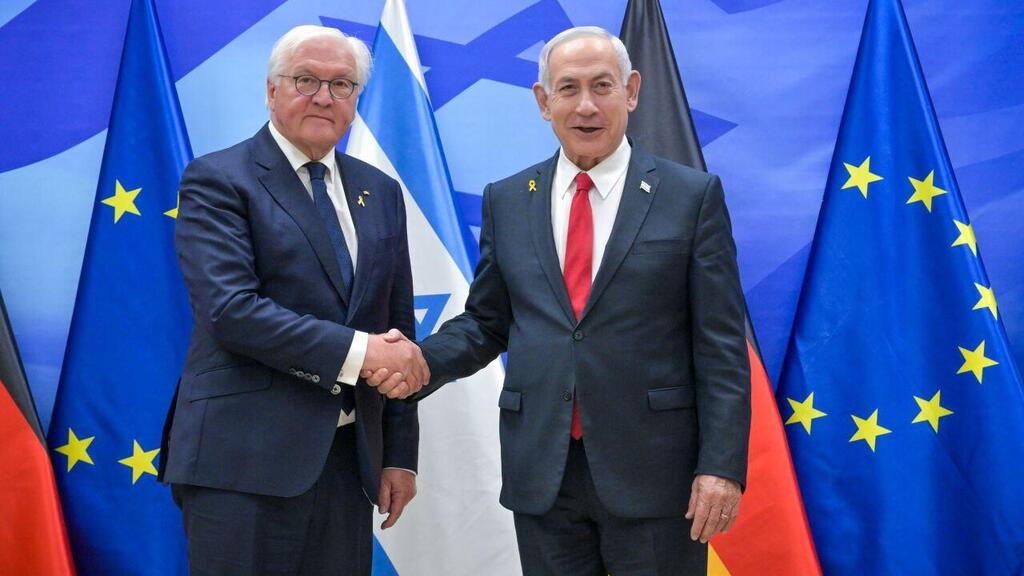
German President Frank-Walter Steinmeier with Israeli Prime Minister Benjamin Netanyahu
(Photo: Koby Gideon/GPO)
"We must address this with regard to the war in Iran. For, in my view, this war is contrary to international law. There is little doubt that, in any case, the justification of an imminent attack on the U.S. does not hold water,” he said.
“This war is also — and please bear with me when I say this, as someone directly involved — a politically disastrous mistake,” said Steinmeier. “And that’s what frustrates me the most. A truly avoidable, unnecessary war, if its goal was to stop Iran from developing a nuclear weapon.”
"The nuclear agreement already helped us make so much progress. We were never further from an Iranian nuclear weapon than after the signing of the 2015 nuclear deal,” he added.
Iranian Foreign Minister Abbas Araghchi was quick to capitalize on Steinmeier’s criticism. In a post shared by Iran’s Foreign Ministry, Araghchi claimed that “international law is effectively dead” due to what he described as Western hypocrisy regarding Gaza and Ukraine, and silence over the “aggression against Iran.” He publicly credited the German president for condemning the operation and called on other world leaders “who value the rule of law” to follow his lead and speak out.

Israel’s ambassador to Germany, Ron Prosor
(Photo: Boaz Adar)
Following Steinmeier’s remarks, Israel’s ambassador to Germany, Ron Prosor, published a sharply worded article criticizing him — an unprecedented move given Steinmeier’s reputation as one of Israel’s closest allies in Germany. Moreover, the president’s comments run counter to the position of the German government.
In the article, published in the center-left Frankfurter Allgemeine Zeitung, Prosor argued that Steinmeier’s remarks effectively undermine Israel’s fundamental right to defend itself against an existential threat. He added that Steinmeier is creating a legal framework that is the ayatollah regime’s fondest dream — namely, delegitimizing any action against it.
The ambassador also noted that, as a supporter of the 2015 nuclear deal, Steinmeier ignored the fact that the issues of ballistic missiles and the ayatollahs’ support for terrorism in the region were not included in the agreement. He wrote that the result — in the form of Iranian drones and ballistic missiles attacking Ukraine and threatening Europe — is now evident. He concluded by quoting former U.S. ambassador to the United Nations Adlai Stevenson: “Power corrupts, but lack of power corrupts absolutely.”
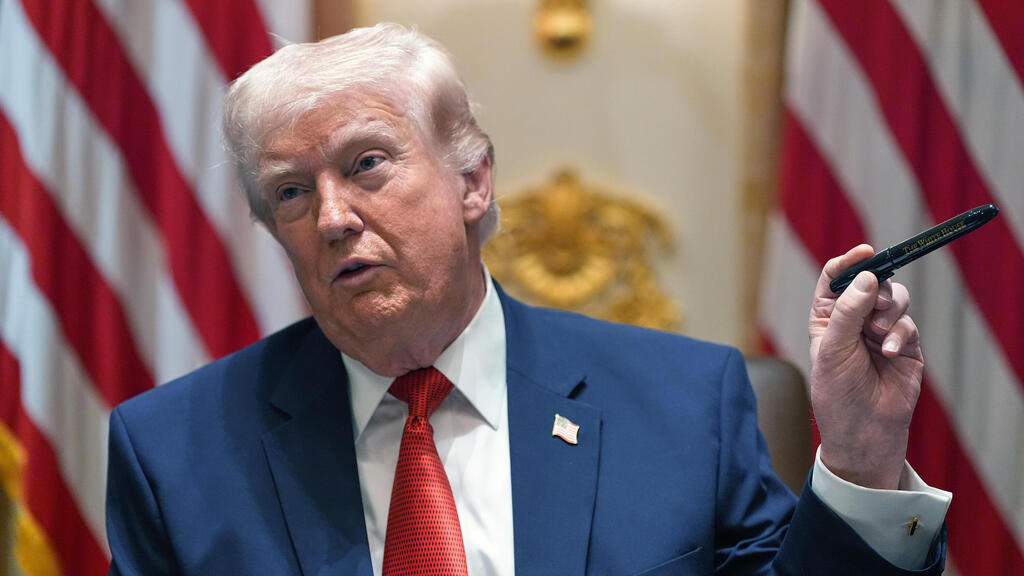
US President Donald Trump
(Photo: Evelyn Hockstein/Reuters)
Later Thursday, during a televised Cabinet meeting, U.S. President Donald Trump also addressed Steinmeier’s remarks. When asked about reports that the U.S. is considering diverting ammunition and weapons from Ukraine to the Middle East, Trump said Washington moves munitions “all the time,” but then again expressed anger over NATO’s refusal to assist the U.S. in forcibly reopening the Strait of Hormuz.
He signaled he might adopt a similar stance when allied countries need Washington’s help: “When I heard the president of Germany say about Iran ‘this is not our war,’ I said, ‘Well, Ukraine is not our war. We helped, but Ukraine is not our war. I thought that was a very inappropriate statement, but he made it. You can’t erase it. That’s how he felt.’”