


The Houthi offensive in Yemen is drawing close attention from Israel’s defense establishment as the new Jewish year begins, with officials increasingly concerned by developments around the Red Sea and their potential implications for global shipping and Israeli security.
In recent days, the Iran-backed Houthis have continued capturing towns along the southern Red Sea coast and gained control of the Bab el-Mandab Strait, one of the world’s most important maritime trade routes.

The dramatic shift came after forces loyal to Yemen’s internationally recognized government withdrew from the strategic island of Perim, also known as Mayyun, which sits in the middle of the southern entrance to the strait. The withdrawal effectively gave the Houthis a critical position from which to exert control over the waterway.
Officials in Jerusalem have described the development as concerning, but Israel’s defense establishment is not expected to intervene unless Israel itself comes under direct attack.
The Houthi takeover and their gradual expansion across the maritime region are viewed in Israel as more than a localized development. Israeli defense officials see the situation as potentially dangerous not only for Israel but for countries around the world that depend on the shipping route.
The geography makes Bab el-Mandab particularly vulnerable.
Farther north in the Red Sea, near Yemen’s major port city of Hodeidah, the sea is relatively broad, ranging from about 160 to 260 kilometers (100 to 160 miles) across. But farther south, at the strait itself, the waterway narrows to only about 18 kilometers (11 miles).
That difference is significant from a military perspective.
By comparison, the Strait of Hormuz, where Iran has demonstrated its ability to severely disrupt maritime traffic, is about 55 kilometers (34 miles) wide. Israeli security officials believe controlling or disrupting shipping could be considerably easier at Bab el-Mandab, which at its narrowest point is roughly one-third as wide.
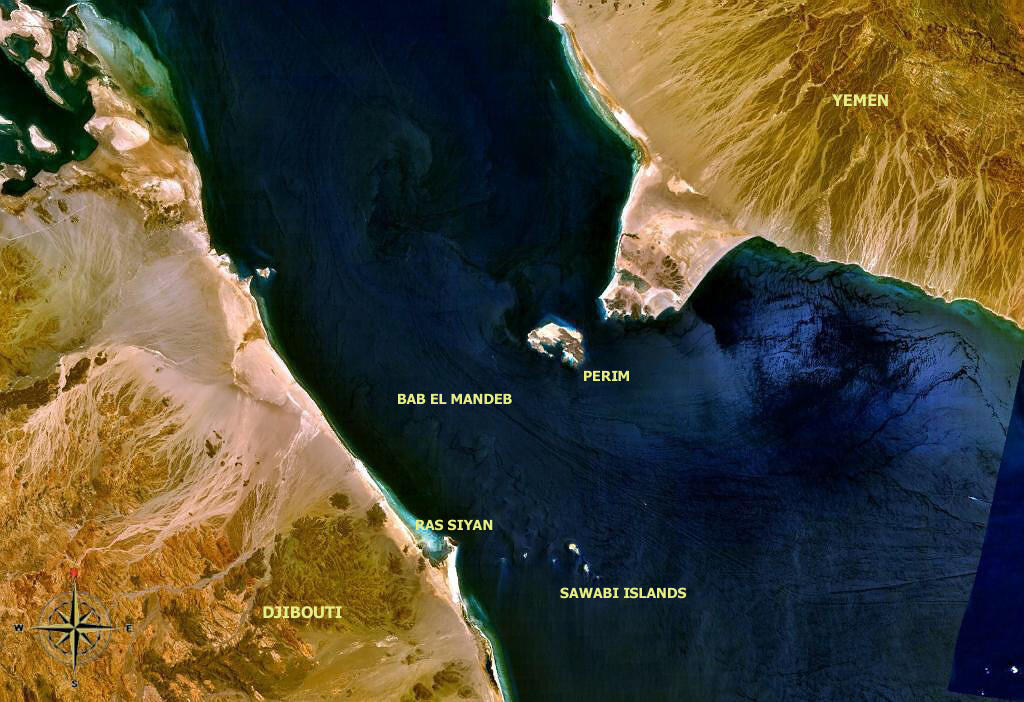
The Bab al-Mandab Strait
In such a confined waterway, sophisticated radar systems or other complex surveillance capabilities are not necessarily required to identify and target ships. Vessels can potentially be observed visually, while relatively simple weapons, including Kornet anti-tank guided missiles, could be fired at them. Explosive-laden boats could also be dispatched against passing vessels.
Israeli assessments therefore suggest that control of Bab el-Mandab could allow the Houthis to select targets with considerable precision, potentially giving the group substantial leverage over a maritime route critical to the global economy.
Questions in Israel over collapse of deterrence
Behind closed doors, some Israeli officials are sharply criticizing what they view as a collapse of deterrence in the region and questioning why Saudi Arabia, Yemen’s internationally recognized government and other regional actors have not responded more forcefully to the Houthi advance.
The result, in their assessment, is that the Houthis have gained the upper hand while encountering relatively little resistance. The developments have also exposed what some Israeli officials view as serious shortcomings in the military flexibility and capabilities of the forces expected to confront the Yemeni rebels.
That weakness stands in contrast to the Houthis’ determination and willingness to employ virtually any means available while their opponents retreat.
The concern within Israel’s defense establishment is that if the Houthis successfully exploit their control of Bab el-Mandab, a more cohesive and formidable Iran-led regional coalition could emerge — one that another power may eventually have to dismantle.
For now, U.S. President Donald Trump has refrained from intervening directly.
“The Houthis don’t want to fight us,” Trump said Saturday, addressing the escalating tensions.
Axios reported that Saudi Crown Prince Mohammed bin Salman called Trump twice last week and asked the United States to strike the Houthis. Trump has so far rejected the request.
Israeli Navy raises readiness
Against the backdrop of the latest developments, the IDF has adjusted its readiness.
Alongside protecting Israel’s land borders, the military is strengthening efforts to defend strategic assets at sea and preserve freedom of navigation for Israeli shipping.
Navy commander Vice Adm. Eyal Harel has ordered the service to raise readiness across its command-and-control network. Senior commanders have also reinforced naval forces at sea in an effort to prevent surprises in the maritime arena.
From the IDF’s perspective, developments in the Red Sea are part of a much broader transformation of maritime security that could ultimately extend into the Mediterranean.
The maritime arena has undergone dramatic changes, from Iranian control of the Strait of Hormuz to the Houthis’ latest gains around Bab el-Mandab.
Israeli officials believe armed groups across the region have closely watched Iran’s actions at sea and that Tehran’s successes have whetted the appetite of its allies to use maritime areas for their own operations. The concern is that such activity could escalate from provocations into serious violations of freedom of navigation and, in some areas, effective control of strategic waterways.
For Israel, the stakes are particularly high.
Although it has land borders, Israel is heavily dependent on maritime commerce and is often described by its security establishment as functioning economically like an island. About 98% of its imports by volume arrive by sea, making uninterrupted access to maritime trade routes a strategic necessity.
As a result, Israeli defense officials increasingly view the sea as a central theater of national security.
Ensuring freedom of action at sea and guaranteeing the movement of goods to and from Israel can no longer remain merely policy slogans, officials say. Those commitments must be backed by greater military capabilities.
The conclusion taking shape within the defense establishment is that the Israeli Navy will have to expand and significantly strengthen its capabilities in the coming years if it is to meet a maritime challenge stretching from the Mediterranean through the Red Sea and into some of the world’s most strategically important shipping lanes.