

Hours after again threatening to destroy Iran’s regime, US President Donald Trump struck a markedly more optimistic tone Tuesday, saying Tehran wants to negotiate and that relations between the two countries are “developing” as he prepared to meet Arab leaders on the sidelines of the UN General Assembly in New York.
Trump told world leaders earlier Tuesday that he faced what he called a major decision between reaching an agreement with Iran and taking far more destructive military action against the Islamic Republic. At the same time, he predicted that a deal would eventually be reached after the US midterm elections in November. Iran has also signaled a willingness to revive negotiations, while Arab governments have been working to arrange high-level US-Iran contacts in New York.
Trump talks during the UN General Assembly
(Video: UN web tv)


Later, during a meeting with British Prime Minister Andy Burnham, Trump again expressed confidence that Washington and Tehran could eventually reach an agreement.
“They want to talk to us. They’re talking to us. Even today they’re talking to us. The relationship is developing,” Trump said. “But we cannot allow them, and they understand, we cannot allow them to have a nuclear weapon.”
Burnham’s first in-person meeting with Trump was expected to focus heavily on the Middle East, including the Iran war and disruption to shipping through the Strait of Hormuz. Britain has also agreed to provide limited defensive aerial refueling support to Saudi Arabia as Riyadh confronts renewed Houthi attacks from Yemen.
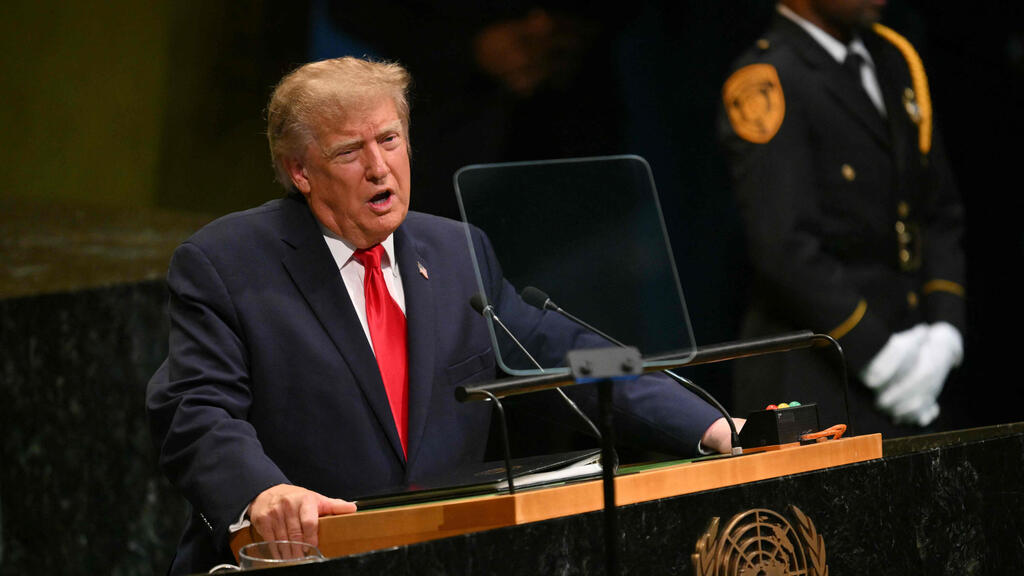
US President Donald Trump
(Photo: ANGELA WEISS / AFP)
Trump is also due to meet Gulf leaders and senior officials in New York for talks expected to focus on the nearly seven-month US-Iran conflict and what comes next. Saudi Arabia, the United Arab Emirates, Qatar, Bahrain, Kuwait and Oman were invited to participate, with Iraq and Jordan also joining the discussions.
Several of the same Gulf governments pressed Trump in August to hold off on a major new strike against Iran, believing an agreement with Tehran could still be within reach. A month later, no such agreement has been concluded.
The Gulf states arrive at the talks increasingly concerned about their own vulnerability. Iranian missile and drone attacks during the war have exposed limits in the security protection offered by the large US military presence in the region, prompting governments to explore both stronger defense arrangements and direct diplomacy with Tehran.
The New York talks are therefore expected to go beyond the question of whether Washington and Tehran can reopen negotiations. Regional governments are also seeking greater clarity over the security guarantees the United States is prepared to provide as they confront the fallout from the Iran war.
The Houthi threat is also expected to feature prominently. The Iran-backed group has expanded its territorial control in Yemen around the strategic Bab el-Mandeb Strait and intensified attacks on Saudi Arabia, creating another security challenge for Gulf governments already contending with Iran and disruption in the Strait of Hormuz.
Saudi Arabia has repeatedly sought greater US military assistance against the Houthis, but Trump has so far stopped short of joining Riyadh’s campaign directly. That hesitation has fueled questions in the kingdom over the extent of Washington’s commitment to its defense, even as the broader US-Saudi military relationship remains extensive.
For now, Trump is publicly leaving both options open on Iran: renewed diplomacy and the threat of further military force. His remarks Tuesday suggested that, despite the warnings delivered from the UN podium only hours earlier, contacts with Tehran have not stopped.
“The relationship is developing,” he said.