


France’s right and far right on Friday accused the Spanish government and Prime Minister Pedro Sánchez of having “encouraged” the wave of undocumented migrants who crossed from Morocco into the Spanish enclave of Ceuta. Politicians on the French left, meanwhile, accused their rivals of spreading falsehoods and manipulating the crisis just months before the presidential election.
Italy announced that it was suspending the European Union’s Schengen free-movement agreement with Spain in response to the crisis. Although Italy does not share a border with Spain, the measure will affect passengers traveling by air or sea between the two countries. Italy’s Interior Ministry also said Rome had agreed with Paris to strengthen checks along the land border between France and Italy.
The rush into Ceuta


About 60,000 migrants crossed the border between Morocco and Ceuta in recent days. Spain’s Interior Ministry said Friday afternoon that at least 48,300 had returned to Morocco.
Sánchez, a frequent and outspoken critic of Israeli policy, condemned the mass crossing as an “attack on Spain’s territorial integrity.” Morocco claims sovereignty over Ceuta and has long demanded that Spain transfer control of the enclave.
A business owner in the Moroccan town of Fnideq, which borders Ceuta, said many of those who had crossed were returning. “Some are coming back because they are hungry and thirsty,” Nabil, 35, who asked The New York Times to identify him only by his first name for fear of reprisals, said. “Business owners are afraid they will be looted or attacked.” It remains unclear what precisely triggered the sudden arrival of such large numbers of people.
French far-right leader Marine Le Pen condemned what she called a “massive and coordinated entry” that she said had been “encouraged” by the Spanish government. She linked the influx to a broad legalization program for undocumented migrants adopted by Spain this year and expected to apply to about 500,000 people. The Spanish government says the plan is intended to support the country’s economic growth.
As in several other European countries, including Italy, Denmark and Finland, National Rally President Jordan Bardella called on the European Union to “immediately suspend” Spain from the Schengen zone, which allows travel between member states without routine border checks or passport controls. He also demanded an emergency session of the European Parliament and accused Sánchez’s government of “passive complicity” in the crisis.
Criticism of Spain’s immigration policy also came from France’s political center, including presidential candidate Édouard Philippe. “One country cannot be allowed to decide unilaterally on a mass legalization of migrants that creates a pull factor for the entire continent,” he wrote on X. Philippe added that, if elected president, he would propose a “fundamental change to this model.”

Moroccans enter Ceuta
(Photo: FARO TV via REUTERS)
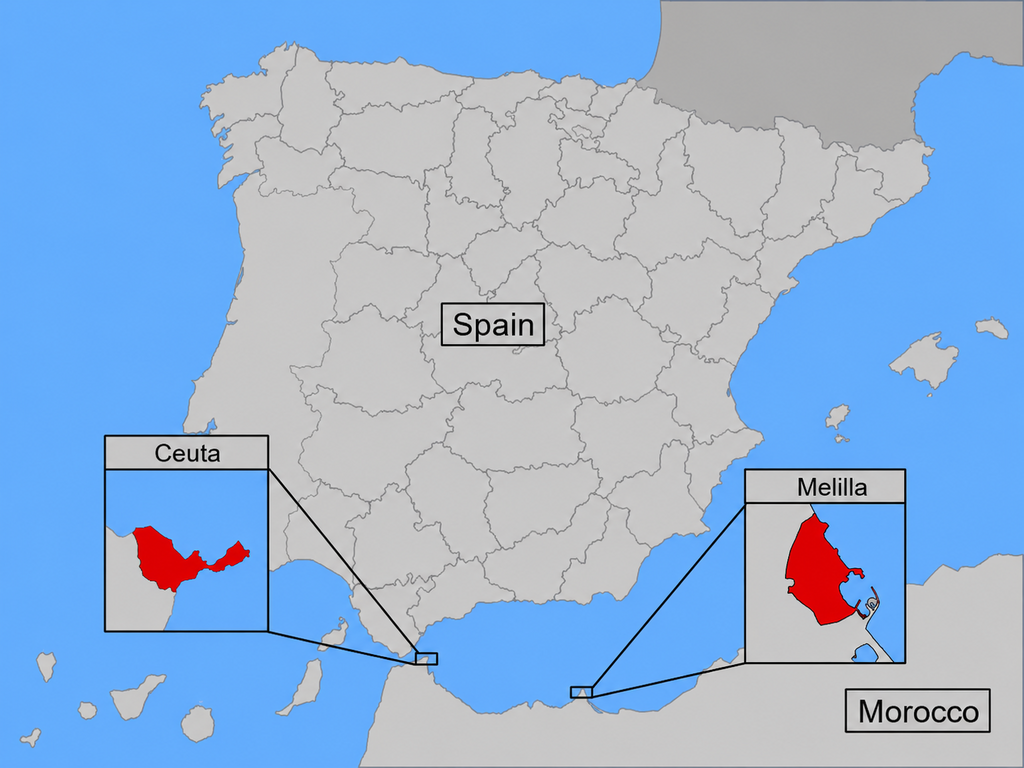
Alongside Ceuta, Melilla is another Spanish enclave in North Africa that borders Morocco. Together, their borders with Morocco constitute the European Union’s only land frontier with Africa, making them highly sought-after entry points for migrants from Morocco and sub-Saharan Africa seeking to enter the bloc on foot rather than make dangerous journeys across the Mediterranean.
Ceuta’s border with Morocco is eight kilometers long, while Melilla’s stretches for 12 kilometers. Both are protected by wire fencing, cameras and guard towers, but large-scale breaches still occur every few years.
In May 2021, for example, more than 8,000 migrants crossed into Ceuta without authorization over the course of two days. Migrants attempting to enter the enclaves do so by climbing the fences, swimming along the coast or hiding in vehicles authorized to cross the border. Once they reach Ceuta or Melilla, they undergo a formal status-review process that may allow them to remain in Spain and eventually begin a new life there.
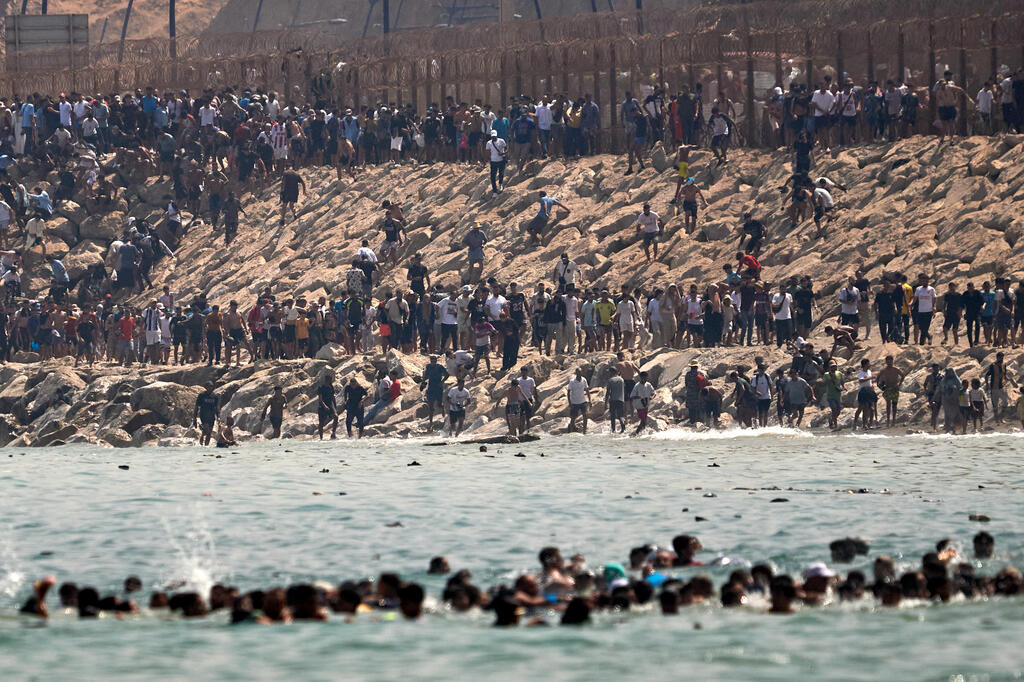
(Photo: AP Photo/Antonio Sempere)
Israel’s Ambassador to the United Nations Danny Danon also criticized Sánchez on Friday. “Spain, which never misses an opportunity to lecture Israel, has declared a state of emergency in Ceuta following the crisis surrounding its migration policy,” he wrote on X. “Perhaps before it continues lecturing us, it is time for Spain to explain to the world why it still maintains colonial enclaves in Africa.”
Following Danon’s remarks, a Moroccan news site accused Israel of “exploiting the migration crisis in Ceuta to settle scores with Spain.” A Moroccan source told ynet that many Moroccans rejected the description of the event as illegal migration. “Many Moroccans said the incident had nothing to do with illegal immigration, but rather with Moroccans crossing the border into a Moroccan city under Spanish occupation,” the source said.
“They argued that the problem is the occupation itself, not the arrival of Moroccans on their ancestral land.”
Another Moroccan source opposed the breach and argued that it was an attempt to damage the country’s image. Some in Morocco have claimed that Algerians, and even figures linked to Iran, may be behind the chaos, using social media to mobilize crowds and fuel tensions inside the country.