


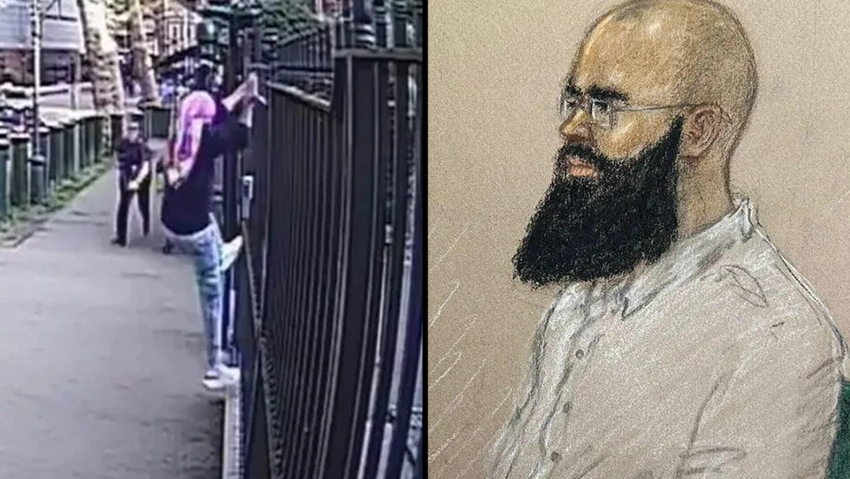
A London court on Monday sentenced Abdullah Albadri, a 34-year-old Kuwaiti, to life in prison with a minimum term of 20 years after he was convicted of attempting to carry out an attack at the Israeli Embassy in the city. He was arrested on April 28, 2025, after a diplomatic security team caught him and pulled him down from the embassy fence. He was carrying two 10-centimeter (4-inch) knives.
The investigation and trial revealed that Albadri, who had arrived in Britain in a small boat 16 days earlier after first entering the country illegally four years before, was driven to carry out the attack by the deaths of Palestinians in Gaza. On the day of the incident, he arrived at the site, saluted police officers and then began climbing the perimeter fence. During questioning, he asked officers why they were stopping him from "committing a crime" and said he wanted to "do something to stop the war."
Attempted attack at the Israeli Embassy in London
(Credit: Sky News)


Prosecutor Catherine Pattison argued that Albadri had planned an act in which he expected to sacrifice his life, noting that people emerging from the embassy at the time would have been unable to defend themselves. Defense attorney Chris Henley, however, argued that his plan could not have succeeded and that he had acted in a theatrical and extreme manner intended to attract attention after struggling to arrange housing. Helen Flanagan, head of Counter Terrorism Policing, praised the officers' response, which prevented a breach of the security perimeter, and said the severity of the sentence reflected the danger he posed and his lack of remorse.
Albadri's trial began in April, nearly a year after the incident. During the proceedings, the jury was told that he had entered Britain not once but twice aboard boats that sailed from the French coast, the main route used by migrants entering Britain illegally in recent years and one that the Labour government has faced mounting criticism for failing to shut down.
Albadri entered Britain by boat — twice
The investigation found that Albadri first arrived in Britain by boat from France on Aug. 5, 2021. In November 2023, however, he left Britain after withdrawing his application for a residence permit for reasons that remain unclear. On April 12, 2025, he returned to Britain, again aboard a small boat from France, and applied for asylum. He claimed he had been forced to leave Kuwait because he feared for his safety and that of his family, saying he was a human rights activist who had been arrested there. Like many other asylum-seekers, he was temporarily housed at the Crowne Plaza hotel in Hampshire.
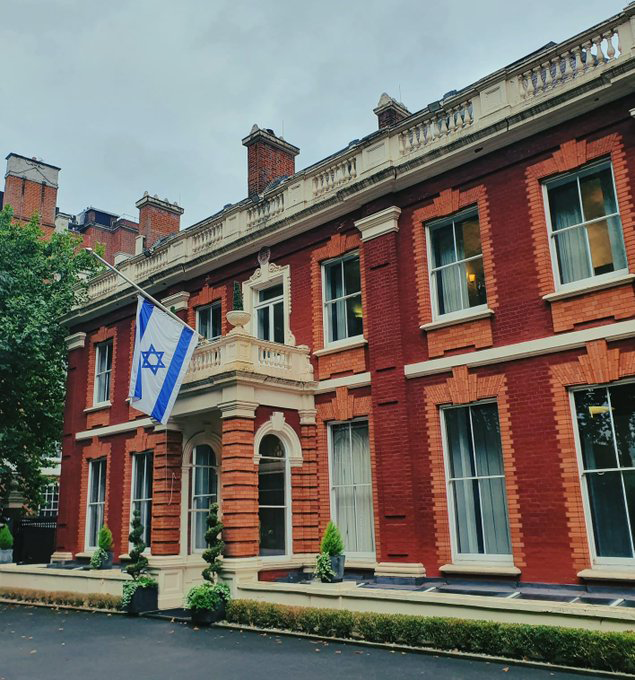
The Israeli Embassy in London
(Photo: Noy Drachman, Israeli Embassy in Britain)
In the days immediately after returning to Britain, Albadri was in contact with several organizations that assist asylum-seekers and met with members of London’s Kuwaiti community. But on April 24, his asylum application was rejected, after which he apparently began taking concrete steps toward carrying out the attack. An examination of his phone showed that on the same day he searched for the location of the Israeli Embassy and for information on Islamic law regarding suicide.
The attempted attack took place four days later, on April 28. At 3:30 p.m., he sent his mother a photograph of a farewell letter he had written. A knife with a red-and-white handle could be seen next to it in the photograph. The letter ended with the words: "I will not reverse my decision to go forth for the sake of Allah, to go forth for Him and confront the enemies in support of the religion of Almighty Allah."
Pattison, the prosecutor in the case, said the letter, which was found on his body after his arrest, was a farewell note written in preparation for becoming a martyr.