

Iran has begun observing 40 days of mourning for those killed in the massacre, as U.S. President Donald Trump said the deadline for talks with Tehran is “within the next month” — and a possible reason for that timetable may now be emerging. According to an assessment cited by the Daily Mail, the aircraft carrier USS Gerald R. Ford, which the United States has decided to deploy to the Middle East along with its strike group, will take up to four weeks to reach the region from its current position in the Caribbean.
Speaking outside the White House on Friday evening, Trump was asked why he had ordered the Ford’s deployment. "If we need it, we’ll have it ready,” he replied. The president added that he believes the talks will succeed, "but if they’re not, it’s going to be a bad day for Iran, very bad.”
Trump's new threat
(Video: FOX NEWS)


The New York Times reported, citing U.S. officials, that the options Trump is considering include military action against Iran’s nuclear program and its ability to launch ballistic missiles. He is also weighing the possibility of sending U.S. commandos to strike specific military targets inside Iran.
A senior U.S. administration official told the Daily Mail that during a White House meeting between Prime Minister Benjamin Netanyahu and Trump, Netanyahu urged the president to take a tougher line on Iran. “Netanyahu basically said, ‘Iran is playing games. You don’t want them to maneuver you.’ Trump listened,” the official said.
Inside Iran, anger continues to simmer over the regime’s sweeping crackdown on protests and the killings that followed. The outrage may intensify in the coming days as families begin marking the traditional 40-day mourning period for their loved ones.
Videos circulating online already show mourners gathering in several parts of the country, holding portraits of the dead. One video showed mourners at a cemetery in Razavi Khorasan province singing a patriotic song dating back to the 1940s, during the rule of Shah Reza Pahlavi. “O Iran, land full of treasures, your soil is full of art,” they sang. “May you live forever. O enemy, if you are granite — I am iron.”
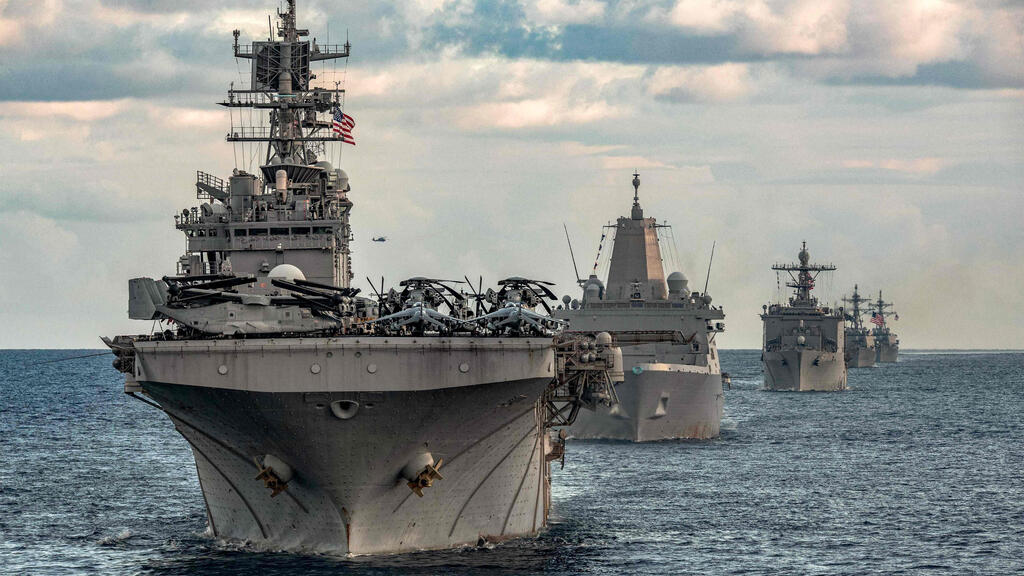
the aircraft carrier USS Gerald R. Ford and its strike group
(Photo: Nolan PENNINGTON / US DEPARTMENT OF DEFENSE / AFP)
Trump's deadline to Iran
(Video: Reuters)
According to the New York Times, at the outset of the anti-regime protests in late December, demonstrators received threatening text messages from authorities stating that their presence at “illegal gatherings” had been documented and that they were under “intelligence surveillance.” “It is recommended to refrain from participating in such gatherings, which the enemy desires,” the message said. Researchers concluded that the government likely tracked protesters using cellphone location data.
Organizations that have examined Iran’s capabilities say the regime possesses one of the most extensive surveillance systems known worldwide, including technology to monitor mobile devices, as well as facial recognition and other tracking methods. While these digital tools have received less attention than the sweeping internet shutdowns imposed during last month’s violent crackdown, Iranian accounts and a security official told the Times that as authorities gradually restore internet access, they have detained individuals suspected of participating in protests and subjected them to lengthy, aggressive interrogations based on facial recognition and phone data.
The USS Gerald R. Ford will join the USS Abraham Lincoln already in the Middle East, marking the first time since March 2025 that two U.S. aircraft carriers have operated in the region simultaneously. At that time, the USS Harry S. Truman and USS Carl Vinson were deployed during U.S. strikes against Houthi targets in Yemen.
The Ford previously deployed to the region at the outset of the war, in a move intended to deter Hezbollah following former President Joe Biden’s widely noted “Don’t” speech. U.S. officials at the time informed Israel of the deployment and stressed that sufficient forces were in place, with additional assets available if needed.
Named for the 38th president of the United States, the carrier carries more than 75 aircraft and is staffed by thousands of Navy personnel. Its defensive systems include missile launchers, Rolling Airframe Missiles, radar systems and Phalanx close-in weapon systems designed to intercept short-range threats, as well as 25 mm and .50-caliber machine guns to defend against small vessels.
Footage from the aircraft carrier USS Abraham Lincoln, which is already in the region
(Video: CENTCOM)
In remarks that included sharp criticism of President Isaac Herzog, Trump reiterated that talks with Iran have a deadline of “the next month” or the consequences would be “very traumatic” for Tehran. “A deal with Iran will probably happen within the next month, something like that,” he said. “It shouldn’t take long — it should happen quickly. They need to agree very quickly.”
He noted that when Iran previously failed to reach an agreement, it culminated in Operation Midnight Hammer, during which the U.S. military struck Iranian nuclear facilities, including the site at Fordow. He did not explicitly mention Israel’s Operation Rising Lion, which marked the start of the 12-day war.
Asked whether Netanyahu wants him to halt negotiations with Iran, Trump said, “He didn’t say that and we didn’t discuss it. I’ll talk to them as long as I want, and we’ll see if we can make a deal. And if we can’t, we’ll have to move to phase two, which will be very hard for them. I don’t want that to happen.”
Israeli officials are familiar with the timeline Trump outlined and say he has allocated only a few weeks for negotiations. Netanyahu remains skeptical, though he has defined his red lines.