

Israel’s ambassador to the U.S., Yechiel Leiter, said Sunday that his son Neriyah remains in critical condition after being seriously wounded in a Palestinian car-ramming attack last week, though the family has seen signs giving them hope.
“My family joins me in thanking everyone for their prayers and support,” Leiter wrote on X. “Neriyah’s life still hangs in the balance but we’ve seen some promising signs that we grasp in hope.”
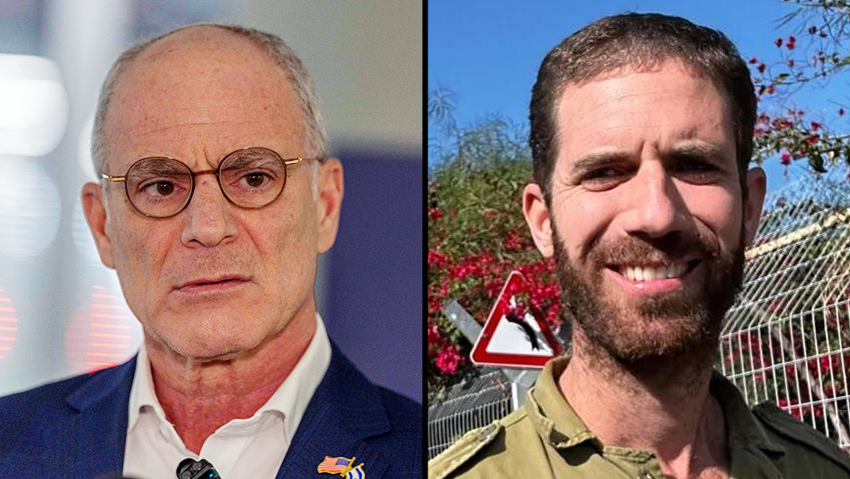
(Photo: Ilia YEFIMOVICH / AFP)
He urged supporters to continue praying for his son, writing: “We believe in the power of prayer, that G-d hears prayer and can heal when healing appears impossible.”
Leiter also asked that prayers for Neriyah include others seriously wounded in terrorist attacks.
“Along with my sense of gratitude to all for caring, I would like to request that the prayers for Neriyah include good wishes for all those who have sustained serious injuries at the hands of terrorists,” he wrote. “They and their colleagues are the heroes who ensure that we will persevere and win the battle against those who spread murder and mayhem. It is a struggle for the future of civilization, no less.”
Neriyah Leiter, an IDF reservist from Havat Yair in the West Bank, was critically wounded Wednesday in a car-ramming attack at a checkpoint on Route 443. A Palestinian terrorist drove his vehicle toward the checkpoint and was killed by IDF troops at the scene.
Leiter was evacuated to Shaare Zedek Medical Center in Jerusalem, where doctors have continued fighting to save his life.
The attack occurred one day before Prime Minister Benjamin Netanyahu’s address to the United Nations, where Ambassador Leiter had been expected to accompany him. Instead, the ambassador flew back to Israel.
“When I boarded the plane from New York while preparing the prime minister’s visit to the UN, there was a fear I would board without hope,” Leiter said last Thursday. “Thank God, the doctors managed to stabilize Neriyah’s condition.”
The ambassador’s family has already suffered a devastating loss during the war. Another of his sons, Maj. (res.) Moshe Yedidya Leiter, was killed in Gaza early in the fighting.
Neriyah himself wrote publicly in May about the decision to return to reserve duty despite that loss, after completing a two-and-a-half-month deployment.
“As a bereaved brother, after my brother Moshe was killed in the war, the decision to go back to reserve duty was not simple at all,” he wrote. “Something in the heart really tears.”
But, he said, he could not remain on the sidelines while his friends continued returning for repeated rounds of service.
“I couldn’t stand by while my friends were doing another round and another round,” he wrote. “I didn’t really have an inner option to stay home.”
Despite the pain and difficulty, Neriyah described his service as a privilege.
“I feel an enormous privilege,” he wrote. “A privilege to be part of these historic moments. A privilege to be with people who give of themselves without calculating too much. A privilege to be part of a group of people who, in ordinary life, are so different from one another, but when needed, everyone simply shows up.”