


Amid denials from Israel Aerospace Industries (IAI) of any delays in delivering Arrow 3 interceptor missiles to the Israeli Air Force, officials at the state-owned defense contractor are expressing hope that Israel will be included in the development of the U.S “Golden Dome” initiative, a multi-layered air defense system championed by President Donald Trump.
That hope may have gained traction Sunday following a high-level meeting between U.S. Senator Lindsey Graham and Prime Minister Benjamin Netanyahu. During his visit to Israel, Graham also met with Foreign Minister Gideon Sa’ar and Mossad Director David Barnea.

“The Prime Minister convinced me that Israel is developing weapons that will change the future of warfare,” Graham told reporters following the meeting with Netanyahu, adding that the Israeli leader had expressed willingness to collaborate with the United States and said he would return to Washington and treat the potential joint project "as a '21st-century Manhattan Project.'”
Graham did not specify which weapons system was under discussion, but his remarks were widely interpreted as a reference to the Golden Dome, the ambitious U.S. missile defense program inspired by Israel’s Iron Dome system.
Announced by Trump last year, the Golden Dome is envisioned as a four-tiered defense network that would include space-based interceptors and 11 short-range missile batteries deployed across the United States. Trump has said the system will be operational before the end of his current term.
Officials in Israel view potential involvement in the program as both a strategic opportunity and a validation of Israel’s technological edge in air defense, especially if the project receives high-priority backing from both the White House and senior members of Congress.
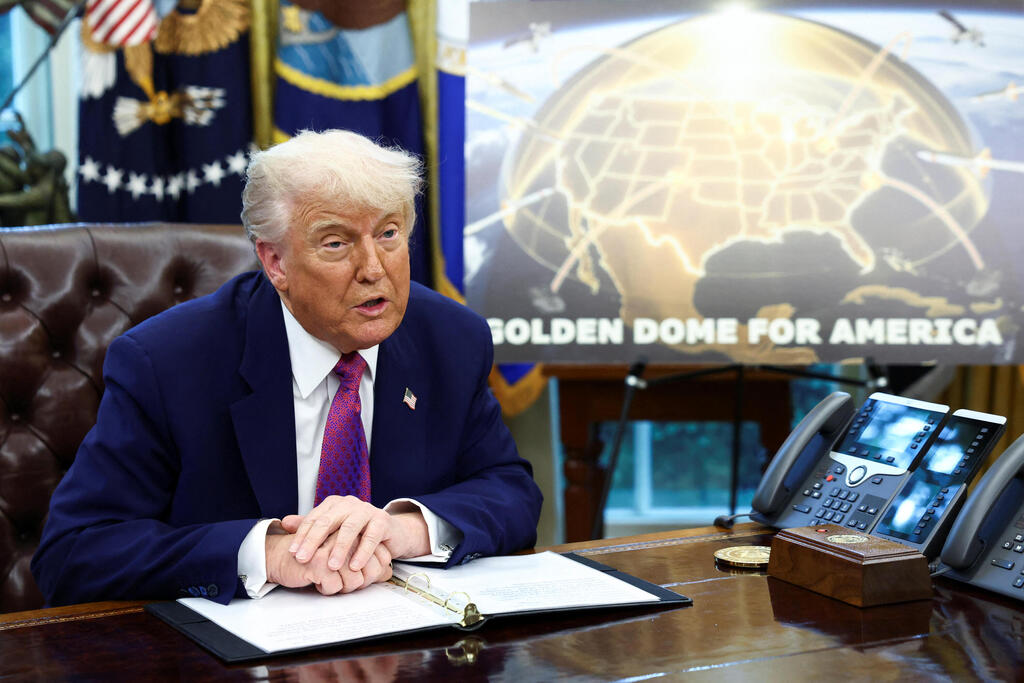
US President Donald Trump reveals the Golden Dome
(Photo: REUTERS/Kevin Lamarque)
IAI CEO Boaz Levy said over the weekend at a conference of the Israeli-American Council that “I believe the technological contribution to both nations will also serve the United States, and we want to be part of it, even though we know we need a prime contractor in the U.S. and that the system must be produced there. But when you have an ally like this and the level of cooperation is so high, it can be done.”
Levy said the “Golden Dome” is a unique architecture designed to defend the United States against ballistic missiles. “This can be done, as in Israel, through ground-based capabilities that intercept ballistic missiles; it can be done from space, and there are many activities involved,” he said. “I believe that the technology we are sharing together, and the maturity the system has demonstrated over the past two years, are the key to the future. We believe we can cooperate with an American company to bring these capabilities to the United States as well.”
The central challenge in developing the concept stems from the sweeping goal set by President Trump for the Pentagon. Unlike Israel’s Iron Dome, which was developed with U.S. assistance to defend limited areas against short-range rockets, the new system is intended to protect the entire United States from ballistic missiles and advanced hypersonic weapons. Trump has directed that the system be based on satellites in space.
Meanwhile, Israel Aerospace Industries rejected reports claiming the company is delaying delivery of Arrow 3 interceptor missiles to the Israeli Air Force, which would leave Israel without full defensive readiness in the event of an Iranian strike in response to a U.S. attack on Tehran. Industry sources described the claims as “pure spin,” saying that even before June's 12-day war against Iran, Arrow missile production lines had been operating at full capacity, seven days a week.

(Illustration: Lockheed Martin)
They said production has recently accelerated further after bottlenecks in obtaining certain missile components from abroad were resolved following the lifting of an embargo on Israel.
IAI has decided not to convert older Arrow 2 interceptors from the IDF’s stockpile into advanced Arrow versions, instead focusing on speeding up production of the new Arrow 4 and delivering it to the air force in the coming months. The company also assessed that the start of missile production for the German military—under the two phases already agreed to in the deal signed recently and shortly before Oct. 7—will have a positive impact on continued deliveries to the IDF, since the version produced for Germany is also suitable for Israeli use.
“There is no budget issue here,” company officials said. “We are producing Arrow missiles nonstop in close coordination with the Defense Ministry.”