

The KC-135 Stratotanker refueling aircraft that crashed Thursday in western Iraq is considered the first jet-powered aerial refueling aircraft to enter operational service with the US Air Force.
The aircraft began service in the late 1950s, replacing the KC-97 Stratofreighter. More than 800 units were produced, making it one of the most widely used aircraft of its type. It serves as the backbone of the US Air Force’s aerial refueling capability, which enables fighter and bomber aircraft to reach long distances.

The KC-135 is based on the Boeing 707, one of the earliest jet passenger aircraft. Its fuselage was modified to include fuel tanks, while a refueling boom mounted at the rear allows the transfer of fuel to another aircraft. In total, the aircraft can carry about 113,000 liters of fuel. Depending on operational requirements and flight range, it can transfer roughly 23,000 to 51,000 liters to other aircraft. The versions currently in service with the US Air Force are the newer KC-135R models, which entered service during the 1980s and 1990s and are expected to remain operational at least until the end of the decade.
These aircraft are equipped with modern CFM-56 engines, replacing the original engines from the earliest versions that entered service in the mid-1950s. The upgraded engines allow longer-range operations and improved efficiency, while upgraded avionics systems enable the aircraft to operate in more complex flight environments. US refueling aircraft arrived in Israel even before Operation Lion’s Roar began, since aerial refueling is considered critical to the mission’s success. This applies both to US fighter jets participating in the operation and to Israeli Air Force aircraft.
The Israeli Air Force does operate a dedicated refueling squadron, the 120th Squadron, but its aircraft are significantly older. They were produced during the 1960s and 1970s and are Boeing 707 aircraft converted from passenger planes. As a result, the arrival of US refueling aircraft significantly enhances the ability of Isra
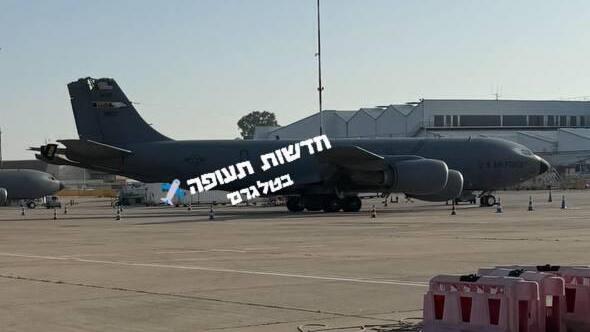
A US KC-135 aerial refueling aircraft at Ben-Gurion Airport
(Photo: Aviation News on Telegram)
eli fighter jets to conduct large-scale bombing sorties in Iran.
Aerial refueling is considered one of the most complex missions in aviation, requiring aircraft to fly in close formation while maintaining precise speed and altitude. Professional sources who spoke with Ynet said the crash in Iraq, which killed six crew members, likely occurred after contact between two refueling aircraft in midair. According to US Central Command, the crash was not caused by enemy fire or friendly fire. One of the aircraft crashed, while the second managed to land at Ben-Gurion Airport with damage to its vertical stabilizer.
Several scenarios could explain such a collision. One of the main possibilities investigators are expected to examine is a failure to maintain altitude and distance separation while the aircraft were flying holding patterns over a designated area.
A similar scenario led to the 1997 helicopter disaster near She’ar Yashuv in northern Israel. Such flight profiles are particularly challenging at night, especially during operational missions over enemy territory. In such conditions, aircraft often fly without the standard aviation detection systems used in civilian aviation, such as external lighting and transponders. Investigators are also expected to examine the command and control systems responsible for monitoring aircraft positions and warning of dangerous proximity between them. The crash marks the fourth aircraft the US Air Force has lost since the operation began. Earlier, three F-15E aircraft were shot down in friendly fire by an F/A-18 belonging to the Kuwaiti Air Force. According to US officials, those incidents also were not caused by enemy fire.