


The attempted hijacking of Israelis aboard a Flydubai flight is not expected to affect relations between Jerusalem and Riyadh. The aircraft was not bound for Saudi Arabia and, as far as is known, the attacker did not intend to crash it on Saudi soil. He tried to take control of the plane only once it was over Jordan.
The nature of relations between the two countries can also be seen in the fact that throughout the incident, the Mossad remained in continuous contact with Saudi officials.
Gallery

The Israeli passengers at the airport in Saudi Arabia
(Photo: AFP/Courtesy of an anonymous source)
The Saudis played an important and positive role in escorting the aircraft and receiving it at their airport. They treated the Israeli passengers very well, providing them with food and medical care. Passengers said the treatment they received was excellent, something that should not be taken for granted.
At the same time, Saudi Arabia firmly refused to allow Israeli Air Force Hercules transport planes to land in the kingdom to evacuate the Israelis. That was considered a step too far and could have been seen as an act of normalization at this time.
Behind the scenes, however, the Mossad came close to persuading the Saudis to allow an unmarked white Israeli aircraft to land in Tabuk. In the end, the plane was not needed after all the passengers agreed to board Flydubai’s rescue flight.
A senior Israeli official said sending an Israeli aircraft, which would almost certainly have been photographed, was too much for Saudi Arabia.
“This also shows that Saudi Arabia, or at least Saudi public opinion, is still not ready for an overt Israeli presence or visible ties with Israel,” the official said. “The kingdom currently enjoys a security relationship in the form of a ‘mistress,’ paying no price for it and only benefiting. If Israel is smart, it will know how to leverage the security relationship and gain diplomatic benefits from it as well.”
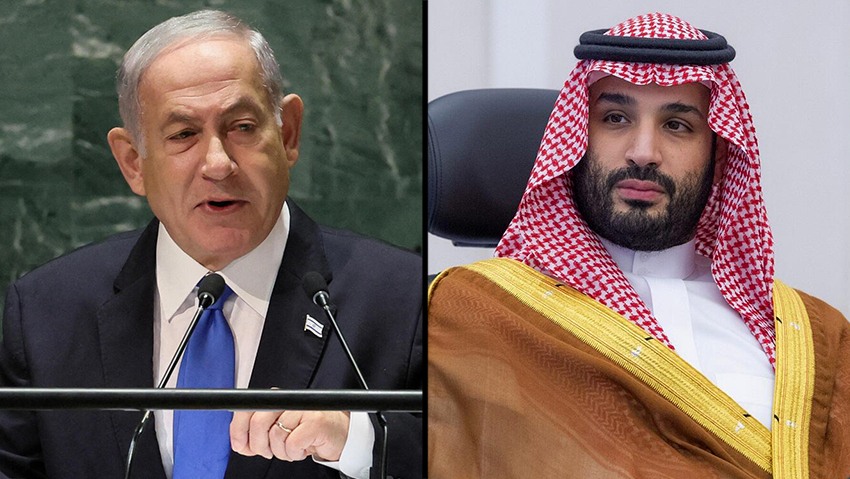
Prime Minister Benjamin Netanyahu, Saudi Crown Prince Mohammed bin Salman
(Photo: AP, Reuters/Brendan McDermid)
Since October 7, Saudi Arabia has continued allowing Flydubai aircraft to cross its airspace on flights to Israel and from Israel to the Gulf.
A senior Israeli official said the incident had already strengthened ties by demonstrating that Saudi Arabia was willing to allow a plane carrying 180 Israelis to land there, adding that Riyadh deserved credit for the way it treated the Israeli passengers.
Beyond that, relations between the two countries depend in part on the continuation of the conflict with Iran.
Only recently, the Saudis asked Israel, through U.S. Central Command, for intelligence assistance in their fight against the Houthis, and Israel apparently did not turn them away. That came despite tensions in relations following the signing of the “Mecca alliance,” which includes Turkey and Pakistan.