

He is likely among the last surviving members of the pre-state undergrounds who will mark in the coming days the mass arrest of the Jewish Yishuv leadership, along with thousands of fighters, defenders and underground activists, in the British Mandate’s most comprehensive and far-reaching arrest operation. The operation became known as “Black Sabbath.” Its goal was to crush the military power of the underground movements, first and foremost the Palmach, and to arrest the Yishuv leadership in direct response to the escalation in sabotage operations by the Jewish Resistance Movement against the Mandate authorities, culminating in the “Night of the Bridges.”
Shabtai Meshulam, who will turn 97 in two months, is one of the last living former teenage fighters, members of the Jewish undergrounds, who were taken from their homes on the morning of Saturday, June 29, 1946, detained for questioning, placed in interrogation rooms run by the British Criminal Investigation Department and later sent to the harsh detention camps operated by the British army.
Gallery
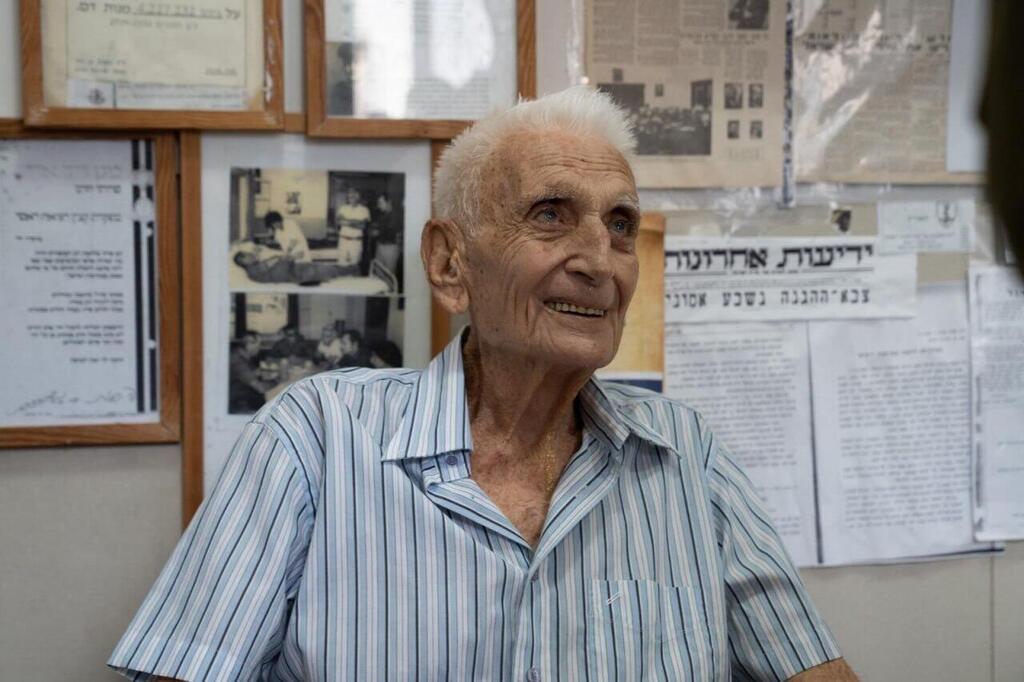
Shabtai Meshulam, one of the last surviving detainees from Black Sabbath
(Photo: IDF Spokesperson’s Unit)
He was born in Saloniki, Greece, and immigrated with his parents to Israel in 1933 after persecution of Jews began. Despite his advanced age, Meshulam is able to vividly and fluently reconstruct the drama that unfolded that morning in his parents’ modest public housing apartment in Tel Aviv.
“My father arrived with 10 pounds in his pocket and an electrician’s certificate,” he said. “We settled in Tel Aviv, in the Florentin neighborhood. Everything was empty and we began living there. I studied at the Tachkemoni school, which was a religious school, even though I was not religious. After finishing school, I began studying in the evening and joined the Working Youth movement, at the branch on Tchernichovsky Street. The person in charge of the branch was Shimon Persky, later Peres. He looked like one of the boys there. Yehoshua Rozin, later known as ‘Mr. Basketball’ and one of Israel’s leading coaches, was my basketball coach.”
Meshulam says he joined the underground while still a boy. “I swore allegiance to the Haganah when I was just 15 and a half. We lived at 52 Hakishon Street, and then suddenly, on Saturday morning, there was a knock at the door,” he recalled. “My parents opened the door, they asked whether Shabtai Meshulam lived there and told me to come with them. There was only a ‘kalani’ — the nickname for a British soldier wearing a red beret — and a detective. The British soldier walked behind me and kept hitting me in the back with the butt of his rifle so I would hurry, though my steps were still short, slow and painful because of an injury I had suffered a few months earlier in another operation.”
“They took me to Jaffa Street in Tel Aviv, to the British licensing office. Groups of soldiers were sitting in the courtyard. They took me into an interrogation room, sat me in front of albums and showed me photographs. They asked whether I recognized anyone and whether I was in a youth movement. I said I was in the Working Youth movement. I decided that even if I recognized some of the Haganah members and fighters in the pictures, I would not give them up,” he said.
According to Meshulam, “I had been in the Haganah since I was 15 and a half. I also knew friends who were in the Irgun and Lehi, and I did not mention a word about them. I made myself look small, not important. I told them I had been in Maccabi and the Working Youth, ‘What do you want from me?’ I was with my parents and I played dumb. What would have happened if they had threatened me with arrest or beatings or something else? I would have kept quiet. In my view, staying silent and not talking was the only solution. I arrived determined not to give anyone up. It was the Saison,” he said, referring to the Haganah’s campaign against the Irgun, “and I knew I did not need to help the British. They thought they would stay here forever, but they did not. I knew that one day we would have a state.”
Meshulam said he was released that same day. “They whispered among themselves until they sent me home. They told me to get out of there. They were looking for big fish and understood they would not get any information out of me. They were looking for the leaders of the Yishuv. They did not interrogate me violently. We were lucky we had the British and not people from other countries. They spoke to me in Hebrew, and I was not afraid of anything.”
“My father enlisted in the British army during World War II. He was lucky he was sent to Egypt and not Europe. They asked whether I knew people, and I told them I was in the Working Youth and went on hikes. I did not come out of Black Sabbath traumatized,” he said.
“I knew the bridges had been blown up. I did not expect the British raid after the Night of the Bridges. A neighbor of mine who was arrested on Black Sabbath was sent to Africa. I was not an object of interest for the British, so they released me after a few hours,” he said. “It is a shame that my generation is being forgotten.”
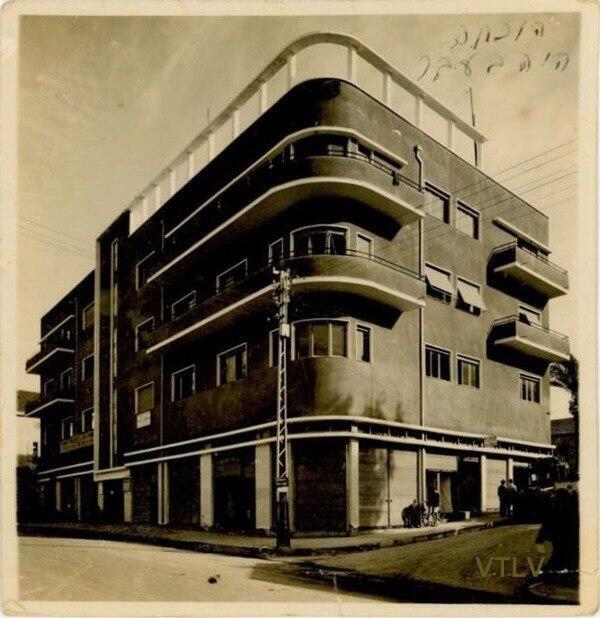
The British CID building on Jaffa Street
(Photo: Courtesy of VTLV)
Moshe Kashi, a military historian and reservist in the heritage officers’ corps who documents the stories of 1948 War fighters, added: “Meshulam was born in 1928 and enlisted in the Haganah as a teenager in 1944. Shimon Persky, later Peres, was the one who recruited him, in one of the many operations in which he took part. During the period of resistance against the British, he was wounded and hospitalized.”
During the British operation against the underground movements, about 2,700 people were arrested, including several senior leaders of the Jewish Yishuv, among them Moshe Sharett and David Remez. Underground arms caches were also uncovered and large quantities of weapons were confiscated.
“On Black Sabbath, Meshulam was arrested by British soldiers and detectives, taken to the offices of the British CID and questioned there at length, and not gently,” Kashi said. “When he refused to provide incriminating information against Haganah commanders, the British were forced to release him home because he was not yet 17.
“On Black Sabbath, thousands of brave Jewish fighters and commanders were arrested, and some were sent to detention camps in Latrun and Rafah. Meshulam is one of the last of those detainees still able to describe fluently what he went through. Meshulam was recruited into the emerging medical corps of the young IDF and served under Prof. Chaim Sheba, the legendary physician. After the War of Independence, he continued serving in the IDF and was one of the founders of Hospital 13, known today as Assaf Harofeh.”