

In 2019, Russia tested a nuclear-powered cruise missile. The test failed, and the missile plunged to the bottom of the White Sea in northern Russia. Shortly afterward, a large explosion occurred near the crash site, causing radiation levels in the area to spike. U.S. intelligence officials assessed that the explosion took place during a Russian operation to recover the missile from the seabed. At least five nuclear scientists and employees of Russia's state-owned nuclear energy company, Rosatom, were killed. Russia quickly denied that the missile was nuclear-powered, but Rosatom subsequently all but acknowledged what had happened.
Now imagine a rocket carrying an actual nuclear reactor to the moon crashing into the ocean. It sounds like particularly dangerous science fiction, but until just a few years ago, the possibility of artificial intelligence taking over the world also seemed like nothing more than science fiction. With the world's major powers locked in a frantic race to install a nuclear reactor in space, such a scenario may be just around the corner.
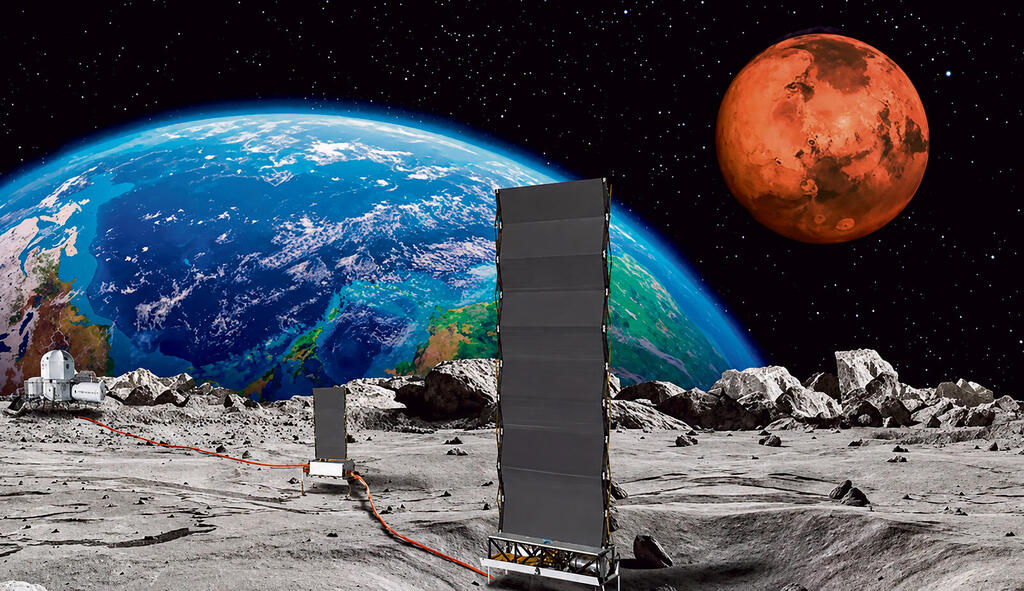
An illustration of what the U.S. nuclear reactor on the moon could look like
(Photo: NASA)
A dangerous undertaking
About two months ago, NASA asked private contractors to prepare to build a nuclear reactor capable of surviving a journey through space and operating without maintenance near the moon's south pole. The target launch date: December 2030. The goal: to beat Russia, which aims to have a reactor operating on the moon by 2036 as part of a not-so-secret partnership with China. In 1961, President John F. Kennedy challenged America's leading scientists to land a man on the moon before the end of the decade. Now the goal is to have a functioning nuclear reactor on the moon within four years.
Even before sending nuclear reactors to the moon, the United States plans to put humans back on its surface as part of the Artemis program. The third test flight is scheduled for summer 2027, while the crewed Artemis 4 mission is planned for early 2028.
The somewhat dystopian race to install a reactor on the moon is probably inevitable, and it has implications for the entire future of space exploration. For example, a lunar day lasts about 14 Earth days, followed by 14 consecutive Earth days of complete darkness. During that time, solar panels cannot generate electricity, and temperatures plunge to minus 130 degrees. A nuclear reactor provides continuous electricity and heat around the clock, regardless of sunlight. Any ambition to reach Mars, let alone establish habitable conditions there, also requires nuclear energy.
Establishing a base on the moon is critical to the search for resources and the launch of missions into the depths of the solar system. All of this makes control over access to lunar resources essential, and the major powers believe a nuclear reactor is the foundation for achieving these ambitions. But it is a dangerous undertaking.
As in the case of the Russian missile in 2019, debris from a reactor falling back to Earth could scatter radioactive materials, as happened in Canada in the 1970s. An explosion or reactor core meltdown on the lunar surface could also render entire areas of the moon off-limits. All three countries promise that their reactors will remain inactive until they reach the moon, but these days it is difficult to take their leaders at their word, especially when the race is also, of course, a display of nationalist power.
Leading scientists warn that governments are moving too quickly at a time when space exploration has experienced a string of failures over the past six years. Chinese, American and Russian rockets have exploded, and space debris regularly falls back to Earth.
"There will always be a space race going on, and if you enter nuclear power into that mix, then it could take a potentially more dangerous turn,” said Edwin Lyman, the director of nuclear power safety at the Union of Concerned Scientists.
A deadline pushed back
When it comes to nuclear power in space, Russia has no rivals. It has launched more than 30 reactors into Earth orbit, primarily aboard Cold War-era satellites in the 1970s and 1980s, and holds the largest stockpile of what is considered the safest nuclear fuel for space missions.
The last space reactor NASA tested, in 2018, used highly enriched uranium, which is lighter and cheaper to launch than other fuels. But its use is dangerous because the material can be turned into a nuclear weapon. That leaves the option of using low-enriched uranium fuel, except that the Americans do not have enough of it and cannot import it from Russia because of a ban imposed in 2024 in response to the war in Ukraine.
To date, the United States has invested more than $20 billion in space nuclear programs. Last month, the Pentagon selected a company called Antares to develop and demonstrate a space microreactor, while NASA is accelerating its timetable out of concern that a Russian-Chinese reactor could effectively establish an exclusion zone on the moon.
Such a move could, in practice, prevent American astronauts and rovers from accessing large areas of the lunar surface. That would itself violate the 1967 Outer Space Treaty, but international agreements are being violated on a daily basis these days.
Despite the sense of urgency, all the major powers have repeatedly pushed back their target dates, and few experts believe they will meet their deadlines. None of them even has a proven lunar lander capable of delivering heavy, potentially radioactive materials to the moon's unforgiving surface.
There is, of course, the option of international cooperation, as has happened time and again in space exploration. But the current global climate leaves little room for optimism.
"Governments have always achieved more by working together than by competing," Katy Huff, head of the Department of Nuclear Engineering at the University of Wisconsin-Madison, told The New York Times. "Collaborative, team-based science in space has always managed to rise above our fraught international politics."