

At first glance, the base in central Israel hardly looks like a classified facility where consequential decisions are made.
But inside its modest portable buildings sit the people without whom much of the battlefield picture would remain obscured: soldiers, officers and civilian Defense Ministry employees whose algorithmic and engineering skills could command enormous salaries in the private sector, but who instead chose to serve as the brains behind the Defense Ministry’s Merkava and Armored Vehicles Directorate.
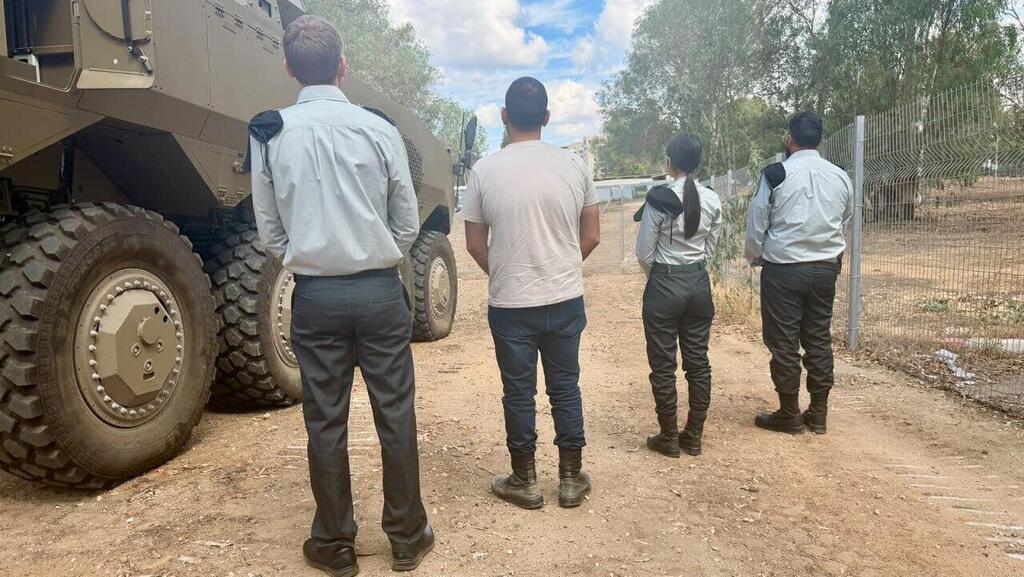
Until now, they have largely remained out of sight. Now they are speaking about the dramatic role they have played since Oct. 7: extracting, analyzing and decoding the “black boxes” of Merkava tanks, Namer armored personnel carriers and Eitan armored vehicles damaged in combat. They are among the first to hear the final seconds of soldiers’ lives, listen to desperate radio calls and reconstruct the angles from which enemy fire struck.
Engineers under fire
In routine times, the directorate is Israel’s national body responsible for developing, producing and restoring armored fighting vehicles. When the war erupted, however, it was assigned an extraordinary mission on an unprecedented scale.
“The footage from the armored vehicles that fought during the initial defensive battles, the footage you later saw in the media, came from the painstaking work our people carried out in the first days of the war,” recalled Lt. Col. M., head of the directorate’s software and cyber branch. “But behind the data we downloaded was a complex, dangerous operation under fire in the heart of the combat zone near Gaza. We received an urgent mission to physically reach Namers and tanks in the field and extract video, audio and telemetry files from their critical systems. The goal was to find any possible lead about hostages and reconstruct what happened in the battle.”
Lt. Col. M. assembled a dedicated team. Together with Maj. Michael, head of the electrical systems section, software and cyber officers put on body armor and helmets, armed themselves and headed south carrying laptops, communications harnesses and hard drives.
“This is definitely not something software engineers train for in routine service,” Lt. Col. M. said.
Because of the danger, unusually high-level authorization was required to send senior technology officers directly into the combat zone. Once in the south, the engineers climbed onto vehicles that had been fighting and connected to their computer systems. The following day, reports arrived of additional Namers damaged in intense fighting. Two Shin Bet personnel and a squad of combat troops were assigned to protect the engineers as they worked in exposed areas.
Inside dark, damaged crew compartments, the team carried out what members describe as “technological surgery,” extracting the full contents of the vehicles’ black boxes and sending the data directly to the Southern Command chief and personnel involved in locating missing people.
The information not only produced critical indications about missing people and hostages, according to the directorate, but also helped establish that crews inside the vehicles had fought intensely, countering rumors circulating in the confusion of the first days that some positions had simply been abandoned.
How a battle is reconstructed
After the first days of fighting, the investigative process became more organized and a dedicated operations center was established.
Lt. Col. T., head of the directorate’s control branch, said teams sent into the field were divided into two groups. “One team of software and electrical engineers extracts the raw information, navigation data and recordings, while a second team of mechanical and materials engineers conducts a physical ballistic analysis of the angle of impact, the type of weapon used by the enemy and the firing distance.”
Those findings led to immediate technological changes. When the unit identified Hamas’ growing use of drones dropping explosives during the early stages of the war, the directorate developed the “pergola” protective structure installed above armored vehicles, which it says eliminated the threat posed to those vehicles by such drones.
Behind the scenes, engineers also developed advanced artificial intelligence software capable of combining audio, video and telemetry into a single investigative environment.
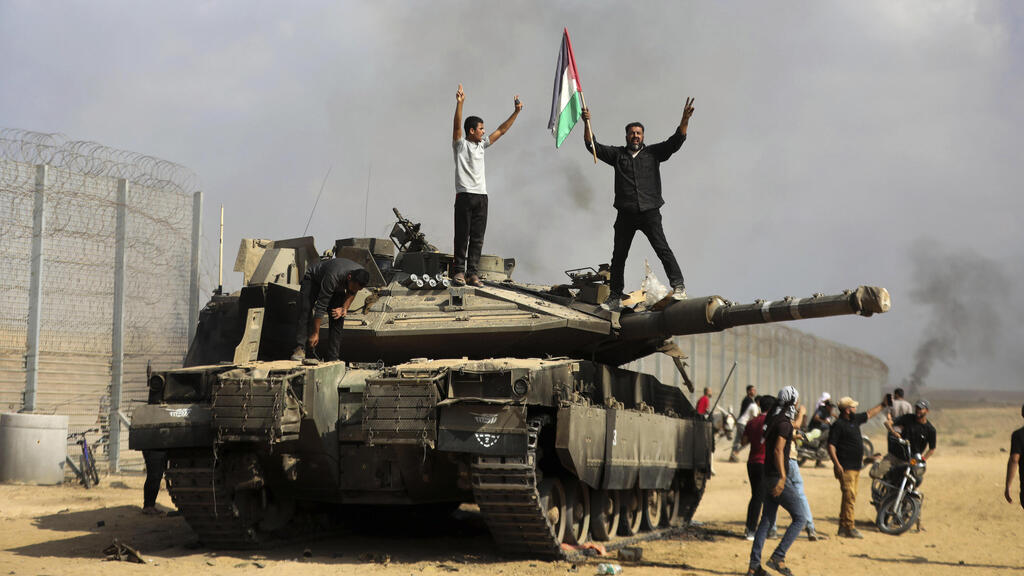
A damaged IDF tank at the Gaza border during the Oct. 7 attack
(Photo: AP Photo/Yousef Masoud)
“In the first days, about 40 black boxes a day were arriving here,” said A., a civilian computer engineer in the directorate. “At first we transcribed everything manually, hour after hour. The software we developed creates a timeline simulation and tells the full story of the battle.”
For the families of fallen soldiers, the technological reconstruction can carry profound significance. Maj. T., head of the fire-control systems section, said the engineers do not communicate directly with bereaved families but see how deeply they need to understand what happened in their loved ones’ final moments.
“They ask for every piece of information,” he said. “It is an entire puzzle they spend months putting together, and suddenly they find the missing piece with us.”
The daily exposure to digital forensic material also carries a significant psychological cost.
“In the end, you hear a person in the final seconds of his life,” said Maj. M. “He is speaking over the radio and nobody answers him. There is only static. That is a very difficult moment that stays with me. He calls out the names of his friends, who are already dead.”
Hoping not to recognize a voice
Because of the sensitivity of the material, the engineers are generally not given the soldiers’ names. Instead, recordings identify them only by their operational positions, such as commander, driver or loader.
But in Israel’s tightly connected society, painful encounters are sometimes unavoidable. A. said there is always a fear that someone on the team will recognize a familiar voice, and on one occasion that fear became reality.
“A relative of one of our team leaders was inside a tank that was hit,” he said. “The moment we understood that, the team leader was immediately removed from any work involving that vehicle.”
Beyond reconstructing battles and developing new protection systems, the directorate’s findings have also become important in international and legal investigations. Its analysis of firing angles and ballistics has provided evidence in sensitive inquiries, including the investigation into the tank shell fired at Pessi’s house in Kibbutz Be’eri, and has been used in formulating official IDF responses to allegations against Israel abroad.
The engineers have also examined some of the war’s deadliest incidents. In one case, 11 soldiers from the IDF’s Givati Brigade were killed when a Namer armored personnel carrier was struck. The detailed engineering investigation helped determine what had happened.
“It is a devastating event that I cannot get out of my head,” said Maj. M., head of a software section. “For days afterward, I thought about what happened there and whether the systems we developed had not been good enough. Eventually we understood that there had been a very specific firing angle. It is a case I carry with me constantly as I work to improve protection for the soldiers.”
“There are engineers and developers here who could earn a great deal of money in civilian life,” she said. “But as one of them put it, ‘We would never find the kind of meaning we have here anywhere outside’”