


The Haifa District Court on Sunday acquitted a man of murdering a 17-year-old girl who was buried alive in 2021 but convicted him of negligent manslaughter, unlawful sexual relations with consent and violating a court order.
The court ruled that prosecutors had not proven beyond a reasonable doubt that Edward Kachura, 53, of Kiryat Motzkin, intentionally killed Lital Yael Melnik, whose body was found at a construction site in the northern coastal city. The verdict was read three years after the teen’s death, in a case that shocked the country and drew national attention.

Family members of the victim wept in court. Her sister Ruth said, “It makes no sense that she buried herself in the sand.”
Judges cite doubts about cause of death
Presiding Judge Yechiel Lifshitz, joined by Judges Galit Ziegler and Shmuel Mandelbaum, said prosecutors failed to eliminate reasonable doubt. The court cited difficulties with the evidence and accepted a medical opinion presented by the defense suggesting Melnik may have died accidentally.
According to that opinion, while using a pipe to breathe inside a sand pit, her carbon dioxide levels could have risen, causing her to lose consciousness and inhale sand and gravel, which blocked her airways.
At the same time, the court stressed that acquitting Kachura of murder did not absolve him of responsibility. The judges wrote that his actions and omissions enabled the “ritual” that led to Melnik’s death.

Lital Yael Melnik
“The defendant’s conduct made it possible for the tragic incident to occur,” the panel said, convicting him of negligent manslaughter. They also found him guilty of unlawful intercourse with consent, ruling that he exploited Melnik’s dependency on him, and of repeatedly violating a restraining order that barred him from seeing her.
Prosecutors plan to appeal
Kachura’s defense attorney asked the court to release him immediately, noting he has been held in detention for four years. The prosecution opposed and announced it would appeal the acquittal on the murder charge. The sentencing phase will take place in three weeks. Until then, Kachura will remain in custody.
Background to the case
Kachura worked as a nurse at Maale Carmel Psychiatric Hospital in Tirat Carmel, south of Haifa, where he met Melnik during her hospitalization. The two developed a romantic relationship, despite a court order forbidding contact between them.
On Oct. 1, 2021, Melnik left a residential program for the weekend and contacted Kachura. She went to his home in Kiryat Motzkin instead of returning to her grandmother’s house. That night, police arrived at his home after her grandmother reported her missing. Kachura did not open the door. Later, he and Melnik left the house to avoid being caught together.
According to the indictment, the two wandered around the Krayot area before deciding to carry out a “ritual” that involved burying Melnik in the sand with a pipe in her mouth for breathing. After failed attempts at a public park, they moved to a construction site.

The scene of Lital Yael Melnik's death
(Photo: Gil Nechushtan)
Prosecutors said Kachura dug a pit in a sand mound, placed bamboo mesh and styrofoam at the bottom and gave her a pipe about 1.2 meters (nearly 4 feet) long to breathe through. They alleged he then covered her body and face with sand and gravel, removed the pipe and prevented her from escaping, suffocating her.
Police arrested Kachura the same morning at his home. He was later charged with aggravated murder, unlawful sexual relations with a minor under 18 and multiple violations of a court order.
Conflicting testimony
Throughout the trial, Kachura denied murdering Melnik. He told police and the court that she had requested a cleansing ritual for spiritual reasons and that the pipe was meant to allow her to breathe.
In testimony last year, Kachura said he believed the ritual would not include covering her face. “She explained it would help her get rid of bad thoughts,” he said. He claimed that when he left the site, she was alive and asked him to go.
The defense argued that she voluntarily entered the pit and may have died from poor ventilation and sand inhalation, not an intentional act of murder.
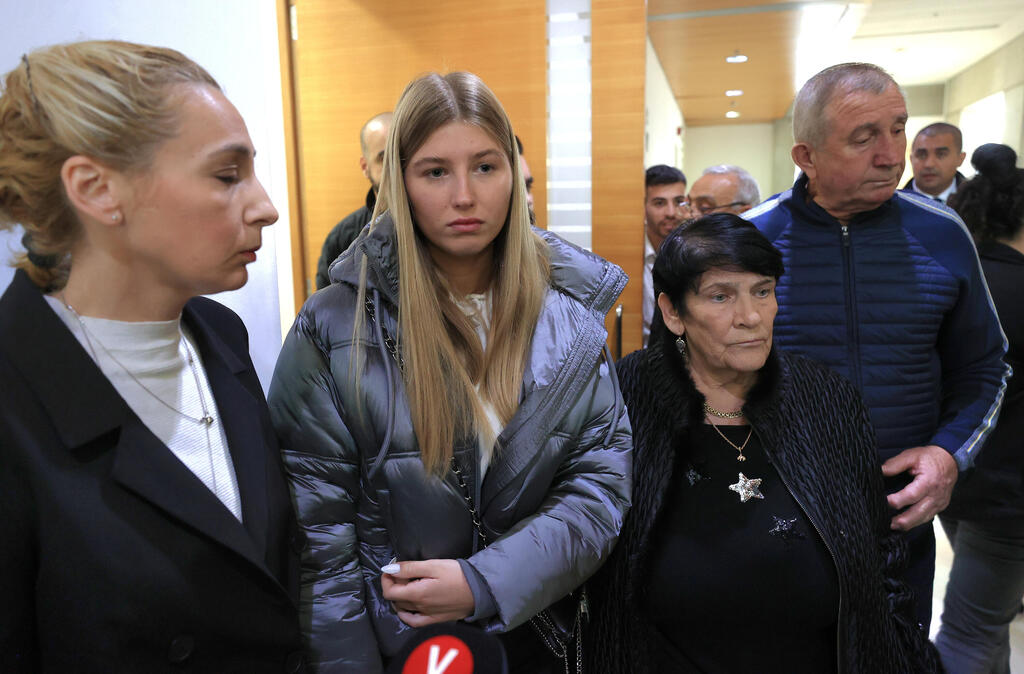
Lital's family
(Photo: Elad Gershgun)
Prosecutors presented Melnik’s personal diary, which indicated Kachura was aware their relationship was illegal. They relied heavily on the testimony of Dr. Ricardo Nachman, a senior forensic pathologist, who concluded that Melnik suffocated after sand and gravel entered her airways while she was still alive.
Emotional toll
One of the most harrowing moments in the trial came from a patrol officer who was first to arrive at the construction site. She testified that she later developed severe post-traumatic stress disorder and was forced to leave the police force. She described seeing Melnik’s hands protruding from the sand.
Melnik’s family, represented by attorneys Sharon Zagagi-Pinhas and Efrat Nachmani-Bar, insisted Kachura deliberately killed her. “He exploited a young girl he treated at the hospital,” Zagagi-Pinhas said. “They both went into the site, but only he came out. The conclusion is clear — he murdered her.”
Despite those arguments, the court ruled that the prosecution failed to prove murder, convicting him on lesser charges.